

Economy and infrastructure | 1 November 2026
The most revealing number in Morocco’s rail expansion is not a proposed top speed. It is the composition of the fleet. The national railway operator, ONCF, presents a programme of 168 new trainsets, but only 18 of them are high-speed trains. The largest group is intended for regional and commuter services.
That changes how the investment should be judged. Morocco is preparing to co-host the 2030 football World Cup with Spain and Portugal, but a tournament visitor and a worker travelling across a metropolitan region need different things from a railway. A faster intercity journey does not, by itself, produce a frequent local service.
This is an examination of the procurement programme, not a new timetable. For operating routes and booking distinctions, see our separate guide to what travelers can book now.
Three fleets inside one headline
ONCF, the Office National des Chemins de Fer, is Morocco’s national rail operator. Its first-half 2025 financial report, filed with capital-market regulator AMMC, divides the programme into 18 high-speed trainsets from Alstom, 40 intercity trains associated with Spain’s CAF, and 110 regional express trainsets from South Korea’s Hyundai Rotem.
These are trainsets, not individual carriages. Nor are they three names for the same product. Alstom’s March 2025 announcement confirms a contract for 18 double-deck Avelia Horizon high-speed trains. CAF describes trains designed for intercity services at up to 200 km/h. Hyundai Rotem’s double-deck trains are intended for regional and commuter travel, with a design speed of 160 km/h, according to Yonhap’s report of the company’s announcement.
A vehicle’s design speed is not a promise of its average journey speed. Stops, the route, signalling and the eventual operating timetable all matter.

Why 40 and 30 can both appear in the paperwork
There is an important qualification inside the intercity figure. CAF’s announcement of 26 February 2025 describes 30 trains plus an option for ten more. It values the base contract at nearly EUR600 million, excluding potential options. The specialist publication Railway Gazette likewise described the overall procurement as up to 168 trainsets.
The distinction is between programme scope and a supplier’s stated base contract. ONCF’s programme figure includes 40 CAF trains; CAF’s original announcement separates the initial 30 from the optional ten. These sources do not, on their own, establish whether that option has subsequently been exercised. It would be wrong to turn the headline total into a claim that every unit is an unconditional delivery, still less that every train is already in service.
The less glamorous part may matter every day
ONCF’s report links the Kenitra-Marrakech high-speed extension to an opportunity to release capacity on the conventional railway. That capacity could support regional express services around Casablanca, Rabat and Marrakech. RER, the French abbreviation used in the programme, means a regional express network rather than another high-speed brand.
The economic logic is therefore wider than moving visitors quickly between cities. Separating some longer-distance traffic from conventional lines can create space for more local services. But available track capacity is an opportunity, not an operating result: the trains, stations and service plan still have to work together.
That is also why tourism arrivals alone cannot measure the value of the railway investment. Useful capacity includes residents’ repeated journeys, not only international passengers arriving for a major event.
Follow delivery and service, not only contracts
ONCF’s first-half 2026 communication says works on the new high-speed line and the wider 2030 programme are advancing. It is a construction and investment update, not an announcement that the expanded network has opened.
The next meaningful checks are distinct: firm orders and options, deliveries, acceptance for passenger use, then actual service frequency and reliability. As with the wider public investment debate, an announced envelope measures intent and resources, not the service households have received.
Morocco’s fleet mix suggests an ambition that reaches beyond a high-speed showcase. Whether that ambition becomes everyday mobility will be demonstrated by the trains people can use regularly after the contracts and construction announcements.
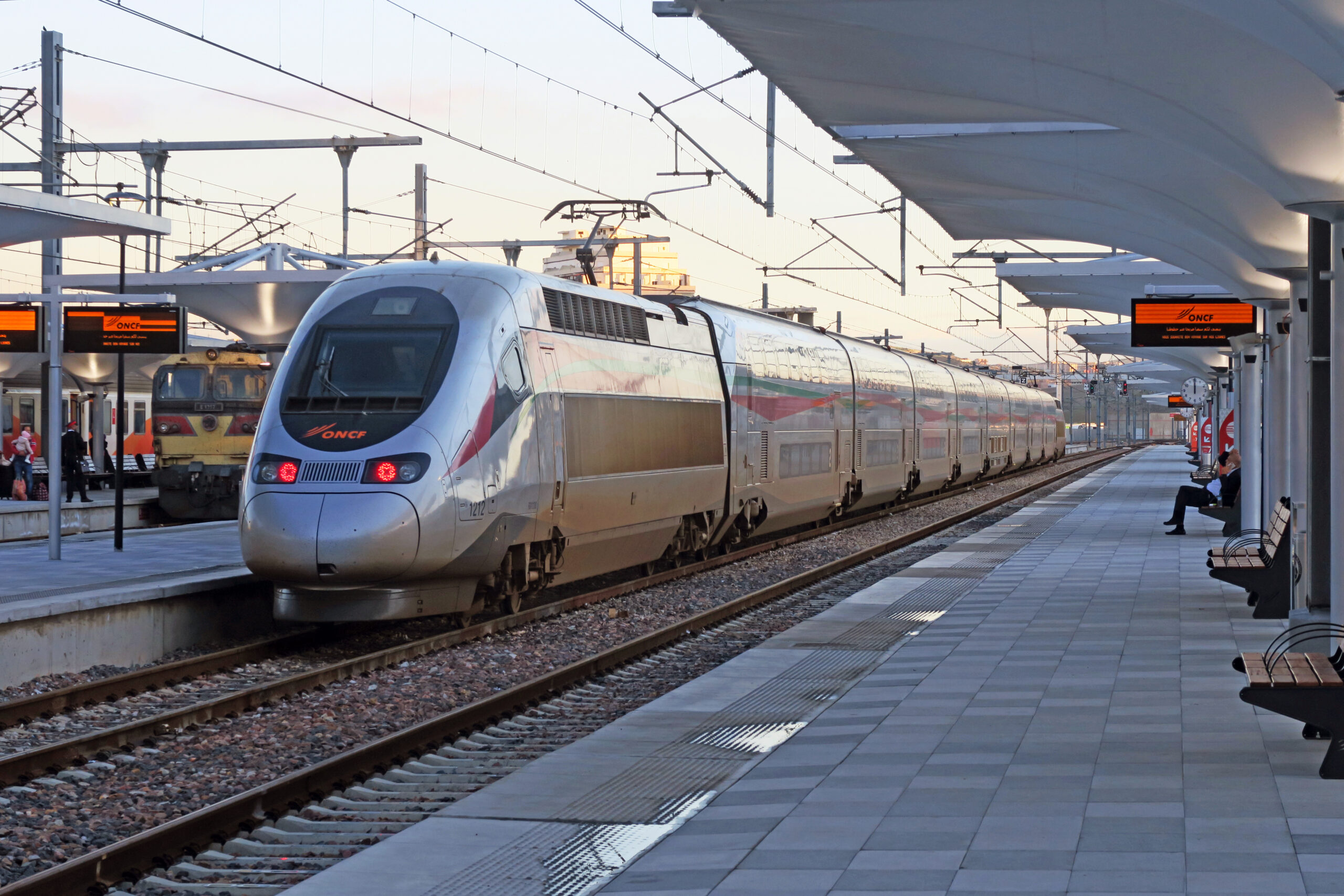
Featured photograph: Rabat-Agdal station, an archive context image, not a new train delivery. Photo: CAPTAIN RAJU, Wikimedia Commons, CC0 1.0. Resized. The file title says January 2026; its description and camera metadata date it 1 February 2026, so no month is asserted here.
