
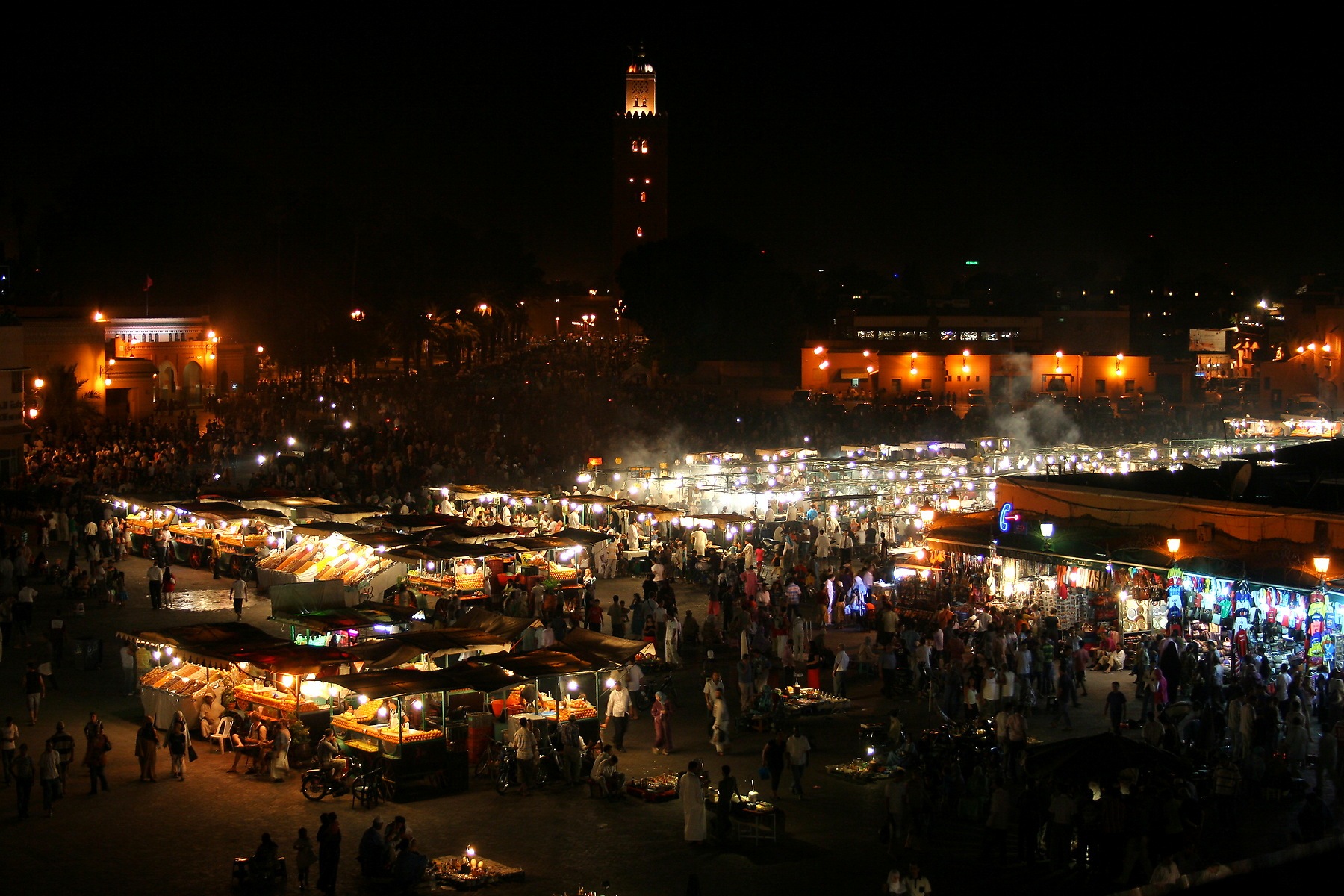

Jemaa el-Fna is often reduced to an evening image: food stalls, smoke and a crowded square beneath the lights of Marrakech. But the reason for its international heritage recognition is harder to capture in a photograph. It lies in people speaking, singing, listening and passing on knowledge in a shared public space.
For a visitor to this city in central Morocco, that distinction changes what is worth paying attention to. The square is more than a place to eat after sightseeing. Its cultural importance depends on the relationship between performers and audiences, and on whether those practices can keep being learned.
Featured photograph: Jemaa el-Fna at night, July 2009. Archive image, not a record of present-day conditions. Photo: Andrzej Kosiński / Wikimedia Commons, CC BY-SA 3.0; image unaltered.

Two kinds of UNESCO recognition
There are two different heritage stories here. UNESCO’s World Heritage entry for the Medina of Marrakesh concerns the historic urban area, including its monuments, streets and traditional trades. A medina is the old part of a city. Jemaa el-Fna sits at the entrance to Marrakech’s medina.
The separate intangible heritage entry for the cultural space of Jemaa el-Fna concerns living expressions associated with the square. It was proclaimed a Masterpiece of the Oral and Intangible Heritage of Humanity in 2001 and inscribed on the Representative List in 2008. Those dates describe different stages of recognition, not competing dates for the same decision.
UNESCO’s description includes storytellers, poets, Amazigh musicians and Gnawa performers alongside the square’s everyday trade and services. This is a description of a cultural space, not a timetable promising that every named practice can be found on every visit.
The audience is part of the performance
A useful word is halqa: the circle formed around a performer. A 1997 study prepared under the Moroccan National Commission for UNESCO describes storytellers using voice, mime and suspense, with listeners drawn into the tale. Read as a historical account rather than a survey of today’s square, it explains why an audience is more than background scenery.
The circle turns an open space into a temporary performance space. The story needs listeners who understand its turns, and a performer able to hold their attention. UNESCO’s listing also describes oral artists adapting older material to contemporary contexts. Change is therefore not automatically a loss of authenticity. The harder question is who gets to shape that change, and whether the skills still pass between generations.

That concern connects the square to other Moroccan traditions. Our guides to Malhun’s sung poetry and Gnawa beyond the festival stage examine different forms of knowledge carried through performance. They should not be treated as interchangeable labels for Moroccan entertainment.
Popularity is not the same as safeguarding
UNESCO’s account warns of pressures from urban development and tourism on the cultural space and its practices. It does not supply a current count of storytellers or a measure of how much any particular practice has changed. A crowded photograph cannot settle those questions either.
The distinction matters for heritage policy. Maintaining a square’s physical setting and drawing visitors are different tasks from helping people learn a repertoire, make a living from it and find an audience. As UNESCO’s explanation of intangible heritage stresses, its importance lies in the knowledge and skills transmitted between generations, with communities central to recognizing and maintaining them.
In Sada Journal’s reading, the test of success should therefore extend beyond footfall or attractive restoration. A busy square may support livelihoods, but visitor numbers alone cannot tell us whether a younger performer is learning a story or whether local listeners still have a place in its telling. It is the same distinction between a destination’s image and its working life that runs through our account of Essaouira’s port and medina.
A museum can help visitors read the square
The Jamaâ el-Fna Museum of Intangible Heritage, run by Morocco’s National Museums Foundation, offers another way into the subject. It occupies the former Bank al-Maghrib premises on the square. The foundation describes displays on the history of Marrakech and Jemaa el-Fna, the halqa and its practitioners, their skills and trades, and the square’s representation in art.
That makes the museum useful as context, rather than a substitute for the living space outside. For visitors, a better approach is to allow time for listening as well as looking, ask permission before close-up photography, and agree any requested payment before taking a picture. These are courtesy recommendations, not a claim that the square operates under one universal photography tariff.
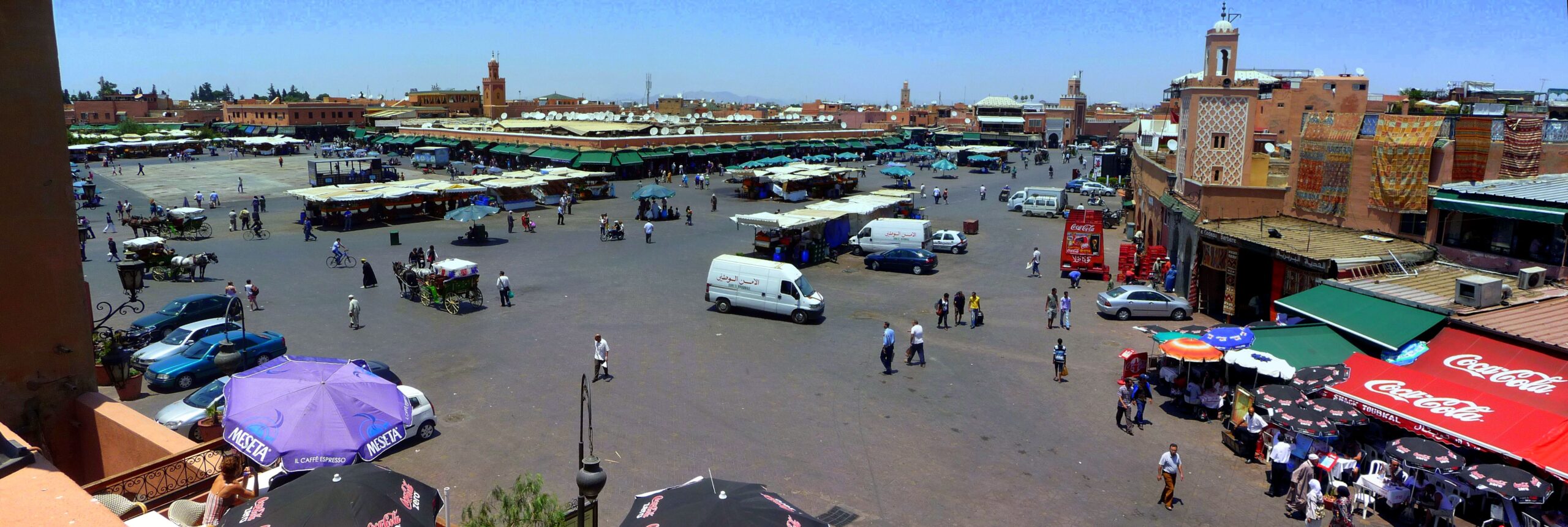
The most useful souvenir of Jemaa el-Fna may be an understanding of what a quick panoramic image leaves out: heritage can reside in an exchange between people, and its future depends on whether that exchange can continue.