
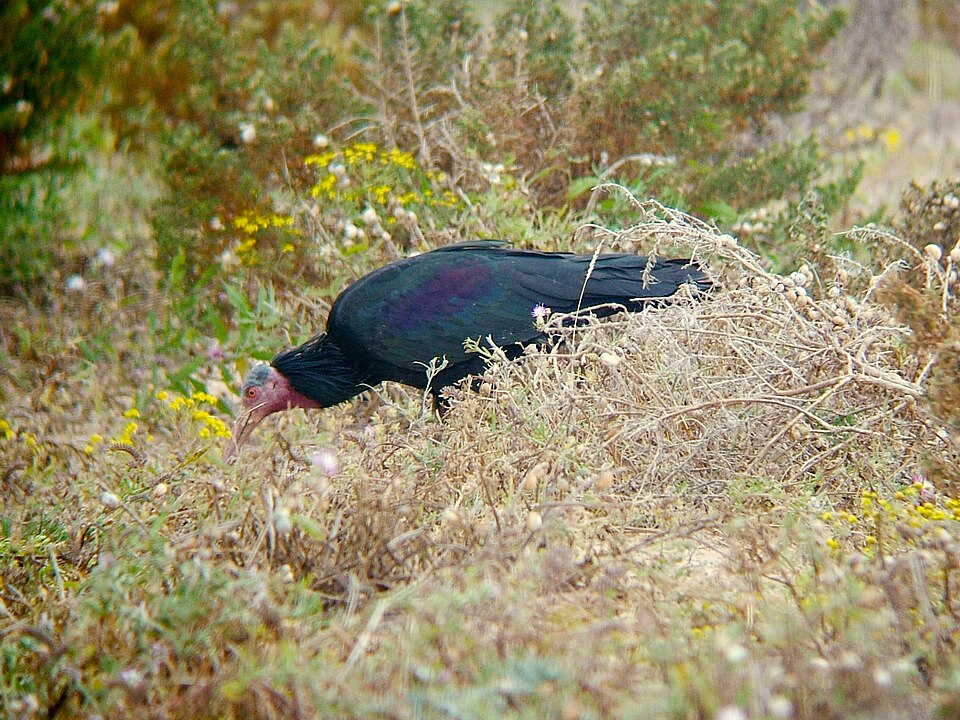

Morocco’s northern bald ibis recovery is a story about the ground around a colony as much as the cliff where it nests. Research on the bird’s former breeding sites identifies two linked requirements: little disturbance at the nest and suitable feeding land within reach. Protecting the rock face alone cannot supply both.
A recovery built around a landscape
The northern bald ibis, Geronticus eremita, is the dark, long-billed bird with an unfeathered head associated with Morocco’s Atlantic coast around Souss-Massa and Tamri, south and north of Agadir. A study published in the 2020 volume of Bird Conservation International records a recovery from 59 breeding pairs in 1997 to 147 pairs and 708 birds in 2018. The total includes juveniles and birds that were not breeding: it is not a count of pairs.
Those are historical benchmarks, not a November 2026 census. Their importance is that a small surviving population increased under sustained protection. In its May 2019 account, BirdLife International describes the recruitment of wardens from nearby fishing villages, daily monitoring and a long collaboration between the national park and conservation organisations. It also records the species’ 2018 change from Critically Endangered to Endangered. An improvement in that threat category did not mean the work was finished.
The ecological study by Andre Schenker and colleagues helps explain what that work has to protect. It examined 72 Moroccan breeding sites known since 1900, with a closer habitat analysis of 28 sites occupied after 1977. The researchers combined historical records, satellite imagery and field checks. This was a reconstruction of ecological conditions, not a controlled experiment that could assign a precise share of recovery to each intervention.
The food lies beyond the cliff
A nesting ledge and a feeding ground do different jobs. The study identifies coastal steppe, fallow land and open, extensively used pasture among suitable feeding habitats. In its assessment of former colonies, low disturbance around nesting sites and feeding areas roughly 5-15 kilometres away emerged as favourable conditions. That distance is an ecological planning guide from the research, not a universal safety boundary or a guarantee that a site will support birds.
The distinction changes how a coastal landscape should be read. Open land that looks empty to a visitor can be part of a bird’s food supply. A protected cliff can remain intact while changes in nearby land use make chick-rearing harder. The paper calls for detailed on-site feasibility work before any translocation, rather than treating a promising-looking former colony as ready for release.
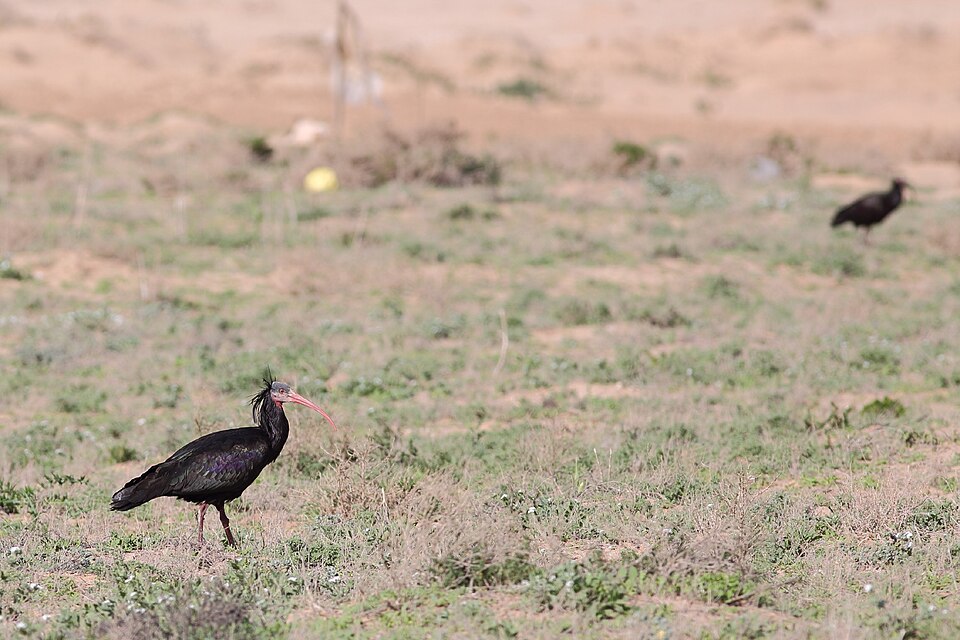

A wet year is not a simple forecast
The same research tested breeding and rainfall records for 1994-2016 at Tamri and the Souss-Massa colonies. Its results did not support a simple rule that more rain always means more young birds. Associations differed by season and location. The authors discuss possible mechanisms, including changes in farming and feeding habitat, but these are explanations to investigate, not experimentally established causes.
Even breeding-pair counts and fledgling counts were not interchangeable. The study found a strong positive relationship between reproducing pairs and fledglings at Tamri, but not at Souss-Massa. A fledgling is a young bird that has reached the stage of leaving the nest; producing more of them and keeping them alive are related but separate conservation tasks. One headline count cannot describe the whole process.
This is a wider lesson in reading Morocco’s wildlife research. As with the food web beneath Merja Zerga’s birdwatching landscape, the habitat that supports an animal matters beyond the moment when a visitor sees it. And, as observational studies of Barbary macaques illustrate, an association is not the same as a tested cause.
Monitoring also means knowing which bird moved
A 2023 correction by GREPOM/BirdLife Morocco shows why identification matters. A photographed ibis had been described as ringed in Spain. GREPOM reported that it had actually been captured, ringed and fitted with a GPS transmitter at Tamri in September 2019. The organisation said 12 ibises were equipped in 2019 and 2021 through a collaborative project intended to study movements, threats and potential breeding sites.
That correction does not mean birds never move between countries. It means a ring or a photograph is not enough to infer an individual bird’s origin without checking its record. Monitoring is evidence about particular birds and places, not merely a way to generate a larger total.
The same landscape priorities appear in a contribution by Latifa Sikli and colleagues to the published proceedings of the March 2025 international ibis symposium. Their intervention plan calls for stronger habitat protection, less disturbance, better breeding conditions and further research. These are proposed measures, not proof that every measure has been implemented. The practical conclusion remains clear: Morocco’s recovery depends on keeping nesting places, feeding land and the people who watch over them working together.
Sources and method: This is a synthesis of published ecological research and dated conservation records, not a field visit, new bird count or assessment of current access rules. Historical figures retain their reference years. AI assisted research, translation, drafting and editorial review; material claims were checked against the linked sources.
Lead photograph: Northern bald ibis near Tamri, 17 April 2006. Archive context, not a current population or habitat survey. Photo: MPF, via Wikimedia Commons, CC BY 2.5, selected from the file’s available licences. Reduced-resolution reproduction of the source’s revised image; no generative changes.
