

Opinion / Economic Analysis. Facts, reported positions, interpretation and forecast are distinguished below.
On November 13 in Rabat, Morocco signed a financing agreement worth €434.4 million with the African Development Bank to support the third phase of a governance and climate-resilience programme. The money is modest: about a fifteenth of what the state transferred to public establishments and enterprises in 2025 alone. Its significance lies in what it is tied to: converting commercial public establishments into companies, and making the electricity and water utility financially viable. That is the part of Morocco’s reform agenda where the state must change itself, and where the national budget has so far carried the cost rather than the change.
- The agreement signed on November 13 implements the AfDB board’s October 21 approval of $487 million for the same programme. It is one operation, not two funding commitments.
- The reform it supports is moving: two public establishments became joint-stock companies in 2026, and electricity and water distribution was transferred to twelve regional companies on November 1, 2025. The hardest case, the national utility ONEE, remains loss-making.
- The binding constraint is political: retail electricity and water prices remain frozen, with no announced revision timeline. The state paid 17 billion dirhams over four years to keep them frozen, according to the 2027 Finance Bill’s economic and financial report as reported by two Moroccan outlets.
A signature, not a new programme
Documented facts. The AfDB’s November 13 announcement says Minister of Economy, Finance and Public Performance Fouzi Lekjaa and the Bank’s country manager for Morocco, Achraf Hassan Tarsim, signed the €434.4 million agreement, close to 4.8 billion dirhams, in Rabat. It finances phase III of the Economic Governance and Climate Change Resilience Support Programme (PGRCC). The board’s October 21 approval of $487 million concerned the same operation; Ecofin Agency’s report confirms the November signing does not represent a separate commitment.
The first component supports restructuring the state’s public enterprise portfolio, modernising the public-private partnership framework and improving the business environment. The second supports governance in the water and electricity sectors and the integration of climate considerations into public policy. The Bank frames the operation within its Global Energy and Fertiliser Crisis Response Framework, citing higher energy and transport costs linked to the Middle East crisis.
Lekjaa called the partnership an expression of “renewed confidence in the reform momentum”. Tarsim said Morocco “has chosen to act and stay the course on reforms”. Both are stakeholder statements made at a signing ceremony, and should be read as such.
The programme is a sequence. Phase I brought €120 million in 2024; Ecofin Agency reports it backed the state shareholding policy, a public procurement observatory and online business creation. Phase II brought €181.8 million, approved in June 2025. Phase III is the largest tranche and the one most directly aimed at the state’s own portfolio.
The portfolio being repriced
Assessed scale. In its 2026 Article IV staff report, the International Monetary Fund estimated that Morocco’s commercial state-owned enterprises hold assets equivalent to 105 percent of GDP. A year earlier, its 2025 staff report found that government transfers to state-owned enterprises had risen from 1.1 percent of GDP in 2020 to 3.4 percent in 2024, mostly to the electricity and water utility ONEE, the railways ONCF and the airline Royal Air Maroc, with current transfers about half of the total. The public enterprises report annexed to the 2027 Finance Bill puts total state transfers to public establishments and enterprises at 72.9 billion dirhams in 2025, of which 60 percent funded operating costs.
The policy architecture exists. The 2021 framework law 50-21 reorganised the sector, the state shareholding policy was adopted by decree in December 2024, and the National Agency for the Strategic Management of State Holdings (ANGSPE) oversees a portfolio of 57 public establishments and enterprises, according to Morocco World News’ account of its second state shareholder report. The finance ministry report records that by end-September 2026, nine of the seventeen legislative and regulatory texts required under the framework law had been approved, two were in the approval circuit and six were still being drafted, including the overhaul of the privatisation regime.
Interpretation. Morocco’s problem is not state ownership as such. It is that its public companies carry social and infrastructure mandates without transparent compensation, which the IMF calls quasi-fiscal activity, while still being expected to perform commercially. Until that trade is priced and paid for explicitly, the transfers are a standing invitation to underperformance, and the state’s balance sheet absorbs the difference.
Conversions are the measurable test
The IMF’s March 2026 recommendation was specific: move faster in transforming fifteen commercial public entities into corporations, to improve resource management and service delivery and gradually open them to private investors. The finance ministry report shows 2026 delivered movement. The hydrocarbons and mines office ONHYM became a company under law 56-24, published June 15, 2026. The ports agency became Ports du Maroc S.A. under law 34-25, published August 10, 2026. The LOARC transformation was approved by the Government Council on July 9, 2026, and regional project-execution agencies became companies under organic law 031-26 the same August. ONEE’s own transformation into a société anonyme is in preparation, according to the same report.
This desk has covered what such conversions change and what they do not: when the airports office became ONDA SA, the legal form altered accountability and investment capacity, while the underlying economics of the sector stayed with the state. Conversion is a governance tool. It is not, by itself, a market outcome. And with the privatisation framework law still in drafting, the end point of the portfolio restructuring remains undefined: nobody can yet say which enterprises the state intends to keep, sell or open.
ONEE is where the reform meets the voter
Documented strain. The state granted ONEE 17 billion dirhams between 2022 and 2025 to hold electricity tariffs steady for all customer categories, absorbing higher imported fuel costs, according to the economic and financial report annexed to the 2027 Finance Bill as reported by Le Matin and Zawaya; this desk did not independently inspect that annex. The enterprises report records a net loss of 6.963 billion dirhams in 2025, with closing forecasts that could reach 8.625 billion in 2026. Le Matin’s reading of the report puts ONEE’s financing debt at 55.93 billion dirhams at end-2025.
The utility’s perimeter has already been redrawn. The twelve regional multiservice companies took over water and electricity distribution on November 1, 2025, with an investment programme of 134.44 billion dirhams for 2026-2030; this desk examined that concession-era shift after November’s storm outages. A convention signed on November 3, 2025 between the state, ANGSPE, ONEE and Masen recentres Masen on renewable development and consolidates ONEE as single buyer for integrated projects. ONEE’s 2026-2030 equipment plan carries 177 billion dirhams for electricity and 42.1 billion for water, including 14.34 gigawatts of new renewable capacity; Le Matin reports an expected 72 percent private-sector contribution to that plan.
The tariff distinction that matters. The electricity regulator ANRE launched a full revision of network tariffs in April 2026, covering transmission and distribution access charges and related components, with entry into force planned for March 1, 2027, according to Les Inspirations ÉCO. Those are network-use prices paid within the industry. Retail prices paid by households and businesses remain regulated, and the IMF noted in March that no timeline has been set for revising that tariff structure. Morocco is rewriting the price of the wires while leaving the price of the electron untouched.
Interpretation. Paying 17 billion dirhams to freeze tariffs was a defensible shock absorber when global energy prices surged. As a standing arrangement it converts a commercial company into an arm of social policy, then records the damage as a loss to be subsidised. The AfDB programme’s second component, governance of the water and electricity sectors, pushes directly at this knot, because no investor will price a network whose largest operator cannot cover its costs.
What the tranche actually buys
Policy-based lending of this kind does not finance a dam or a transmission line. It disburses against completed and committed reforms, and its real product is sequencing: a dated, externally anchored order in which politically difficult steps are taken. The October approval and November signature tell Rabat’s own ministries, and Parliament during a difficult budget season, that the conversion calendar and the utility’s restructuring now carry an external counterpart.
The risks are equally clear. Energy costs driven by the Middle East crisis could widen ONEE’s losses faster than restructuring can close them. Tariff reform of any kind touches purchasing power, which the government has repeatedly chosen to protect. And a conversion programme without an adopted privatisation framework can produce companies that are corporatised in form but unreformed in behaviour.
Forecast. This desk assesses the probability at 0.55 that by September 30, 2027, laws transforming at least two additional commercial public establishments into sociétés anonymes, beyond the ONHYM and ports conversions already completed, are published in the Bulletin Officiel. In favour: the 2026 pace of two completed conversions plus the LOARC approval, the standing IMF recommendation and the AfDB programme’s portfolio-restructuring component. Against: the complexity of the remaining entities, led by ONEE, and the unfinished privatisation and financial-control texts.
Resolution rule. A law counts if it transforms an établissement public exercising commercial activity into a société anonyme and is published in the Bulletin Officiel on or before September 30, 2027; the LOARC transformation law would count if published by that date. ONHYM (law 56-24) and Ports du Maroc S.A. (law 34-25) predate this forecast and do not count. Publication dates in the Bulletin Officiel are the resolution source. The original probability and criteria remain recorded if later assessments change.
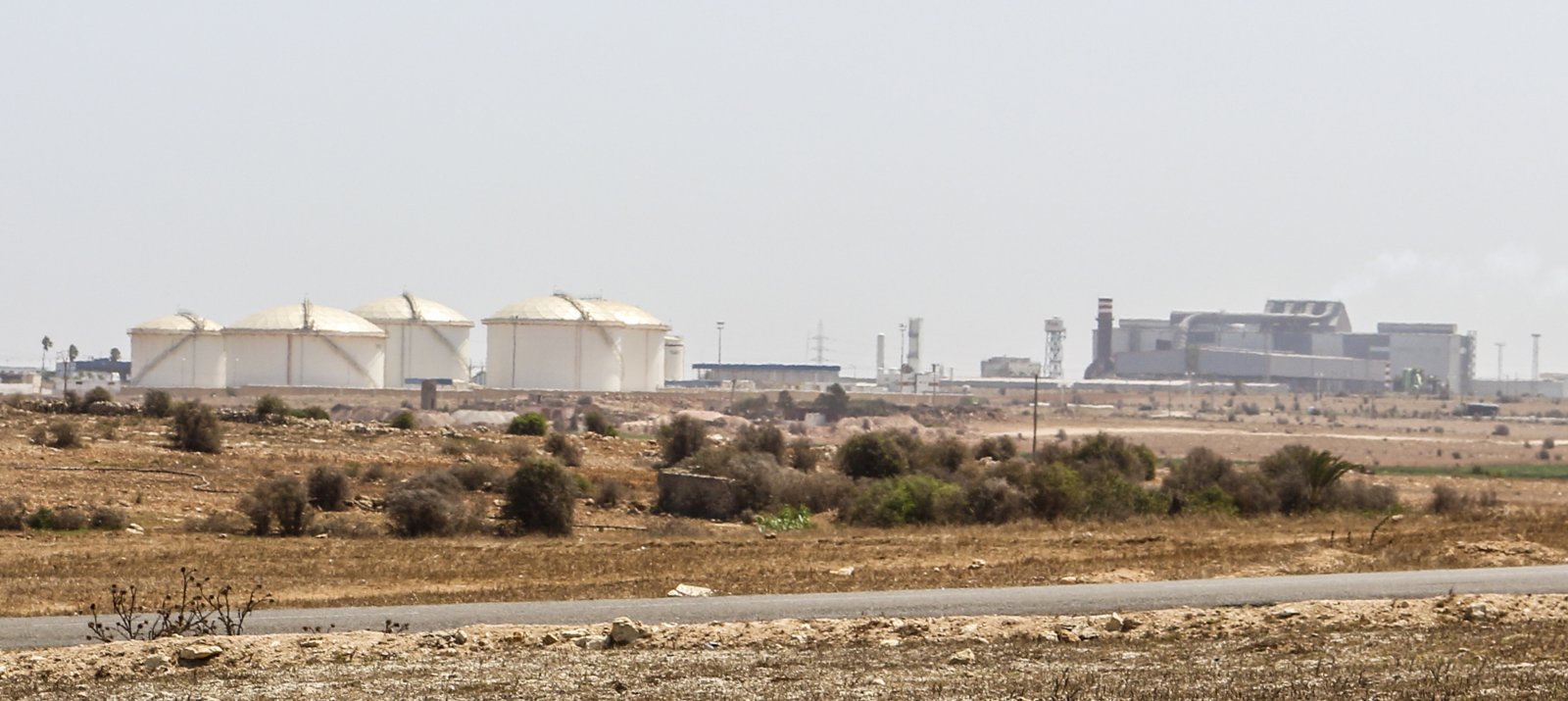
Image: the Jorf Lasfar industrial park near El Jadida, site of Morocco’s largest thermal power complex, photographed in 2023. An illustrative image of the fuel infrastructure behind ONEE’s cost burden, not a photograph of any event described in this article. Photo: Mounir Neddi, Wikimedia Commons, CC BY-SA 4.0; resized for display.

Source limits: the AfDB press releases, IMF consultation documents, the public enterprises report annexed to the 2027 Finance Bill, and the linked Moroccan reporting were read directly. The 17-billion-dirham tariff support figure comes from the Finance Bill’s economic and financial report as reported by Le Matin and Zawaya; that annex was not independently inspected. The AfDB’s simplified appraisal report for PGRCC III was consulted only through its published summary page. The expected 72 percent private contribution to ONEE’s equipment plan is Le Matin’s reporting of the report’s contents. This article does not establish the PGRCC III disbursement conditions or the final scope of the privatisation framework.