

Opinion / Economic Analysis. This is analysis, not straight news. Documented facts, official statements, disputed claims, interpretation and forecasts are labeled separately throughout. All figures are dated; where sources conflict, we say so rather than choosing silently.
Update, November 12: this article was updated the same day with the ONEE’s own communiqué on the incident (16:55 onset; four 225 kV lines – main and three backup feeds – damaged simultaneously; partial return from 18:23; source substations resupplied by 20:54), which documents the transmission-level damage from the upstream operator’s side. See “What the storm actually hit” and sources 16-17.
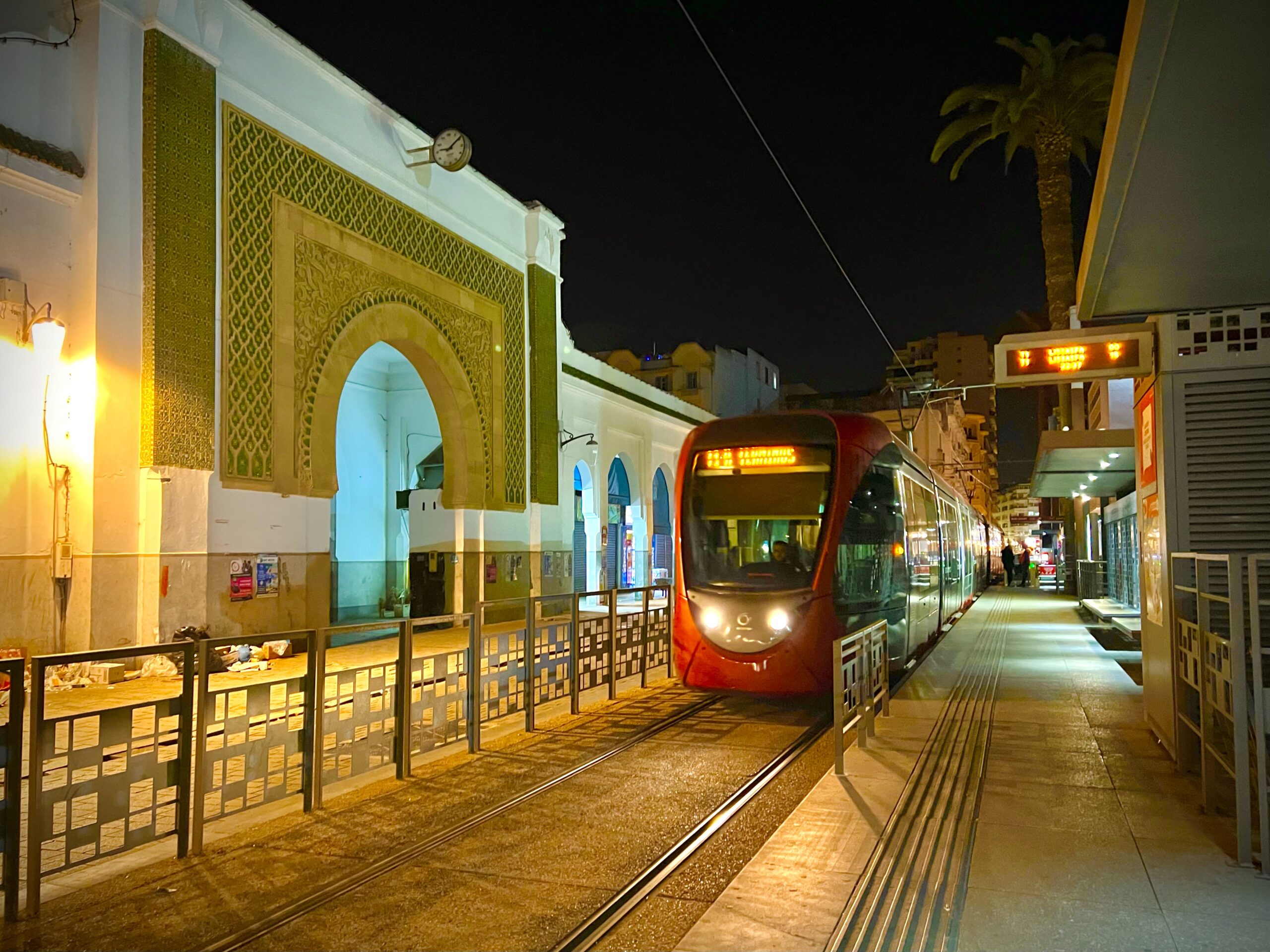
At 4:48 p.m. on Wednesday, November 11, as Storm Charles drove gusts and thunderstorms across Morocco’s Atlantic coast, Casablanca’s lights went out. The tram stopped in its tracks. Traffic lights died on the city’s main arteries. The outage reached from the city center and the Medina to Ain Chock, Ben M’sick, Sebata and Sidi Othmane, and out to Bouskoura, Ouled Azzouz and Dar Bouazza, according to the statement the city’s electricity and water operator issued that evening. Power came back progressively – roughly half of affected customers within the first hours, local reports said – and was fully restored around 9 p.m., a little over four hours later, after a crisis cell at the wilaya brought the region’s governor and the national electricity office’s director general into the same room.
As infrastructure stories go, a four-hour storm outage that ends with a coordinated overnight restoration is not a scandal. It is something more useful: a measurement. The operator that issued Wednesday’s statement, the Société régionale multiservices Casablanca-Settat, has existed for barely two years. It is the flagship of the deepest restructuring of Moroccan local public services in a generation – the replacement of private concession contracts, some dating to 1997, with public regional companies. Wednesday was the largest outage in Casablanca since that change that we could find in the coverage we reviewed, and the first time the new model had to explain itself in real time. What it said, and what it did not need to say, is the story.
What the storm actually hit
The SRM’s own account, carried by Morocco World News on November 11, is precise about the physics. The fault, it said, occurred “outside the control” of the company, at the very high-voltage (HTB) level, caused by wind gusts and thunderstorms; it affected substations feeding the city. Le360’s reporting the same night adds the geography: the storm struck lines around Casablanca, hitting the supply to the Dar Bouazza and Ouled Haddou posts. The company’s teams, the statement said, worked with the National Office of Electricity and Drinking Water (ONEE) – which runs the country’s high-voltage transmission – to intervene directly, while carrying out emergency operations on its own medium-voltage network.
Translated out of utility language: on the operator’s account, the storm did not knock over its own neighborhood lines; it hit the upstream tier – the transmission level that belongs to ONEE, before electricity ever reaches the network the SRM manages. No independent engineering assessment has been published. The crisis cell that convened at the wilaya, with wali Mohamed Mhidia and ONEE director-general Tarik Hamane present according to le360, reflects that split: both tiers of the system, plus the state that owns them both, in one room.
On November 12, ONEE published its own account of the night, and it adds both precision and texture. The incident, the office said in a communiqué, occurred at 16:55, when wind gusts and thunderstorms simultaneously damaged four distinct 225-kilovolt lines: the main supply and the N-1, N-2 and N-3 backup feeds of the Ouled Haddou and Dar Bouazza source substations. The office called it an unprecedented event of rare intensity, activated its own crisis cell, returned power partially from 18:23 and resupplied all affected source substations by 20:54. The two utilities give different onsets for the blackout – the distributor’s statement timed it at 16:48, the communiqué at 16:55 – and the seven-minute difference is unreconciled; each figure is presented on its own terms. ONEE’s 20:54, by the communiqué’s own wording, is the full resupply of the affected source substations, not the restoration of every household, which local reports put around 21:00. On the essential point, the two accounts agree: the damage sat on the transmission tier, in the storm, not in the city’s own network. What the distributor’s evening statement framed as a fault “outside the control” of the new operator, the upstream operator’s communiqué now documents from its own side of the seam: the main line and all three backups, gone at once.
Storm Charles itself was a national event. Authorities suspended classes in twelve provinces, seven of them in the north; the meteorological directorate’s orange alert forecast gusts of 80 to 90 km/h around Casablanca and, nationally, winds of 80 to 120 km/h with rainfall between 20 and 110 millimeters, heaviest in Tangier, Chefchaouen and Larache; ferry services between Tangier and Spain were disrupted, and the equipment ministry urged drivers to postpone travel (Al Jazeera, November 12; Canal212, November 11). Against that backdrop, a four-hour outage in the economic capital, restored overnight, is a defensible operational result. The interesting part is not the outage. It is the first reflex of the new operator’s statement: before anything else, to locate the fault outside its perimeter – “beyond our control,” at the transmission tier. That reflex is the institutional story of the decade, compressed into one sentence.
The 30-year experiment, and its audit
To hear why that sentence matters, you need the model it replaced. In 1997, Casablanca signed the first of Morocco’s big delegated-management contracts, handing Lydec the distribution of water, electricity, wastewater and public lighting. Rabat followed with Redal in 1999, Tangier and Tetouan with Amendis in 2002. By 2013, the Court of Auditors counted four distribution concessions covering 46 communes: 32.3 billion dirhams invested since the contracts began, 10.8 billion dirhams of revenue in 2013 alone – about a third of the country’s water-distribution revenue and a quarter of its electricity-distribution revenue – and 8.9 billion dirhams collected through the “fonds de travaux,” the works levy on customer bills that financed 40 percent of the concessionaires’ investment.
The Court’s October 2014 evaluation – the closest thing the concession era has to an official biography – is a two-sided document. It credits delegated management with modernizing networks and management, catching up on sanitation investment, and introducing tariff flexibility. Then it opens the ledger. Investment by the concessionaires, it found, did not fully meet the objectives set, in project content or in deadlines, with significant shortfalls on structuring sanitation works – outfalls, pretreatment stations, interceptors. The causes it names are not weather: insufficient equity, late release of share capital, dividends distributed early, technical-assistance charges it judged unjustified, excessive spending, and over-reliance on borrowing. Contract control was weak: fewer than one in five contracts in its sample had an operational monitoring committee, control services depended on the concessionaire for their own resources, penalties assessed at 446 million dirhams by end-2012 were entangled in long negotiations, and tax audits of the distribution concessionaires ended in roughly one billion dirhams of adjustments. The Court’s recommendation, in 2014, reads like a prophecy: generalize regional multiservice distribution companies across the national territory.
The quiet buyback
A decade later, that is exactly what Morocco built – not with a nationalization law and a fight, but with a corporate statute and a checkbook. Law 83-21 of July 12, 2023, cited in the market regulator’s September 2024 communiqué, created the sociétés régionales multiservices: public-capital companies, one per region, to take over water, electricity and sanitation services. In July 2024, Veolia – which had inherited Lydec in its 2022 takeover of Suez – announced it had agreed, in line with commitments made to the Moroccan competition authorities, to sell its entire Lydec stake to the SRM Casablanca-Settat. The Competition Council’s July 18, 2024 notice records the acquisition of 99.67 percent of Lydec’s capital and voting rights. The price, reported by Medias24 and Challenge at around 1.68 billion dirhams, explicitly reflected the residual value of a concession contract that was due to expire in 2027 – the state bought the operator out about three years early. On October 1, 2024, the SRM took charge of the services Lydec had run for 27 years.
The rest of the map is filling in on a published schedule. The SRM Rabat-Salé-Kénitra began operating on June 1, 2025 – but Veolia’s Redal keeps managing its own perimeter there until its contract ends in 2028 (Medias24, June 2025). The SRM Tanger-Tétouan-Al Hoceïma launched on September 1, 2025, taking a first zone covering Larache, Chefchaouen, Ouezzane and Al Hoceïma, while Amendis continues on its historical perimeter until the end of 2026 under the transition programming the region’s wali described in January 2025. The Interior Ministry’s rollout schedule covers eight more regional companies (Global Water Intelligence, January 2025). Veolia, for now, remains in Morocco through the Rabat, Tangier and Tetouan contracts, as its own July 2024 statement says.
What the state actually bought
This section is our reading of the documented record, not any party’s stated position.
Start with what the 1.68 billion dirhams did not buy. Under a concession, the networks’ assets revert to the public authority when the contract ends; the 2027 expiry was priced into the sale. What changed hands early was not the pipes and cables but three other things: the operating margin, the works fund, and the accountability chain. The 8.9 billion dirhams of works-fund levies the Court counted to 2013, and whatever the concessions earned above their costs, now accrue inside a public company. So do the obligations.
That is the part the celebration of “the state taking back its services” tends to skip. The Court of Auditors’ central criticism of the concession era was never simply that private operators profited; it was that investment fell short of need while the state’s own control apparatus was too weak to enforce the contracts it had signed. Ownership change answers the first half of that diagnosis politically. It does nothing, by itself, for the second half. The SRM inherits the same networks, largely the same staff and the same backlog. Casablanca-Settat’s answer to the backlog is money: the company announced an investment program of more than 5 billion dirhams for 2025 (Medias24, January 2025), inside a roughly 61-billion-dirham program over its mandate, serving more than seven million people (Finances News Hebdo interview, February 2025). Nationally, the SRMs are deploying a five-year investment program of more than 78 billion dirhams (Le Matin, October 2025) – a different envelope with a different scope, presented here on its own terms. Those are the concession-era numbers’ public mirror: the bill that the Court said private operators were dodging has not disappeared; it has moved onto the public balance sheet, where it will be paid either through tariffs, through the treasury, or through debt the SRMs raise themselves.
The control problem changes shape
Which brings us back to Wednesday night, and to that careful sentence about the fault being “outside the control” of the SRM. Under the concession model, every serious incident opened a negotiation between a public authority and a private operator about whose perimeter the failure sat in – with the authority, per the Court, chronically under-resourced to win the argument. The SRM model was supposed to end that blur. What Wednesday showed is that the blur has not vanished; it has moved one tier up. The new reflex is a public distributor pointing at a public transmitter, ONEE, with the wilaya mediating between them. This is not a criticism of how the night was handled – by the available reporting, it was handled competently. It is an observation about incentives: when both sides of the seam are the state, the public’s problem is no longer a concessionaire hiding behind a contract. It is two public entities sharing a border, each with a statement ready.
The deeper question the SRM model has not yet answered is the one the 2014 report posed: who audits the operator now? The concession era’s answer was supposed to be the delegating authority, and it failed for want of staff and independence. The SRM era’s answer will have to be the Court of Auditors and its regional branches – which retain jurisdiction over public companies – parliament, and the Interior Ministry that designed the reform. None of these is inside the story in a way the public can yet grade. The first annual execution reports of the SRMs’ investment programs will be the first real document on that desk.
What to watch
Three dated checkpoints will show whether the model change is a governance reform or a flag change. First, the end of 2026: whether Amendis’s remaining perimeter – Tangier, Tetouan and the communes they serve – actually passes to the SRM Tanger-Tétouan-Al Hoceïma on the published schedule, and on what terms for the staff and the works fund. Second, 2028: whether Redal’s Rabat perimeter transfers to the SRM Rabat-Salé-Kénitra at contract end, without a quiet extension or a repackaged private contract. Third, execution: whether the SRMs’ announced investment – the 61 billion dirhams over the Casablanca-Settat mandate, the national rollout to the eight remaining regions – shows up in audited execution rates, or only in anniversary communiqués. And through it all, the network will keep being measured by storms. Morocco’s meteorological services are not done with this coast, and every orange alert is now a live exam for a model that asked to be judged as public service, not as concession.
Our forecasts
First, 85 percent: the remaining Amendis distribution perimeter passes to the SRM Tanger-Tétouan-Al Hoceïma by June 30, 2027. Checkable against the companies’ and the region’s public statements. Assumptions: the transition programming the region’s wali described publicly holds with ordinary slippage, and the precedent transfers – Casablanca in October 2024, the TTA first zone in September 2025 – show the schedule is enforced.
Second, 70 percent: Redal’s perimeter transfers to the SRM Rabat-Salé-Kénitra at or before its contract end in 2028, without a new private delegated-management contract replacing it. Checkable by December 31, 2028. Assumptions: the model is decided at national level and Veolia has already accepted exit terms in Casablanca; the risk is a negotiated extension framed as continuity.
Third, 60 percent: through December 31, 2030, none of the four legacy concession perimeters – Casablanca, Rabat-Salé, Tangier, Tetouan – returns to private delegated management for water and electricity distribution. Assumptions: the political economy of the SRM model (a public margin, regional governance, Interior Ministry sponsorship) is self-reinforcing once installed; the risk is fiscal – if SRM investment plans cannot be financed through tariffs and public debt, a hybrid model with private capital could be revived under another name. The probabilities are editorial judgments stated so readers can hold us to them; we will count ourselves wrong when we are.
Sources
1. Morocco World News, November 11, 2026 (the SRM Casablanca-Settat statement: 4:48 p.m. outage, HTB-level fault outside its control, affected districts, restoration operations with ONEE, apology):
https://www.moroccoworldnews.com/2026/11/346013/power-outage-disrupts-casablanca-after-strong-winds-thunderstorms/
2. le360, November 11, 2026 (full restoration around 9 p.m. after a little over four hours; the Dar Bouazza and Ouled Haddou posts; the wilaya crisis cell with wali Mohamed Mhidia and ONEE director-general Tarik Hamane):
https://fr.le360.ma/societe/casablanca-le-courant-retabli-apres-quatre-heures-de-blackout-provoque-par-la-tempete-charles_6WFA5EH5CREHVBZF7E23QUADCM/
3. Al Jazeera, November 12, 2026 (Storm Charles: classes suspended in 12 provinces, seven in the north; 80-120 km/h winds; 20-110 mm rain, heaviest in Tangier, Chefchaouen, Larache; Tangier-Spain ferry disruption; road-travel advisory):
https://www.aljazeera.net/news/2026/11/12/%d8%a7%d9%84%d8%b9%d8%a7%d8%b5%d9%81%d8%a9-%d8%aa%d8%b4%d8%a7%d8%b1%d9%84%d8%b2-%d8%aa%d8%b6%d8%b1%d8%a8-%d8%a7%d9%84%d9%85%d8%ba%d8%b1%d8%a8-%d9%88%d8%a7%d9%84%d8%b3%d9%84%d8%b7%d8%a7%d8%aa
4. Canal212, November 11, 2026 (the meteorological directorate’s orange alert, gusts of 80-90 km/h in Casablanca; neighborhood-level outage reports, with its own caution that restoration times were not independently confirmed):
https://en.canal212.ma/casablanca-power-restored-storm-outage-11-november-2026/
5. Morocco Court of Auditors, “La Gestion Déléguée des Services Publics Locaux” synthesis, October 2014 (the four distribution concessions, 46 communes, investment and revenue figures to 2013, the investment-shortfall diagnosis and its causes, monitoring-committee weaknesses, penalties and tax adjustments, and the recommendation to generalize regional multiservice companies):
https://www.courdescomptes.ma/wp-content/uploads/2023/01/synthese-GD-FR.pdf
6. Veolia press release, July 5, 2024 (agreement to sell its entire Lydec stake, inherited in the 2022 Suez takeover, to the SRM Casablanca-Settat under commitments to the competition authorities; continued presence in Rabat, Tangier and Tetouan; CEO Estelle Brachlianoff’s statement):
https://www.veolia.com/en/our-media/press-releases/morocco-veolia-signs-agreement-divest-its-stake-lydec
7. Morocco Competition Council communiqué, July 18, 2024 (acquisition of exclusive control of Lydec SA through 99.67 percent of capital and voting rights):
https://conseil-concurrence.ma/communique-du-conseil-de-la-concurrence-relatif-au-projet-de-concentration-economique-concernant-lacquisition-par-la-societe-societe-regionale-multiservices-casablanca-settat-sa/
8. Challenge, July 10, 2024, relaying Medias24 (the transaction amount of about 1.68 billion dirhams for about 99 percent of Lydec’s capital):
https://www.challenge.ma/lydec-cedee-par-veolia-le-montant-de-la-transaction-avoisine-les-17-milliard-dh-284134/
9. AMMC communiqué, September 30, 2024 (the SRM Casablanca-Settat takes charge on October 1, 2024 of the services previously entrusted to Lydec, under law 83-21 of July 12, 2023):
https://www.ammc.ma/sites/default/files/CP_Lydec_30_09_24.pdf
10. Medias24, June 5, 2025 (the SRM Rabat-Salé-Kénitra operational from June 1, 2025; Redal keeps its perimeter until 2028):
https://medias24.com/2025/06/05/rabat-sale-kenitra-la-srm-operationnelle-et-pilote-les-investissements-redal-conserve-la-gestion-de-son-perimetre-jusquen-2028/
11. Le Matin, September 3, 2025 (official launch of the SRM Tanger-Tétouan-Al Hoceïma, a public-capital company, from September 1, 2025, under law 83-21):
https://lematin.ma/regions/lancement-officiel-de-la-srm-tanger-tetouan-al-hoceima/299637
12. Chamaly, January 21, 2025 (the wali of Tanger-Tétouan-Al Hoceïma’s reported transition programming: Amendis continues until end-2026, with the regional company beginning progressive management from 2025; transition details attributed to this reporting):
https://chamaly.ma/2025/01/21/le-wali-el-tazi-amendis-poursuivra-ses-services-jusqua-fin-2026-la-societe-regionale-commencera-la-gestion-progressive-a-partir-de-2025/
13. Medias24, January 28, 2025 (the SRM Casablanca-Settat’s announced investment program of more than 5 billion dirhams for 2025):
https://medias24.com/2025/01/28/casa-settat-pour-2025-la-srm-prevoit-un-programme-dinvestissement-de-5-mmdh/
14. Finances News Hebdo, February 14, 2025 (the SRM Casablanca-Settat’s planned ~61-billion-dirham investment program over its mandate, for more than 7 million people; company interview):
https://fnh.ma/articles/casablanca-settat-srm
15. Le Matin, October 28, 2025 (the SRMs’ national five-year investment program of more than 78 billion dirhams):
https://lematin.ma/economie/eau-et-electricite-les-srm-investiront-78-milliards-de-dh-sur-cinq-ans/310368
16. ONEE communiqué, November 12, 2026 (original: incident at 16:55; four distinct 225 kV lines – the main supply and the N-1, N-2, N-3 backup feeds of the Ouled Haddou and Dar Bouazza source substations – damaged simultaneously; partial return from 18:23; all affected source substations resupplied at 20:54; this concerns transmission-level substation supply, not household-level restoration):
https://www.one.org.ma/FR/PAGES/actua.asp?esp=2&id1=8&id2=70&t2=1&id=3870
Reproduced by Médias24, November 12, 2026: https://medias24.com/2026/11/12/coupure-geante-delectricite-a-casablanca-la-tempete-a-endommage-la-ligne-principale-et-les-lignes-de-secours-courant-retabli-1790152/ (corroborated the same day by TelQuel, Le Matin and le360)
17. TelQuel, November 12, 2026 (the ONEE communiqué’s characterization of the event as exceptional and of rare intensity; the office’s crisis-cell activation):
https://telquel.ma/instant-t/2026/11/12/lonee-retablit-lelectricite-a-casablanca-apres-une-coupure-exceptionnelle_2017796/
Featured image: a Casablanca tram at the Marché Central station on a November night in 2023 – an illustrative night view of the network that stopped during the November 11, 2026 outage, not a photograph of the event. Photo: Sharon Hahn Darlin, CC BY 2.0, via Wikimedia Commons.
Method note: Sources are named in the text and listed above so readers can check our work; editorial responsibility rests with the publication.