

Opinion / Economic Analysis. This is analysis, not straight news. Documented facts, official statements, interpretation and forecasts are labeled separately throughout. All figures are dated and attributed to their issuer; where sources conflict, we say so rather than choosing silently.
In our reading, the most consequential decision the Moroccan government took on Thursday, November 12, was not the one that made the evening headlines. The headlines went to the temporary suspension of new export licenses for tomatoes, onions and potatoes – a demand-management measure, reversible by design. The consequential item sat further down the same council’s readout: the approval of bill n° 06.25, which, if parliament enacts it, will turn the Office national des aéroports, the state body that has run Morocco’s airports since 1990, into a joint-stock company called Aéroports du Maroc S.A. One decision manages a season. The other redraws an institution. It deserves the slower read.
What the bill actually does
The account here is the government’s own: the statement read by government spokesperson Samir Belfkih – who is also minister of territorial planning, urbanism, housing and city policy – at the press briefing after the Government Council chaired by Head of Government Fatima Ezzahra El Mansouri, as carried by MAP-sourced outlets (Challenge, Yabiladi) and by le360’s own reporting of Belfkih’s explanations, all dated November 12. The bill rests on framework law n° 50-21 on the reform of public establishments and enterprises, and takes into account law n° 82-20, which created the ANGSPE, the national agency that manages the state’s shareholdings and monitors public enterprises. The plan has three components, Belfkih said. First, the bill would turn ONDA into a société anonyme named Aéroports du Maroc S.A., charged with managing air navigation and the public airport domain on the state’s behalf. Second, the company could grant concessions to manage and operate designated airports to its own subsidiaries, under specific conventions. Third, a separate subsidiary would manage its shareholdings in the airport companies.
Two guardrails matter as much as the mechanism, per Belfkih’s explanations to le360. The public airport domain – the land and the immovable assets on it – would be neither contributed to the company’s capital nor folded into its patrimony: it would remain state property, inalienable, unseizable, imprescriptible, with a convention between the company and the national defense administration fixing the terms of use. And the strictly sovereign missions – the creation of new airports and the other regalian functions – would stay with the ministry of Transport and Logistics and the civil aviation directorate. The government’s stated rationale, in Belfkih’s words as reported: more management flexibility, easier mobilization of financing for modernization, stronger transparency and accountability, and alignment with international safety and performance standards.
Why now: the arithmetic of 38 billion dirhams
The timing is not mysterious; it is budgetary. In July 2025, the government and ONDA signed a protocol for 2025-2030 covering 38 billion dirhams of investment – about 4.2 billion dollars – signed in Rabat on July 24 under then-head of government Aziz Akhannouch, according to the head of government department’s communiqué carried by the state portal. Twenty-five billion go to expansion: capacity works at Marrakech, Agadir, Tangier and Fès, and a new hub terminal plus a new runway at Casablanca’s Mohammed V airport; thirteen billion go to maintenance, modernization and land acquisition. The program’s stated target, reported by Reuters at the signing, is to raise national airport capacity to 80 million passengers a year by 2030, from a baseline of 38 million that Reuters reported at the time, in July 2025. In May 2025, per the same Reuters report, Morocco had already issued two expressions of interest for the Casablanca terminal, designed to add 20 million passengers of capacity at the country’s largest airport.
The demand side is moving just as fast, and ONDA’s own numbers make the case the government didn’t need to. Moroccan airports handled 36.3 million passengers in 2025, up 11 percent from 32.7 million in 2024, according to the office’s traffic communiqué – a record it credits to the Aéroport 2030 strategy and the Africa Cup of Nations, which drew arriving fans from around the world. Casablanca passed 11 million passengers in December; Marrakech crossed 10 million for the first time; Rabat-Salé grew 26 percent and passed two million. The network is concentrated: five airports carry nearly 90 percent of national traffic, with Casablanca at 32 percent and Marrakech at 28 percent. Tourism, the demand engine behind the strategy, recorded 17.4 million visitors in 2024 against a target of 26 million by 2030 (Reuters, July 2025). An office run on administrative-budget logic does not easily borrow, contract and build at that tempo; a company can. That, in one sentence, is the government’s case.
The ancestry: from one airport’s office to the shareholder state
ONDA itself was a reform of exactly this kind. It was created by law n° 14-89 – dahir n° 1-89-237 of September 30, 1989, published in the Official Bulletin of January 3, 1990 – which converted the Office de l’aéroport de Casablanca, a single-airport body, into a national airports office. The 1989 law nationalized the scope; the 2026 bill changes the legal form. The shelf the new bill sits on is the EEP reform architecture: framework law 50-21, which sorts public establishments and enterprises, and the ANGSPE, created by law 82-20, whose job is to hold the state’s stakes and grade the enterprises’ performance. The direction of travel is consistent: the state assembles itself as a shareholder with a portfolio, an auditor with a scorecard, and a regulator that no longer runs the day-to-day.
Same week, opposite directions, one doctrine
This section is our reading of the documented record, not any party’s stated position.
Place Thursday’s bill next to the story this column covered one day earlier – the end of the concession era in Casablanca’s water and electricity, where public regional companies (the SRMs) are buying out and replacing private delegated managers – and the surface reading writes itself: utilities go public, airports go corporate, the state doesn’t know what it wants. We think the surface reading is wrong, and that the two moves share one grammar. In both cases the state is not changing what it owns; it is changing where it sits. Casablanca’s networks were always public property reverting at contract end; what the SRM reform moved was the operator’s margin and the accountability chain into a public company. The airport domain would likewise remain inalienable state property under bill 06.25; what would move is the operator, from administrative office to company with subsidiaries, a shareholding arm and – eventually – audited accounts that a shareholder state can grade. The common enemy in both reforms is the blur between owner, regulator and operator that the Court of Auditors documented in the utility concessions and that framework law 50-21 was written to dissolve across the whole public-enterprise sector.
But the differences are the part to watch, and they cut against complacency. The SRM model abolished the concession; bill 06.25 explicitly builds concessions back in – to the company’s own subsidiaries, under specific conventions the company would define, on the readout’s account. That is delegation inside the public perimeter, not outside it, and it may well be the right tool for running Marrakech differently from Errachidia. Yet it recreates, one level down, the exact relationship the utility reform just spent a decade escaping: a public principal monitoring an operator behind a contract. The Court of Auditors’ 2014 diagnosis of that relationship – under-resourced control, monitoring committees that never meet, penalties that dissolve in negotiation – was written about private concessionaires, but nothing in its logic is limited to private ones. Whether Aéroports du Maroc S.A. builds a control apparatus stronger than the one the concession era lacked is the question the bill’s communiqués cannot answer. The first specific conventions will.
There is also a financing question hiding inside the flexibility rationale. How a future Aéroports du Maroc S.A. would mobilize its share of the 38 billion dirhams is not settled in anything the government has published: borrowing, airport charges, budget support and equity injections are the ordinary channels for a state company, and Thursday’s readout does not say which it intends. The question matters because one of those channels lands on users. Airport charges in Morocco are ultimately paid by airlines and passengers, and the tourism strategy that justifies the build-out is sensitive to cost competitiveness; if the company leans on its revenue line, the strategy pays through tickets. The bill’s public record so far says nothing about tariff governance – who approves charge levels for the future company, and against what service obligations. And it says nothing about opening capital: no privatization, no stake sale, no listing was announced, and the public domain’s inalienability is spelled out precisely to foreclose that reading. What was announced is a state-owned company, full stop. The transparency Belfkih promised will be tested not on ownership but on the dull, decisive ground of published accounts, concession conventions and fee schedules.
What to watch
Three dated checkpoints. First, parliament: bill 06.25 now goes to the two chambers, and the text they amend and adopt – not Thursday’s readout – will define what Aéroports du Maroc S.A. actually is; watch for the provisions on tariffs and on the perimeter of subsidiary concessions. Second, the implementing decrees and the transfer: an office becomes a company only when staff, contracts and assets legally move, and Moroccan administrative history is generous with examples of transformations that took years to complete. Third, the first subsidiary convention: its terms – duration, investment obligations, control rights, penalties – will tell readers more about the doctrine’s real content than any framework law. The Casablanca hub terminal, already out for expressions of interest since May 2025, is where all three threads meet.
Our forecasts
First, 80 percent: parliament enacts bill n° 06.25 into law, amended or not, by June 30, 2027. Checkable against the Official Bulletin. Assumptions: government bills anchored in the EEP framework law move with the majority’s calendar, and the 2030 deadlines create urgency; the risk is ordinary legislative congestion, not principled opposition we can identify.
Second, 65 percent: the transformation is legally effective – Aéroports du Maroc S.A. constituted and ONDA’s missions, staff and contracts transferred – by December 31, 2027. Checkable against the company’s registration and the administration’s publications. Assumptions: enactment on the schedule above plus roughly a year of implementation, consistent with the pace of comparable Moroccan institutional transformations; the risks are the staffing and balance-sheet transfers that make such operations slow. The bill’s full text was not public at publication time; this forecast rests on the government’s readout, not on the text.
Third, 55 percent: at least one airport management and operation concession is granted to a subsidiary of Aéroports du Maroc S.A. by December 31, 2028. Checkable against the company’s published conventions. Assumptions: the subsidiary mechanism is what the government’s readout describes as the plan’s second component, so the intent exists; the probability is held near half because the company must first exist, organize, and choose a perimeter, and none of that has a public calendar. The probabilities are editorial judgments stated so readers can hold us to them; we will count ourselves wrong when we are.
Sources
1. Le360, “L’ONDA transformé en société anonyme chargée du développement des aéroports: les explications du porte-parole du gouvernement,” November 12, 2026 – bill n° 06.25, the council chaired by El Mansouri, public-domain guardrails, sovereign missions retained, 36.3M passengers and the 80M capacity target: https://fr.le360.ma/economie/londa-transforme-en-societe-anonyme-chargee-du-developpement-des-aeroports-les-explications-du-porte_K57WQ6XDI5AGTJTPSEANWVUY6Y/
2. Yabiladi (with MAP), “Government Council approves bill to turn Morocco’s airports authority into a joint-stock company,” November 12, 2026 – the three components and Belfkih’s titles: https://en.yabiladi.com/articles/details/207548/government-council-approves-bill-turn.html
3. Challenge (with MAP), “Le gouvernement approuve la transformation de l’ONDA en Société anonyme,” November 12, 2026 – the MAP readout, framework law 50-21 and law 82-20: https://www.challenge.ma/le-gouvernement-approuve-la-transformation-de-londa-en-societe-anonyme-326587/
4. ONDA, “36,3 millions: record du trafic aérien pour l’ONDA – l’effet Aéroport 2030 et CAN,” press release (2025 traffic): 36.3M passengers, +11% vs 32.7M in 2024, airport-level breakdowns, top-five concentration: https://www.onda.ma/content/download/18877/236694/version/62/fichier/CP+Trafic+ae%CC%81rien+2025+FR.pdf
5. Maroc.ma (portal of the head of government’s department), “Signature d’un protocole d’accord entre le Gouvernement et l’ONDA, pour la période 2025-2030, d’un montant d’investissement de 38 MMDH,” July 25, 2025 – the 38bn split (25bn expansion incl. the Casablanca hub terminal and runway; 13bn maintenance/land), signed July 24, 2025: https://www.maroc.ma/index.php/fr/actualites/signature-dun-protocole-daccord-entre-le-gouvernement-et-londa-pour-la-periode-2025-2030-dun-montant
6. Reuters, “Morocco to spend $4.2 billion to expand airports ahead of World Cup,” July 24, 2025 – dollar figure, 80M capacity target from 38M, the May 2025 EOIs for the Casablanca terminal (+20M passengers), tourism figures: https://www.reuters.com/sports/morocco-spend-42-billion-expand-airports-ahead-world-cup-2025-07-24/
7. QanounAI / Adala legal record, law n° 14-89 (dahir n° 1-89-237 of September 30, 1989, Official Bulletin n° 4027 of January 3, 1990) converting the Casablanca Airports Office into the Office national des aéroports: https://huquqai.ma/laws/4593-القانون-رقم-14-89-المتعلق-بتحويل-مكتب-مطارات-الدار-البيضاء-الى-مكتب-وطني-للمطارات
8. Court of Auditors (Cour des comptes), synthesis of the evaluation of delegated management of local public services, October 2014 – the monitoring-committee, control-resource and penalty findings cited in the comparison: https://www.courdescomptes.ma/wp-content/uploads/2023/01/synthese-GD-FR.pdf
9. Sada Journal, The Daily Perspective, “Who Keeps the Lights On Now: Storm Charles and the End of Morocco’s Concession Era,” November 12, 2026 – the SRM utility record this article contrasts: https://sadajournal.com/storm-charles-casablanca-outage-srm-concession-era/
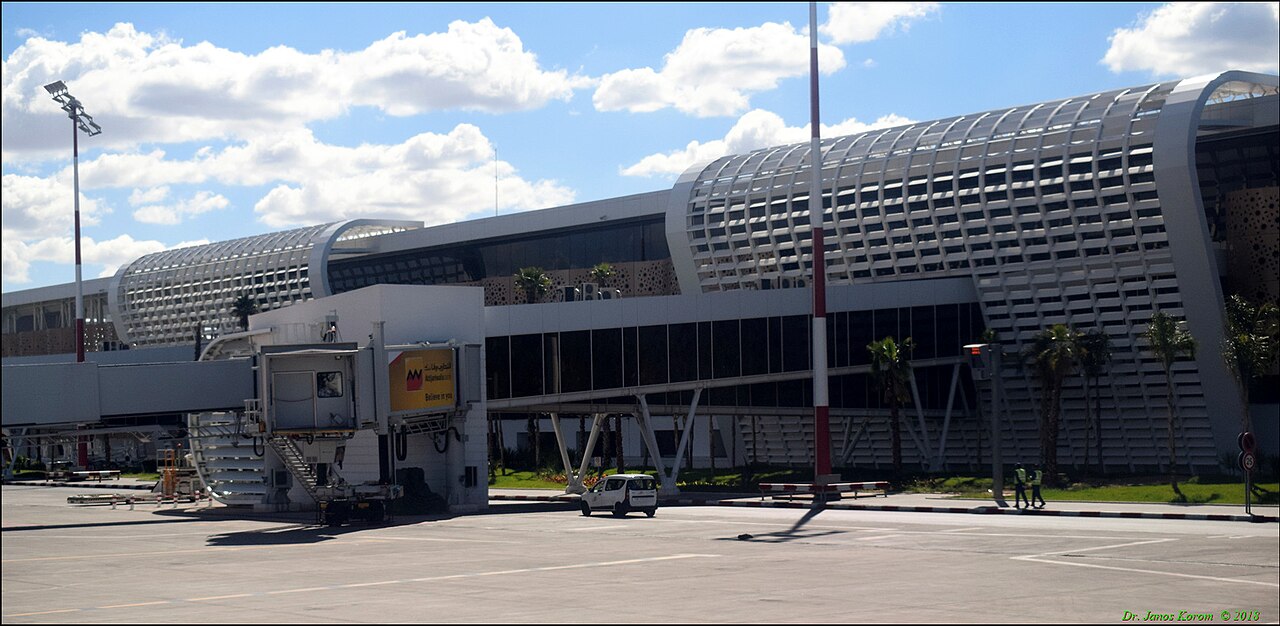
Featured image: Marrakech Menara Airport terminal, 2018. Photo: Janos Korom Dr., via Wikimedia Commons, CC BY-SA 2.0. Illustrative image; it does not depict any event discussed in this article.
Method note: Sources are named in the text and listed above so readers can check our work; editorial responsibility rests with the publication.