

Economy and environment | 31 October 2026
Morocco’s water debate often begins with an engineering project: a dam, a transfer pipeline or a desalination plant. The harder economic question comes afterwards. Who receives the extra water, what does it cost to deliver, and does total use remain within what the system can sustain?
New supply matters. But treating a plant’s announced capacity as proof that scarcity has ended skips the networks, energy, farming decisions and public finances that determine its value.
A long-term constraint, not one dry season
The World Bank’s 2022 Morocco Economic Monitor summary put renewable water availability at about 620 cubic metres per person in 2020, down from 2,560 in 1960. These are historical resource estimates, not a measurement of the water in Morocco’s dams today.
The distinction matters. A reservoir filling rate describes stored water at a particular moment. Long-term renewable availability describes the resource against which growing demand has to be managed. A better rainy season can improve the first without removing the second constraint.
The Bank’s Country Climate and Development Report identifies water scarcity and drought as a priority alongside flood resilience and decarbonisation. This places water inside the growth debate, rather than treating it as a separate environmental concern.
Desalination changes the supply mix, not every farm’s economics
In December 2025 reporting by Reuters, Water Minister Nizar Baraka set out a target for treated seawater to supply 60% of drinking water by 2030. That was a policy target, not a statement that the share had already been reached. It also concerned drinking water, not 60% of every use of water across the economy.
The difference between uses is important. In June 2025 remarks reported by Reuters, Baraka said desalinated water would not be used for wheat because of costs and the area involved, but could release more dam water for inland farms. Extra coastal supply and agricultural water security can be connected without being the same service.
A reader assessing a new project should therefore ask whether it is operating or still planned, whom it serves and how the water reaches those users. Nameplate production capacity alone does not answer those questions.


The less visible investment: losses, reuse and information
The World Bank’s 2023 water-security programme announcement illustrates this wider approach. Its pillars include governance, financial sustainability and water-use efficiency, as well as non-conventional resources.
The announcement set objectives of saving 25 million cubic metres of potable water in distribution networks and making 52 million cubic metres of treated wastewater available for reuse. Those are programme aims. They should not be repeated as verified savings already delivered.
Reducing losses means making more of the water already treated available to users. Reuse can provide an alternative resource for suitable purposes. Better groundwater information helps authorities understand withdrawals rather than managing only what is visible above ground.
Affordability belongs in the calculation
The World Bank’s 2025 regional desalination report argues for combining new supply with demand management, loss reduction, wastewater reuse and stronger utilities. It also stresses energy requirements, environmental impacts and the need to protect vulnerable households when reforming prices.
This is not a simple choice between building infrastructure and asking people to use less. It is a question of making investment work: controlling avoidable losses, choosing appropriate uses and financing a reliable service without putting an unfair burden on households.
For Morocco, the useful test of progress is more demanding than a construction announcement. It is water delivered reliably, resources managed across uses, and a service whose operating costs and social effects are understood. More supply can be essential. What happens to it is the other half of the story.
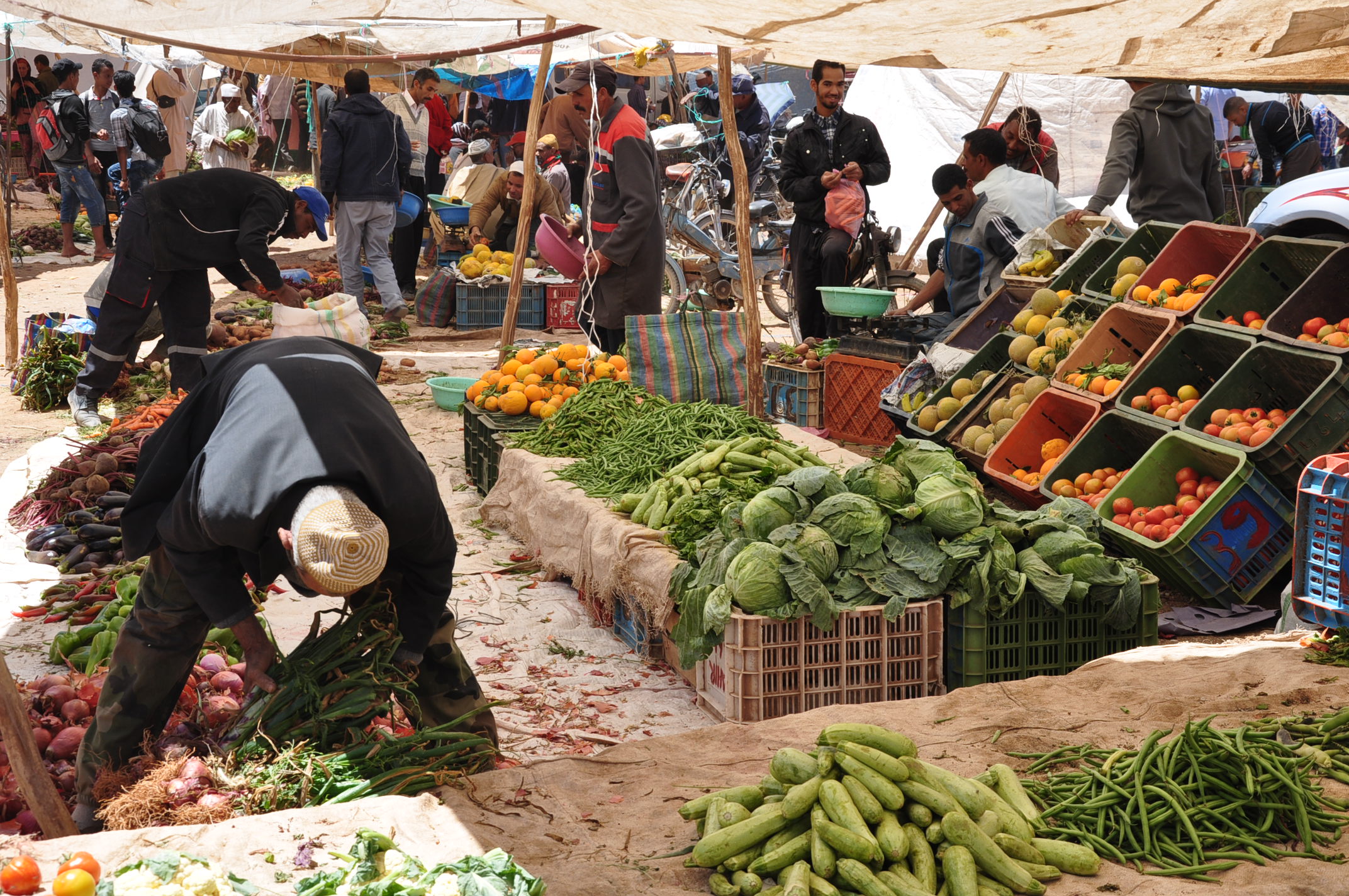
Source-based explainer using dated research and published reporting. No current dam-filling rate, new tariff, completed programme saving or on-the-ground inspection is claimed. Featured photograph: Skoura market produce, 29 April 2013, illustrating the food economy rather than current prices or drought conditions. Photo: Vincent van Zeijst, Wikimedia Commons. Photograph and display crops: CC BY-SA 3.0.
