

A line of singers, a group of drums and repeated movements can make ahwash look simpler than it is. In one documented High Atlas form, the musicians’ task includes a difficult transformation: they must carry dancers from an even rhythmic pattern into an uneven one without breaking the flow.
Ethnomusicologist Bernard Lortat-Jacob calls this passage tizi, a mountain pass. His account gives a precise way into a wider Moroccan performance tradition. The work is collective, but its success depends on distinct skills, negotiated roles and close attention to timing.
A name for several local forms
Ahwash, also written ahwach or ahouach, brings together singing, poetry, percussion and dance. It is associated with Amazigh communities in southern Morocco, including the High Atlas and Anti-Atlas mountains. Amazigh refers to North Africa’s Indigenous peoples and their languages; it does not describe a single uniform repertoire.
In a 2023 account of a heritage tour, the High Atlas Foundation described encountering variations in Telouet, Agouim, Toubkal and Aoulouz. Its report places performances at weddings, harvest celebrations and welcomes for visitors. That is a cultural organisation’s account of particular encounters, not a survey of every community.
The variations matter. Mohamed Elmedlaoui and Sigal Azaryahu’s 2014 ethnomusicological study describes men and women performing together or separately, depending on locality and form. It also describes room for skilled participants to improvise poetry and melody. A photograph of one formation cannot supply rules for all the others.
Crossing the musical pass
Lortat-Jacob’s study of central High Atlas ahwash, published in a 2013 journal issue and put online in 2015, is unusually specific about the work inside a performance. Its observations date mainly to the early 1970s and concern the area between Demnate and Ouarzazate. They should not be mistaken for a description of every present-day troupe.
In the form he describes, a singer opens with a couplet. Two choirs take it up in alternation, while drums establish a shared pulse. The performance gradually accelerates. A lead drummer must control that acceleration and guide the change in rhythmic organisation, rather than simply play faster.
In his analysed example, the underlying cycle moves from eight equal subdivisions to seven, grouped unevenly as four plus three. The point is not arithmetic for its own sake. A listener expecting the earlier balance is carried into a different pattern while the movement continues. The passage is successful when the change feels continuous, even though its result is clearly different.
The words also change their function during this process. Lortat-Jacob describes the repeated couplet becoming less intelligible as the dance accelerates, before the choir stops singing and attention settles on the dance and rhythm. This is one reason not to assign the same priority to every phase of an ahwash, or to every local version.

The gathering is part of the music
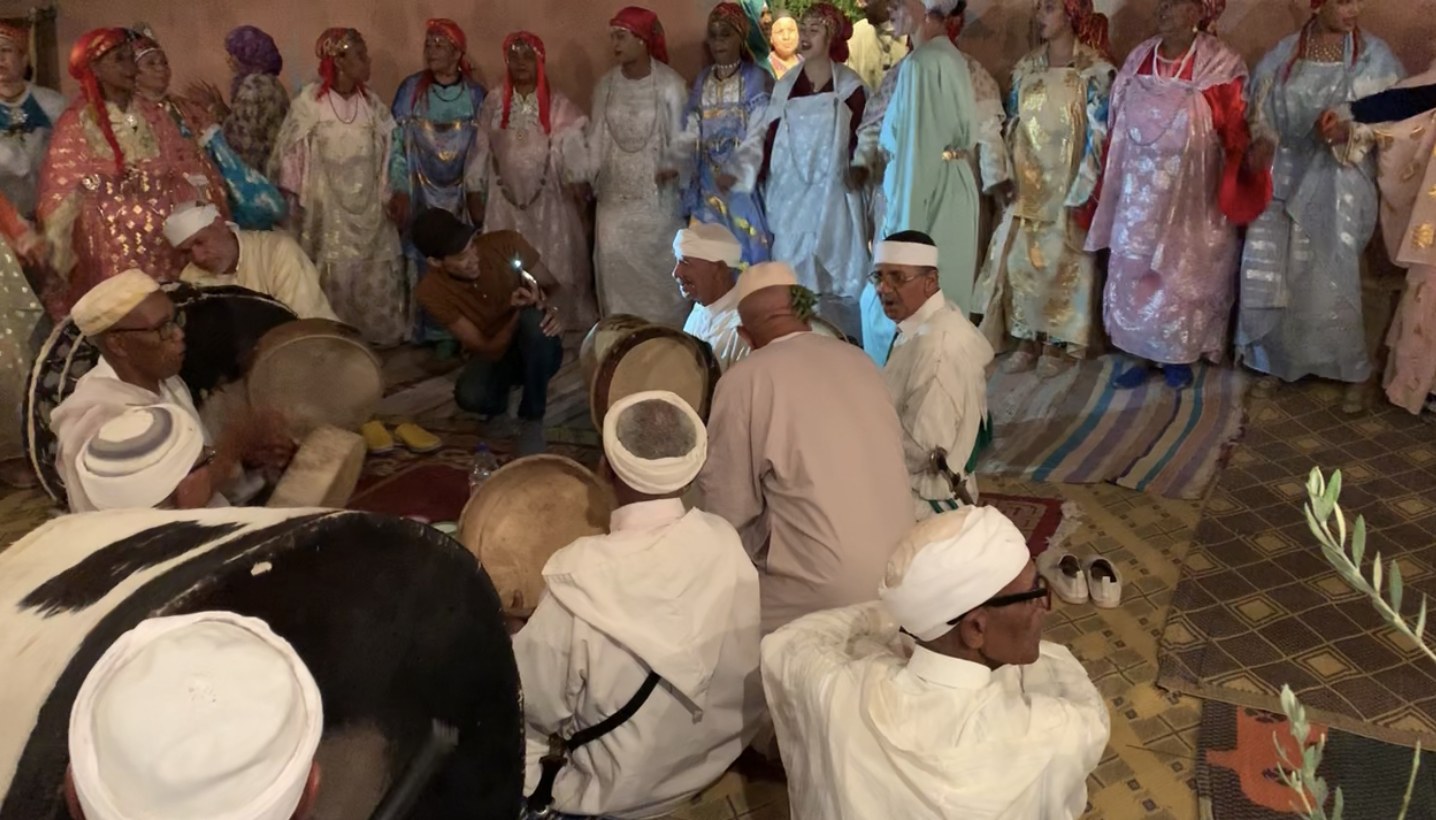
The study also follows the organisation around the sound. Village associations help bring people into the performance, manage turns and contain disputes. A participant can move from the edge of the gathering into an active role. Musical knowledge is therefore exercised through relationships, not only held by a soloist.
Other records make the range of settings visible. The Lomax Digital Archive catalogues a September 1967 performance in Fez by a confraternity of merchants from the Souss, a region in southwestern Morocco. The catalogue describes a circle of men with drums at a gathering for the Moussem of Moulay Idriss. This is evidence of a particular performance away from its region of origin, not grounds for treating ahwash as exclusively urban or rural.
A separate CNRS ethnomusicology catalogue record identifies an ahwash recorded by Miriam Rovsing Olsen in the central Anti-Atlas on 31 August 1979, with a wedding as its context. These archive descriptions preserve dates, places and circumstances. They are not a current census of performers.
Keeping more than the visible steps
Documentation remains a live concern. Biladi’s October 2026 report from Ouarzazate describes a festival discussion calling for more recording, archiving and transmission to younger generations. Those calls identify work participants want done; they do not measure how much transmission has already succeeded.
For a newcomer, the useful question is what a particular performance asks its participants to know. That includes language, rhythmic control, a place in the group and an understanding of the occasion. As with Morocco’s distinct malhun tradition, hearing a voice without understanding its role leaves part of the art unexplained. And, as the distinction between Amazigh languages and their writing systems makes clear, preserving words on a page is a different task from keeping a performance usable.
The musical pass offers a practical lesson in attention: repeated movement need not mean an unchanging rhythm, and a coordinated group need not mean interchangeable roles.
Source note: This explainer draws on published scholarship, archive catalogue descriptions and attributed cultural reporting. It is not a field report or an independent musical transcription. The archive audio was not assessed for this article; descriptions of sound are attributed to the cited researchers and catalogue notes. Historical observations are not presented as a survey of current practice.
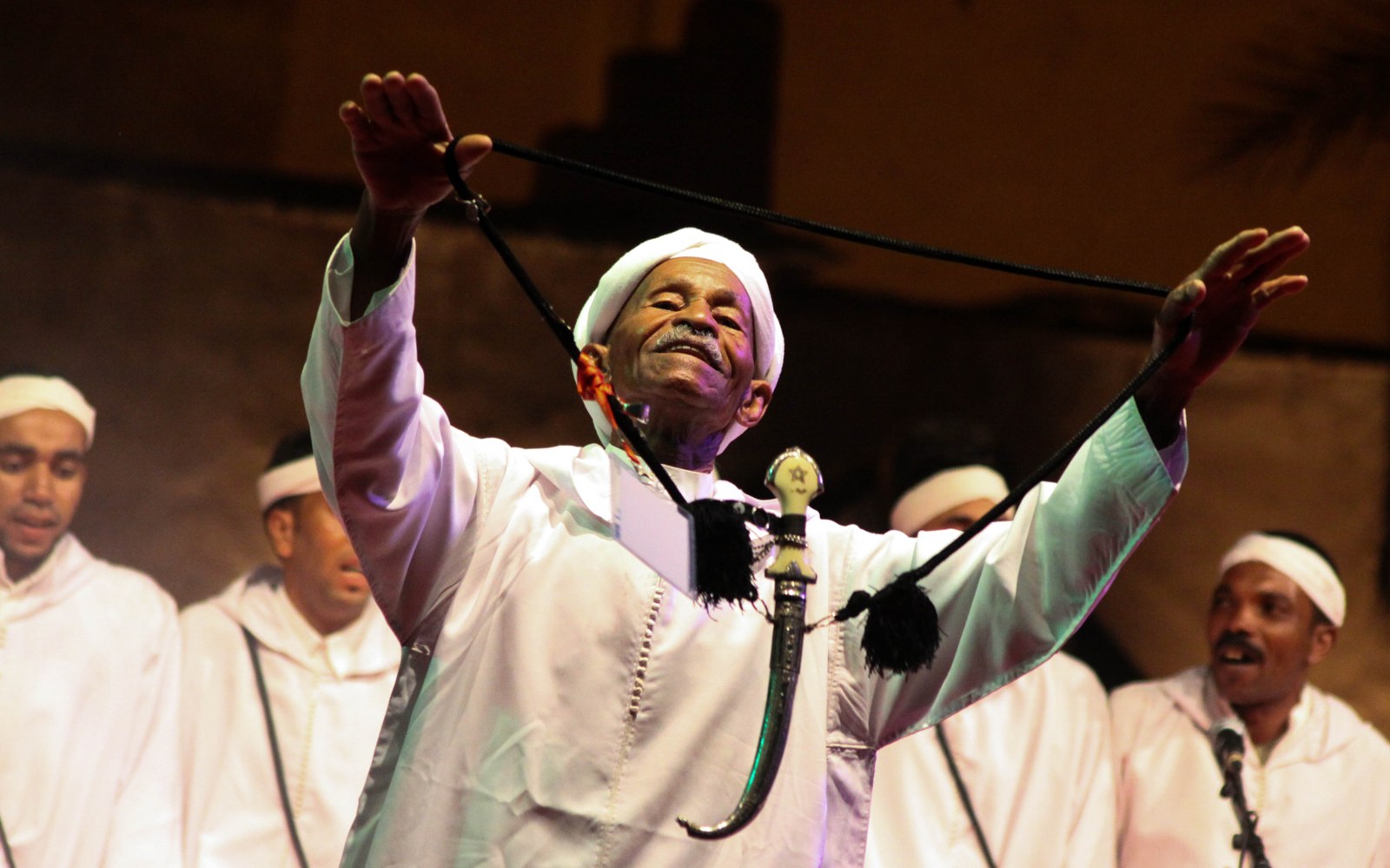
Lead photograph: An ahwash performer in Ouarzazate, by SAMIR ikhioui. Wikimedia Commons, CC BY-SA 4.0. Archive photograph uploaded in January 2017; the record’s January 2008 capture date has not been independently corroborated. Reduced-resolution, recompressed copy; photograph and display crops under the same licence. Not the performance analysed in the study.
