
The geometric letters on a Moroccan sign are not a separate language called Tifinagh. They belong to a writing system used for Amazigh. That distinction is the best starting point for understanding what the script does, and what its presence on a building or a screen cannot tell us by itself.
Modern Moroccan Tifinagh is a standardized alphabet. It draws on a longer North African writing history, but its present form also reflects deliberate choices about sounds, letter shapes and teaching. A common set of letters can help people produce textbooks and exchange text. It does not make every spoken variety identical, or show how many people can read a particular sign.
A language, a script and a spelling system
A language includes vocabulary, grammar and ways of speaking. A script supplies written signs. Orthography is the set of conventions for using those signs to write words. These layers interact, but they are not interchangeable.
In Morocco, the main Amazigh varieties are commonly identified as Tarifit, Central Atlas Tamazight and Tachelhit. The Unicode Standard’s Tifinagh chapter describes a character repertoire designed to accommodate more than one variety and writing tradition. It is not a claim that all speakers use the same vocabulary or pronounce every word alike.
The Royal Institute of Amazigh Culture, known by its French initials IRCAM, is central to Morocco’s standardization work. Its alphabet page presents a basic alphabet of 33 letters. That teaching alphabet should not be confused with every character available in the wider Unicode Tifinagh block, which includes extended and Tuareg forms as well.
Language choice is another question again. Debates about French in Morocco’s institutions concern which languages carry authority in public life. Identifying Tifinagh tells us how an Amazigh text is written, not whether a whole institution is accessible to its intended readers.
Old roots, modern decisions
Tifinagh has historical links to ancient Libyco-Berber writing, while Tuareg communities maintained writing traditions that differ from the standardized Moroccan alphabet. A historical overview published by Inalco, France’s institute for the study of languages and civilizations, describes both that inheritance and the modern adaptation of letter forms.
Neo-Tifinagh is the name used for modern systems developed for Amazigh varieties in North Africa. Unicode’s account places an influential proposal by the Académie Berbère in the 1960s. Morocco’s IRCAM alphabet belongs to this modern standardization history; it is not simply a photograph of an ancient inscription converted into a schoolbook.
A 2010 paper by IRCAM researchers Youssef Aït Ouguengay and Aïcha Bouhjar dates the official adoption of Morocco’s graphic system to February 2003 and the introduction of Amazigh teaching to September that year. Those are milestones in institutional use, not evidence that literacy became universal at the moment the alphabet was selected.

Learning letters is not the same as standardizing a language
Common letter shapes make a shared written resource possible. The choices behind spelling, vocabulary and grammar still need attention. The 2010 IRCAM paper describes heterogeneous linguistic material and the work needed to prepare consistent corpora, meaning organized collections of language examples for study or computer processing.
The authors distinguish rewriting material to follow linguistic conventions from merely transliterating it, or changing its script. Replacing one set of symbols with another does not, by itself, settle a spelling difference or decide which word belongs in a dictionary.
A 2025 study by Abderazaq Ichou and Said Fathi examines Tifinagh standardization through technical and social criteria. It supports the system’s adequacy, but its discussion also makes clear that learning, reading, writing and social acceptance are different tests. The article is an argument about standardization, not a fresh national survey of reading ability.
Amazigh has also been written in Arabic and Latin characters. The Inalco overview discusses manuscripts, scholarship and literary production in these scripts. Calling Tifinagh a modern Moroccan standard should not erase that written history or reduce the language’s earlier life to speech alone.
What Unicode does, and what a font does
Digital text needs more than an image of a letter. Unicode assigns characters stable identities so that software can exchange text. The Tifinagh block is U+2D30 to U+2D7F. Its scope is broader than the 33-letter basic Moroccan alphabet.
Encoding and appearance are separate jobs. A font supplies the shapes that a reader sees; a keyboard provides a way to enter the characters. Unicode Technical Note 59, dated August 2024, discusses these practical layers and lists fonts and keyboard resources. It is informative guidance, not an additional binding part of the Unicode Standard.
Modern Moroccan Tifinagh is written from left to right. Historical inscriptions did not all follow one direction. That is why a present-day digital convention should not be projected backwards onto every ancient text.
Oral and written forms can also support different kinds of cultural work. In a different Moroccan linguistic tradition, Malhun’s sung poetry illustrates why performance carries meaning that is not exhausted by a written page. A standardized script is a tool for writing, not a replacement for the language as people speak, sing and use it.
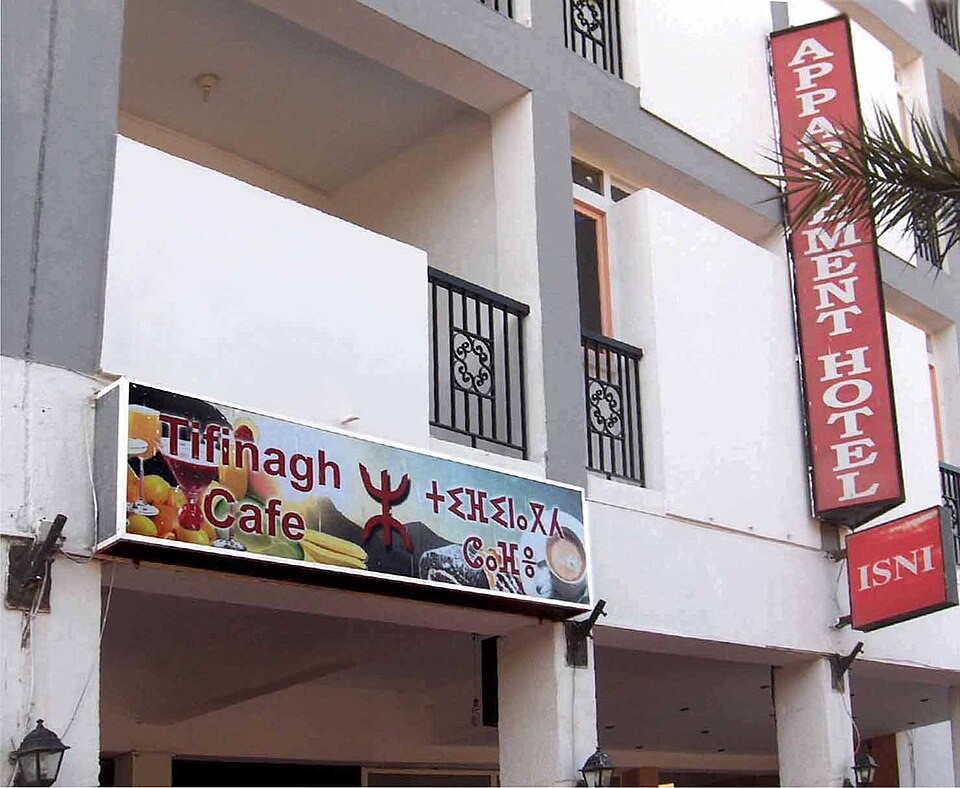
A Tifinagh sign can therefore be read at two levels: as visible recognition of Amazigh, and as a text meant to communicate. Evaluating the second requires asking about spelling, the intended readers and the setting. The alphabet makes that communication possible; the letters alone cannot prove that it succeeds.
Method and transparency: This is a source-based explainer, not a field report or a test of readers’ abilities. AI assisted research organization, drafting and editorial review. The institutional, linguistic and technical sources were checked for their scope and dates. No current literacy percentage, school-coverage total or business-status claim is made.
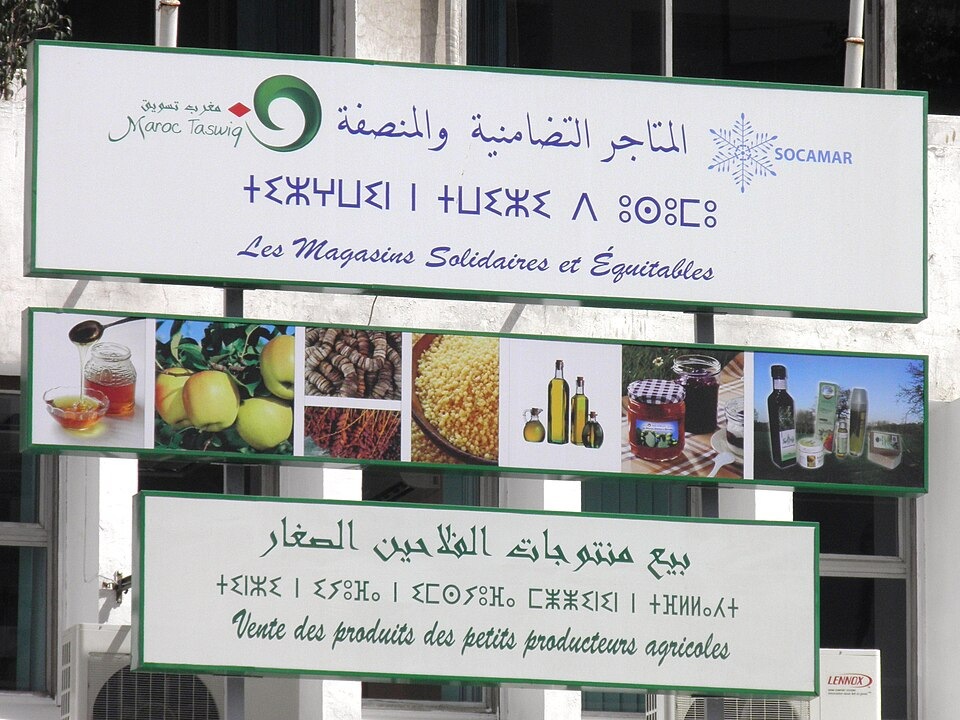
Lead photograph: Maroc Tawsiq signage in Arabic, Tifinagh and French, photographed by Mohamed Amarochan on 11 July 2012. Wikimedia Commons, CC BY-SA 3.0. Archive illustration, not evidence of current trading activity or independently checked translation. Reduced-resolution copy; no generative changes.
