

Heavy pumping can leave an aquifer with two problems: less water in storage and a reduced ability to replenish it. A study of Morocco’s Haouz plain, around Marrakech, links falling groundwater levels to weaker recharge, suggesting that recovery can become harder the longer depletion continues.
The research, published in the September 2026 issue of the Journal of Hydrology and explained by France’s Research Institute for Development, or IRD, on November 12, examines the water system beneath an irrigated plain at the foot of the High Atlas. Its finding is more specific than the familiar warning that drought and irrigation can empty reserves: depletion itself can change how those reserves are renewed.
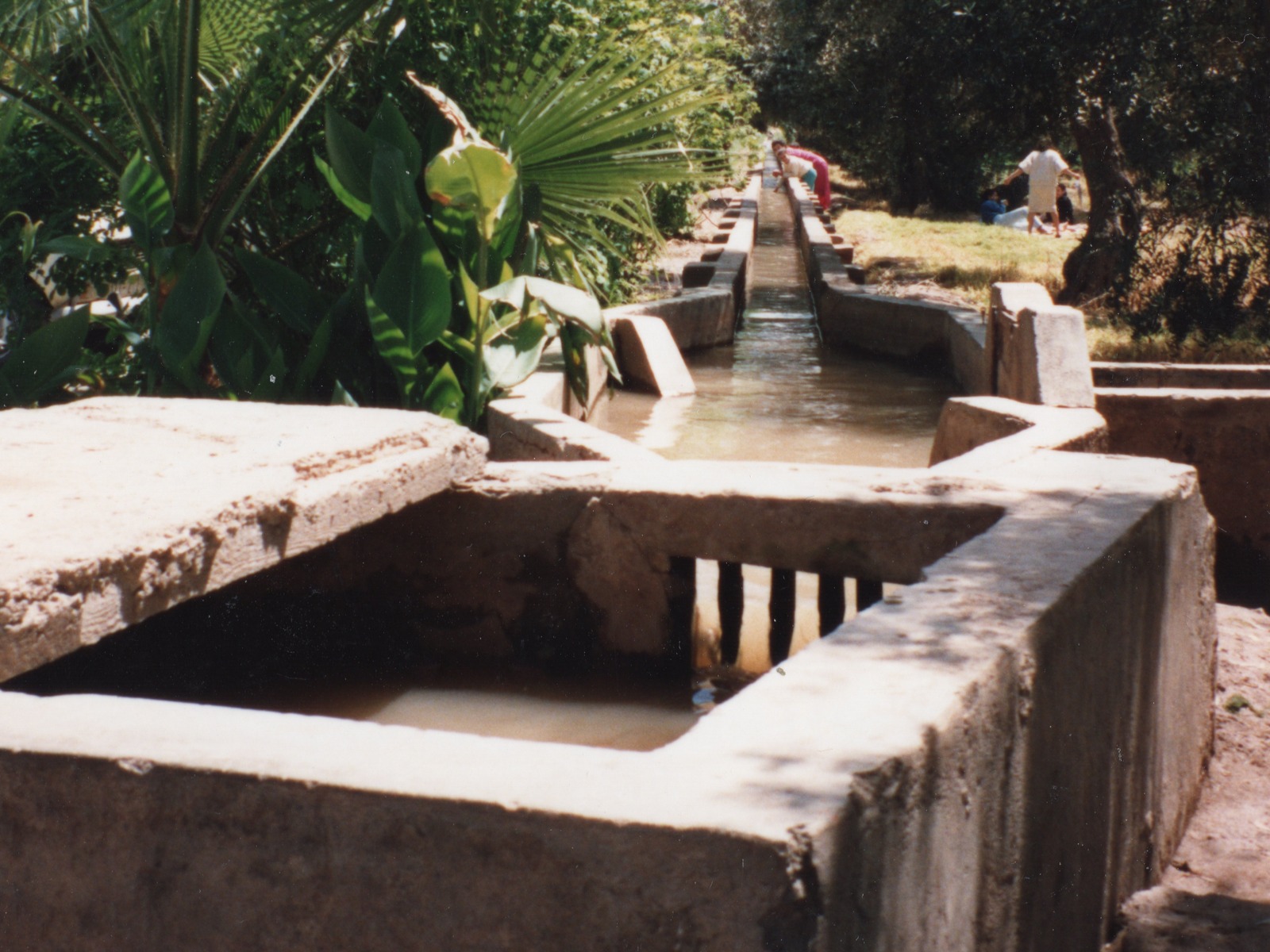
Archive photograph: irrigation channels in Marrakech’s Menara Garden, March 1989. This is water-management context, not a study sampling site or evidence of present groundwater conditions.
A longer journey below the surface
An aquifer is not usually an underground lake. Water occupies connected pores and fractures in geological material. Above the water table lies an unsaturated zone, where the spaces are not completely filled with water. Infiltrating water must travel through that zone to reach the groundwater below.
When pumping lowers the water table, that journey becomes longer. The study’s authors argue that the resulting thickening of the unsaturated zone can reduce recharge and reinforce depletion. Less stored water and slower renewal then become connected parts of the same problem.
The paper’s abstract, held in IRD’s research repository, reports that groundwater decline accelerated after 2000, reaching up to 5.8 metres a year in certain sectors. That is a local rate in parts of the studied aquifer, not an average for the Haouz or for Morocco. It must not be multiplied into a nationwide loss estimate.
What the tracers add
A falling water level alone does not establish that recharge has weakened. The researchers combined groundwater-level records with satellite-based estimates of irrigation water requirements, drought indicators and isotopic tracers. Isotopes are forms of an element that can help distinguish water’s origins and renewal history.
The abstract reports less evidence of modern recharge in depleted areas where groundwater was more than 50 metres deep. It also describes a shift towards older water with signatures associated with higher-altitude mountain sources, rather than local low-altitude rainfall. Those observations underpin the authors’ interpretation of a feedback loop.
The 50-metre observation is not a universal boundary below which every aquifer stops recharging. Nor does the study show that the Haouz cannot recover. The more careful conclusion is that prolonged depletion can make recovery more difficult. No date for that recovery is established here.
Efficient equipment is not a basin-wide water balance
IRD’s account also separates irrigation efficiency on a farm from total pressure on the aquifer. Drip irrigation can reduce water applied to a particular plot, while an expansion of irrigated land can offset that saving. Better equipment and lower overall withdrawals are different outcomes.
That accounting problem is not unique to Morocco. FAO and FutureWater’s 2021 guidance on real water savings distinguishes reductions in withdrawals from reductions in consumption and non-recoverable return flows. Water that leaves one field can remain available elsewhere in the system. Assessing a change therefore requires following the water beyond the farm boundary.
This does not make drip irrigation useless or imply that farmers should return to less controlled watering. It means that evaluating conservation requires evidence about total use, crop area and recharge, alongside equipment installed. The Haouz study adds a further reason to act before the water table falls much farther: restoring the stock may be harder if the conditions for renewal have also changed.
Sada Journal’s broader account of Morocco’s water economy explains why additional supply is not the same as sustainable use. Its reporting on khettara water-sharing systems shows another way falling groundwater can undermine a water service. The new research concerns the aquifer’s renewal mechanism, not a verdict on every Moroccan irrigation project.
Sources and limits: Checked November 14, 2026. This account uses the publisher’s accessible abstract, introduction and section previews, IRD’s repository abstract and explanatory reporting, and FAO guidance. The complete subscription paper and underlying data were not available for independent review; its recharge model and uncertainty estimates were not reproduced. No field visit or interviews were conducted.
Photograph: JopkeB, “Irrigation canals in Menara Garden, Marrakech 1989”, March 29, 1989, via Wikimedia Commons, CC BY-SA 4.0. Cropped, resized and recompressed; this image version remains under the same licence. No generative changes.
