
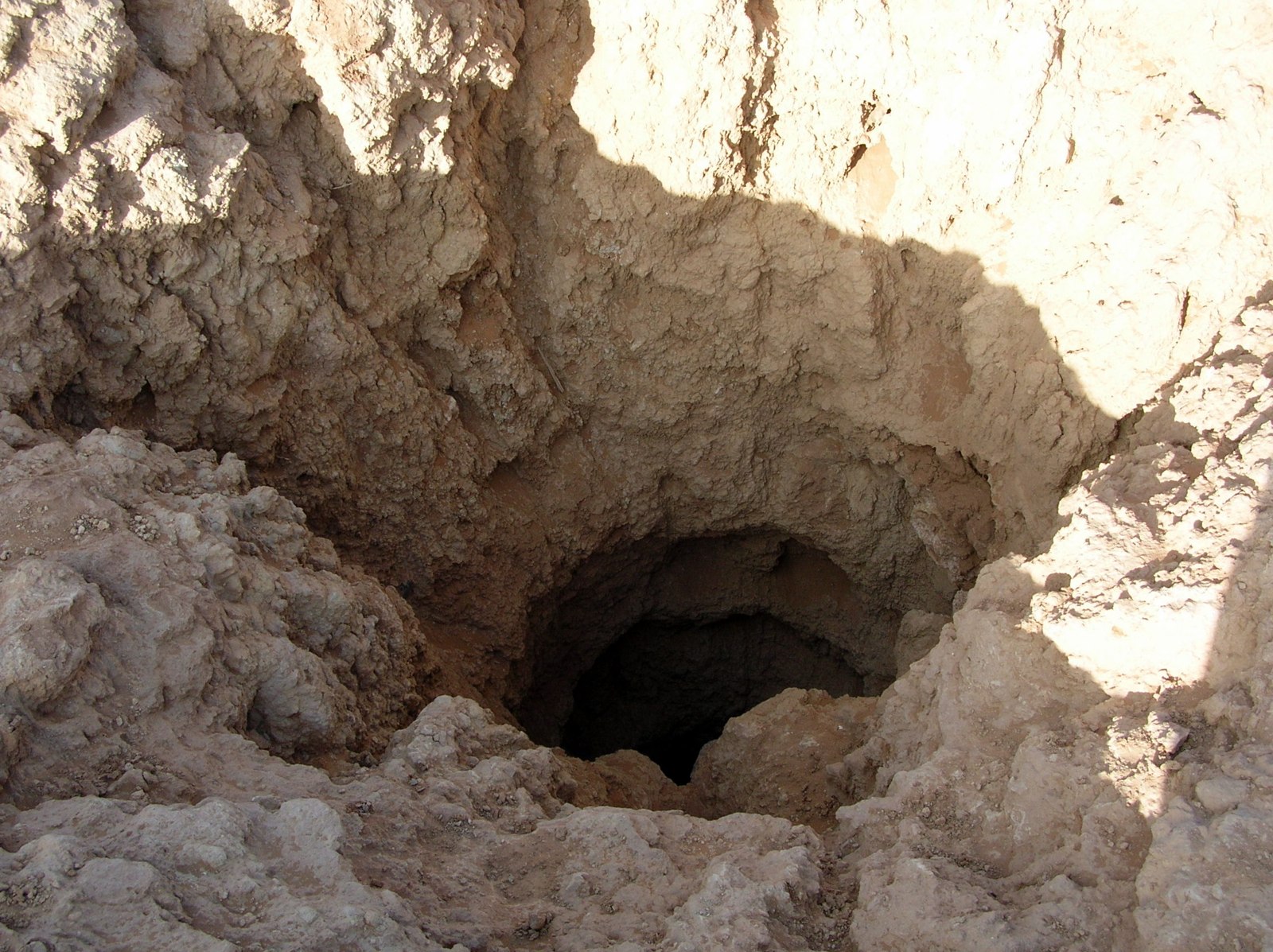

A line of holes in the ground can be the visible part of a much larger water system. In Morocco’s oasis country, a khettara is an underground gallery that collects groundwater and carries it downhill by gravity. But the tunnel alone does not explain how the system works. Someone must maintain it, divide its flow and agree when each user receives water.
That makes khettaras a useful way to understand heritage as a working relationship between people, land and a shared resource. Their importance is not that old technology can magically solve a modern drought. It is that engineering and collective organization have to function together.
Featured archive photograph: a khettara shaft near Erfoud, 24 January 2005. Bernard Gagnon / Wikimedia Commons, CC BY-SA 3.0. Resized. The photograph does not establish current water flow.

What lies beneath the shafts
UNESCO’s water museum account describes galleries that draw water from higher ground toward oases, where it is used mainly for irrigation. The underground route and gentle gradient allow water to move without a motorized pump. Vertical shafts connect the gallery to the surface.
For a visitor, those openings may be the most recognizable feature. For a farmer, the important question is whether groundwater still reaches the gallery and whether the channel can deliver it to fields. An impressive structure and a functioning water supply are not the same thing.
Nor should different places be collapsed into one timeless story. Khettaras have histories in several Moroccan regions, and their construction, water rights and present condition vary. A description of one oasis is not an inventory of every system in the country.
The water is shared in time
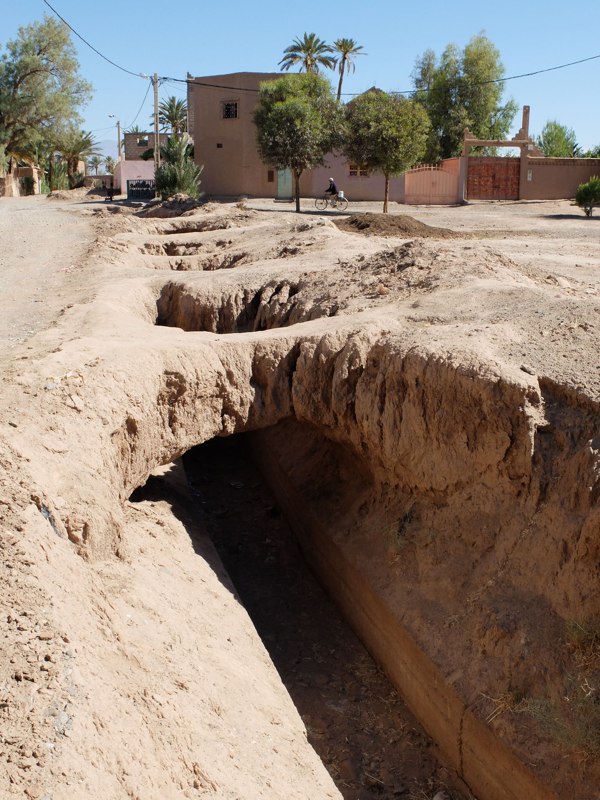

A 2022 study of khettaras in Tafilalet, in southeastern Morocco, describes customary water rights linked to contributions to construction and passed between generations. It also describes maintenance obligations and water allocation measured in time. The rules and measuring methods differ between areas.
This is a different picture from water simply being available to whoever arrives first. A turn in the flow is part of an organized system of rights and responsibilities. Cleaning a blocked passage or repairing a leak is therefore a social task as well as a physical one.
A JICA water-use manual for khettara irrigation makes that connection concrete: improving canals can change how quickly water reaches individual plots, so irrigation schedules may need to be adjusted among users. Even an apparently straightforward repair can require a new agreement.
As with the knowledge behind argan oil, the visible product is only part of the heritage. Skills, maintenance and the transmission of rules matter too. Calling a tunnel ingenious is easier than explaining who keeps it useful.
Why gravity is not a guarantee
A gravity-fed gallery depends on the aquifer it drains. If groundwater levels fall, preserving the masonry does not automatically restore the supply. That distinction matters when khettaras are presented as a ready-made answer to water scarcity.
Research published in Cahiers Agricultures in 2023, drawing on fieldwork in Ferkla from February 2021 to January 2022, examined communities adding solar-powered pumping to support khettara systems. It found a difficult trade-off: pumping could help preserve collective access in the short term while contributing to groundwater depletion. The researchers did not present solar power as a guarantee of long-term survival without regulation of groundwater use.
That is evidence from a particular place and period, not a claim that every khettara now uses pumps. It does show why the choice is more complicated than tradition versus modernity. Communities can change the equipment while trying to preserve collective access, and still face limits imposed by the water resource.
Our guide to Morocco’s water economy examines the wider distinction between increasing supply and managing demand. At oasis scale, the same practical question remains: how much water is available, who can use it, and under what rules?
Seeing heritage without turning it into a cure
When looking at a khettara, ask about both the channel and the organization around it. Is it carrying water now? Who maintains it? How are turns allocated? Which parts have been repaired or changed? A dated photograph cannot answer those questions for a present-day visit.
Do not enter shafts or underground passages on the strength of a photograph or travel description. Confirm local access arrangements and treat water infrastructure as something people may depend on, not an invitation to explore.
The most useful lesson of khettaras is neither nostalgia nor a promise of unlimited resilience. It is that a water system includes the people who share its benefits, maintain its structures and adapt its rules. Keeping that whole system in view is a better starting point than admiring the holes in the ground.