
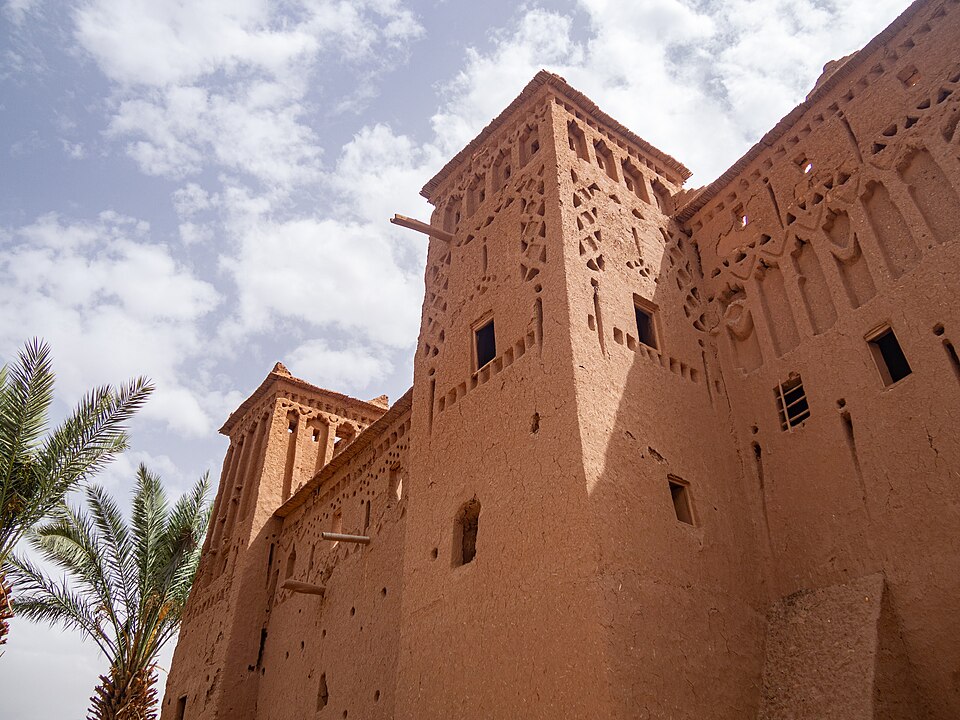

Ait-Ben-Haddou’s earthen towers look solid from a distance. Their survival depends on something less visible: repeated repairs, building knowledge and decisions about how people can continue to use the place. A World Heritage label recognizes that inheritance. It does not make earth permanent.
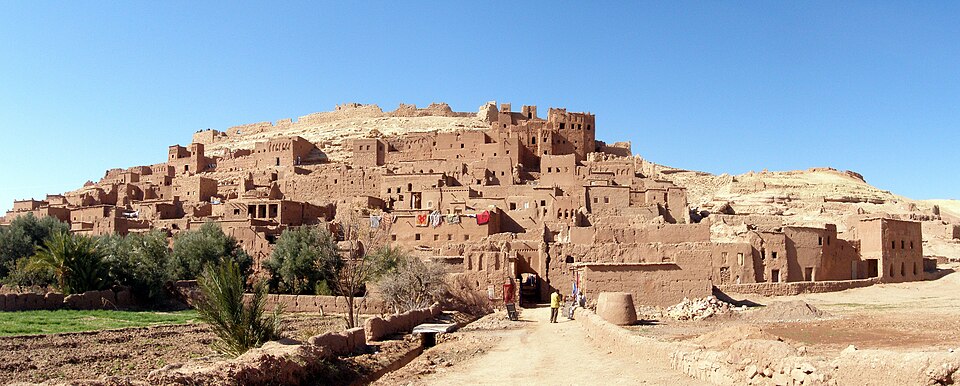
In the Ounila Valley, on the southern side of Morocco’s High Atlas mountains, Ait-Ben-Haddou is a ksar: a fortified settlement containing closely grouped homes and shared spaces. Understanding that collective form changes the view from a picturesque silhouette into a place built for living together.
Featured archive photograph: decorated earthen towers, 16 July 2019. C messier / Wikimedia Commons, CC BY-SA 4.0. Resized. Both photographs in this article predate the 2023 earthquake and do not show current restoration work.

A settlement, not one castle
UNESCO’s account of the site, inscribed in 1987, describes houses within defensive walls reinforced by corner towers. The ensemble includes a mosque, a public square, threshing areas outside the walls and a hilltop granary, alongside other community and religious spaces.
The grander houses can resemble small castles, but the whole settlement is the ksar. Its value lies in the relationship between buildings, lanes, shared facilities and the surrounding landscape. Reading only the decorated towers misses much of the architecture.
Age needs care too. UNESCO says the oldest surviving constructions do not appear to predate the 17th century, while the building traditions are older. An ancient technique does not establish an ancient date for every wall now standing.

Conservation is a continuing task
Earth and wood are part of the site’s architectural identity. UNESCO’s conservation assessment published in 2009 linked vulnerability to the loss of regular maintenance as inhabitants left. That dated assessment should not be mistaken for a count of residents today. It explains why preserving a material also means sustaining the ability to repair it.
The conservation organization CRAterre records work with CERKAS, Morocco’s specialist centre for the architectural heritage of the Atlas and sub-Atlas regions, including a conservation manual and participatory management planning in the 2000s. UNESCO’s account of the 2008 technical assistance describes work on the upper enclosure and community granary. Care for the site therefore long predates the earthquake.
There is a parallel with Morocco’s khettara water systems: the visible structure survives through organized work, not admiration alone.
What the restoration record actually says
Morocco’s October 2025 conservation report says restoration of buildings affected by the September 2023 earthquake began in February 2025. It sets out a phased programme, using traditional earthen techniques and local skills alongside technical supervision.
A timetable is not a completion certificate. The 2026 conservation review records the launch of works but also identifies gaps in the documentation supplied. In its adopted 2026 decision, the World Heritage Committee welcomed progress and requested a consolidated account of planning, methods, progress and coordination with the housing-restoration programme begun in 2014.
The same decision calls for visitor management and risk management to be integrated into the site’s management plan. Commercial activity, residential use and conservation have to be considered together. A busy visitor economy does not, by itself, show that a settlement’s housing and repair needs are met.
Look beyond the silhouette
For a visitor, the useful questions concern what the buildings contain, how they are maintained and which areas are accessible now. Confirm local access arrangements rather than treating an old photograph as evidence that every lane or building is open.
Keep heritage and screen scenery separate, too. Our Ouarzazate cinema feature examines constructed film worlds. Ait-Ben-Haddou has its own architectural history. Its most important story is the continuing work needed to keep an earthen settlement standing.