

Trilobites in Morocco’s High Atlas inhabited a coast where river water mixed with the sea, according to a new reconstruction of the rocks around their fossils. The study adds evidence that some of these extinct arthropods could tolerate changing salinity. It does not show that trilobites as a whole were freshwater animals.
The research, published on 2 November in Communications Earth & Environment, examines the Aït Youb section in the High Atlas. Cadi Ayyad University drew attention to the findings on 16 November. Researchers from the Marrakech university and Mohammed V University in Rabat worked with colleagues in several other countries.
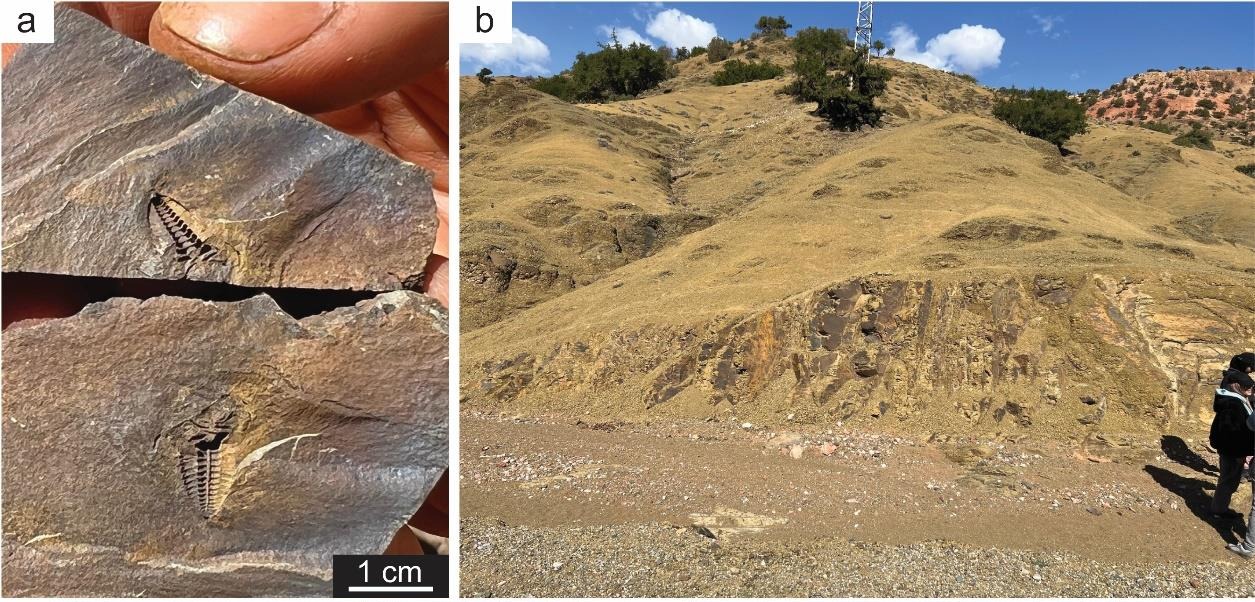
The water is gone, but its setting left evidence
Aït Youb preserves a succession of Cambrian sedimentary rocks, from long before dinosaurs. The study follows the Issafen and Tatelt formations into the lower part of the Jbel Wawrmast Formation. A formation is a recognisable body of rock; its layers record different stages in the history of the same area.
The researchers collected 74 rock samples and combined the chemistry with observations of minerals, sedimentary structures and fossils. These are samples of the surrounding geological record, not a count of 74 trilobites. Channels, sandstone beds, mud-rich layers and volcanic deposits help reconstruct the processes that accumulated the sediment.
The authors interpret much of the older part of the succession as a shallow coastal system influenced by rivers and waves. Freshwater arriving from rivers would have mixed with seawater, creating variable conditions, including brackish water, a mixture of fresh and salt water. Later deposits show a stronger marine influence. The conclusion concerns this studied succession, not every Cambrian habitat in Morocco.
Why one chemical ratio is not enough
No sample bottle contains the original Cambrian water. Instead, the paper uses chemical proxies: relationships between elements in the rocks that can help indicate conditions during deposition. Ratios involving boron and gallium, and yttrium and holmium, contribute to the salinity interpretation.
Other ratios need particular care. The researchers explain that volcanic material can raise strontium relative to barium or lower rubidium relative to potassium. Read alone, those changes could suggest a different salinity history. Comparing several chemical signals with the minerals and sedimentary structures is therefore part of the argument, rather than an optional extra.
As with interpreting Morocco’s dinosaur footprints, an observation and the environment inferred from it are different kinds of evidence. The paper’s reconstruction rests on how the observations fit together, including where individual indicators become less reliable.
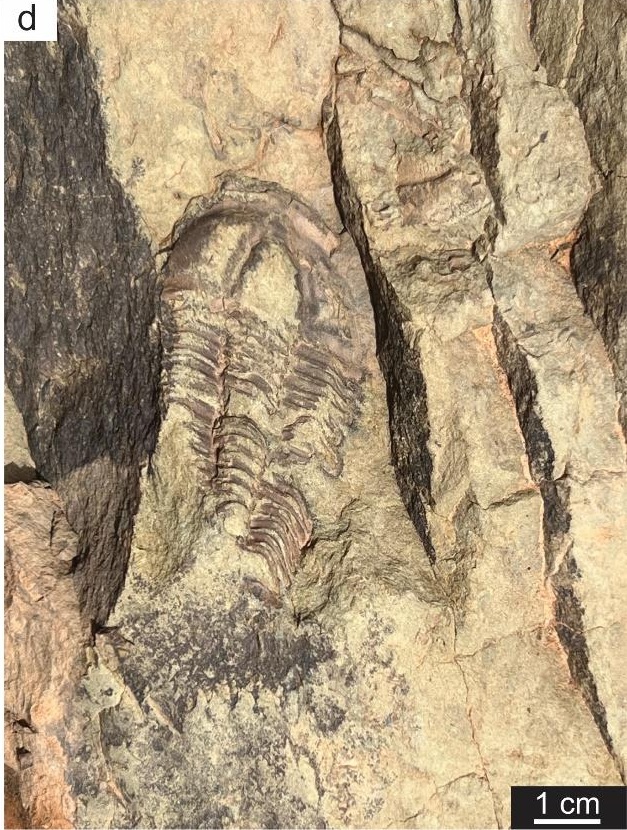
A broader habitat, not a simple growth experiment
The idea that some trilobites tolerated brackish water predates this study. Research published in 2021 used body fossils, traces and sedimentary evidence to examine the movement of other trilobite groups into estuaries. The Moroccan paper adds a geochemical reconstruction from a different succession and discusses the possible environmental range of its Cambrian assemblages.
It also compares smaller trilobites in older intervals with a broader size range, including larger forms, higher in the succession. But this is not a controlled experiment showing one species growing larger as the water became saltier. Different groups have different typical body sizes, while marine influence, environmental stability and carbonate availability can vary together.
The original paper explicitly leaves direct ecological control unproven. Physiological mechanisms that might have helped the animals tolerate changing conditions remain to be tested. Its stronger contribution is a more detailed account of the environments in which the fossils occur, rather than a single demonstrated cause of evolutionary success.
The question also differs from the preservation filters studied in Morocco’s younger Fezouata fossils. One asks how the surrounding environment changed; the other examines which anatomical information survived. Keeping those questions separate makes Morocco’s fossil record more useful, without treating every well-preserved specimen as a complete record of its living ecosystem.
Sources and method: This article explains the full accepted paper and its supplementary geological context, alongside the university release and the earlier research cited above. The publisher labels the November 2026 paper an early, peer-reviewed accepted version still subject to editing. This is not a field visit, specimen examination or independent rerun of the geochemical analysis. No current site-condition assessment or new discovery by Sada Journal is claimed.