
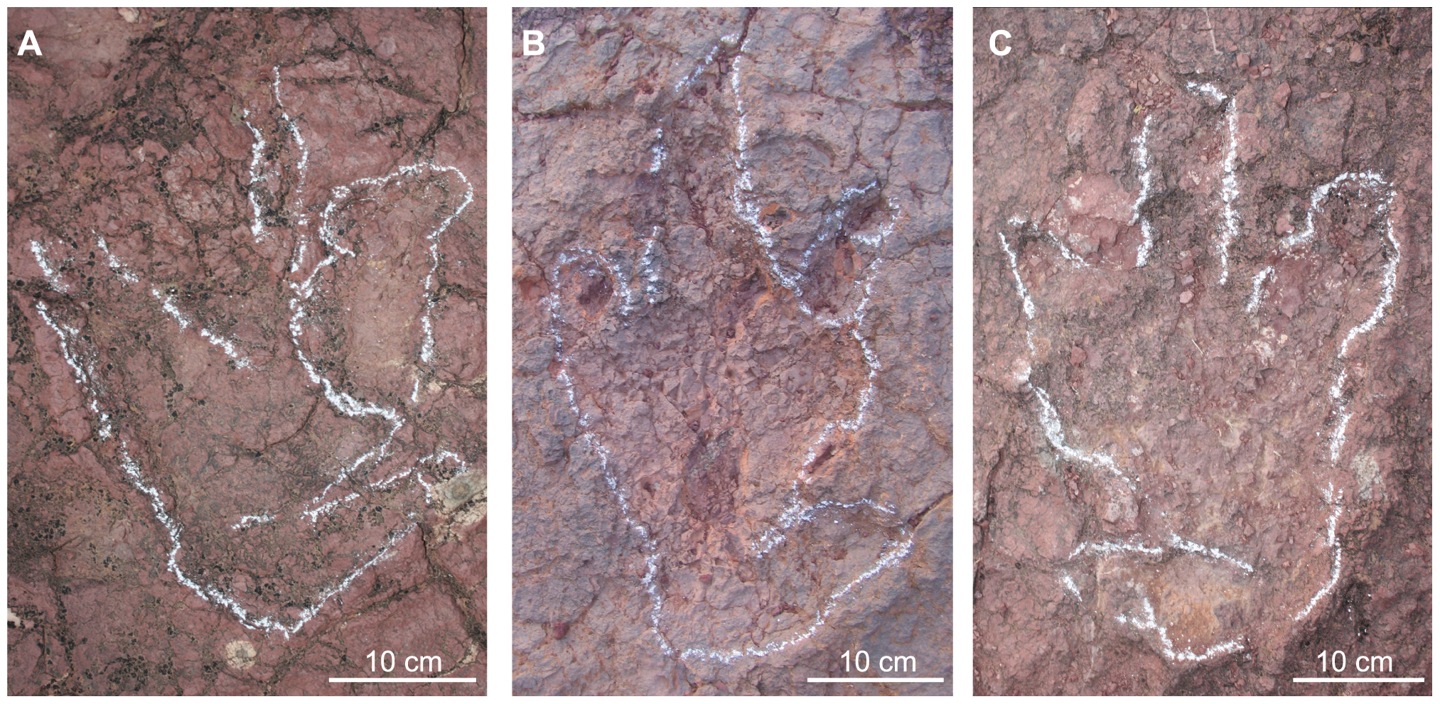

A dinosaur footprint is not a photograph of a foot. At Iouaridène in Morocco’s central High Atlas, a single animal could leave tracks showing different numbers of toes. The ground, the animal’s movement and the way the trace survived all helped shape what researchers can see today.
That makes the site more interesting, not less informative. Its tracks preserve evidence of animals moving through a Jurassic landscape. But naming a footprint, reconstructing a foot and identifying a dinosaur species are separate tasks. The rock does not answer all three with equal certainty.
A former muddy surface in the High Atlas
Iouaridène lies east of Demnat, in Azilal province. It is part of the M’Goun area, which UNESCO lists as a Global Geopark. The scientific literature describes a syncline, a downfold in the rock layers, containing the red sedimentary beds in which the tracks are preserved.
A 2011 study by Jaouad Nouri, Ignacio Díaz-Martínez and Félix Pérez-Lorente places its studied track-bearing layers in the Late Jurassic, specifically the Oxfordian-Kimmeridgian interval. That dates the geological setting of those tracks. It should not be expanded into one exact age for every fossil or rock formation across the geopark.
The paper describes mud cracks and other sedimentary structures around the prints. In some examples, a dinosaur’s foot broke or displaced cracks that had already formed. Those relationships help researchers reconstruct the order of events: the surface dried and cracked, an animal stepped across it, and the resulting disturbance became part of the geological record.
The geopark’s own description of Iouaridène emphasizes the red beds, temporarily exposed surfaces and the need to preserve the footprints. Its visitor-facing reconstructions are not a substitute for the measurements and qualifications in the research papers.
A name for a trace is not a species identification
The 2011 paper formally described Boutakioutichnium atlasicus, a type of footprint with an unusual impression of the first toe, or hallux. The researchers studied more than 100 prints in 15 trackways with these features. A trackway is a sequence of footprints attributed to an animal’s passage, rather than one isolated mark.
The name classifies the trace. It is not the name of a skeleton discovered beside it. The authors identified a theropod trackmaker, a dinosaur walking on two hind limbs, but did not find a secure match between the inferred foot and the known record of foot bones. They allowed that its maker might be a theropod whose foot was not yet known.
This is a different evidential problem from the human remains at Jebel Irhoud, where anatomical specimens and associated dating evidence can be examined together. Both subjects depend on context, but a preserved bone and a disturbance in sediment do not preserve the same information.
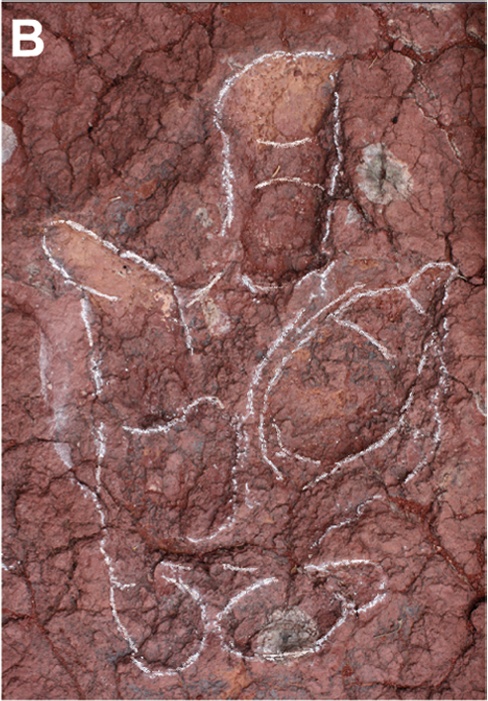
Why three toes and four can belong in one trackway
A 2018 follow-up by Mohamed Boutakiout, Jaouad Nouri and Félix Pérez-Lorente studied two Iouaridène sites. It counted 199 traces in total, while concentrating its analysis on 140 theropod prints. The remainder comprised 58 sauropod prints and one unidentified isolated footprint. These are the study’s counts, not a current inventory of the whole landscape.
Some sequences alternated between three-toed and four-toed impressions. The researchers warned against turning each different outline into a different kind of dinosaur. A toe can exist without leaving an equally clear mark at every step. At the same time, the paper did not establish a single explanation for why the hallux appeared in some prints and not others.
The broader mechanism is explained in a 2026 review by Peter Falkingham and Stephen Gatesy: anatomy, foot movement and sediment properties interact to produce a track. One foot can leave different forms, while similar feet belonging to different animals can leave similar traces. How the buried track is later exposed adds another filter.
That last point matters. A surface visible today is not automatically the original surface on which the animal walked. A track can include deformation through a volume of sediment, and different exposed levels can show different shapes. Reading only the outline risks mistaking preservation for anatomy.
Movement is evidence; behaviour remains an interpretation
The 2018 researchers also examined winding paths and variations between successive steps. They did not infer limping or a consistent preference for one side from those irregular patterns. A plausible story about an injured animal is not enough: the pattern must support that particular explanation.
Parallel paths raise another question. The study interpreted some approximately parallel trackways as possible evidence of loosely grouped animals. That remains a behavioural interpretation. In a separate North American setting, the US National Park Service’s explanation of trackways sets out the competing possibilities clearly: parallel traces may suggest movement together, but preservation and exposure can complicate what survives. That is a general caution, not independent proof about the Moroccan tracks.
As with measurements at Oukaimeden Observatory, the useful question is how an observation becomes a tested conclusion. At Iouaridène, the measurements begin at ground level: the shape of a toe mark, its depth, its place in a sequence and its relationship to the sediment. The result is a record of movement worth reading carefully, without filling the missing animal with certainty the evidence cannot supply.
Sources and method: This is an explanation of published research, not a new discovery, field visit, current site-condition survey or access guide. Counts retain their study years. No exact dinosaur species, body size, running speed or present total is claimed. AI assisted research organization, drafting and editorial review; material claims were checked against the linked sources.
Lead photographs: Three different Iouaridène footprints, specimens 8IGR1.23, 8IGR3.2 and 8IGR3.3, from Nouri, Díaz-Martínez and Pérez-Lorente’s 2011 PLOS ONE study, figure 3. Published white outlines and 10 cm scale bars retained; capture dates not stated. Archive research photographs under Creative Commons Attribution; publisher’s reuse policy. Reduced-resolution reproduction of the photographic plate, no generative changes. These are not photographs of present site conditions.