
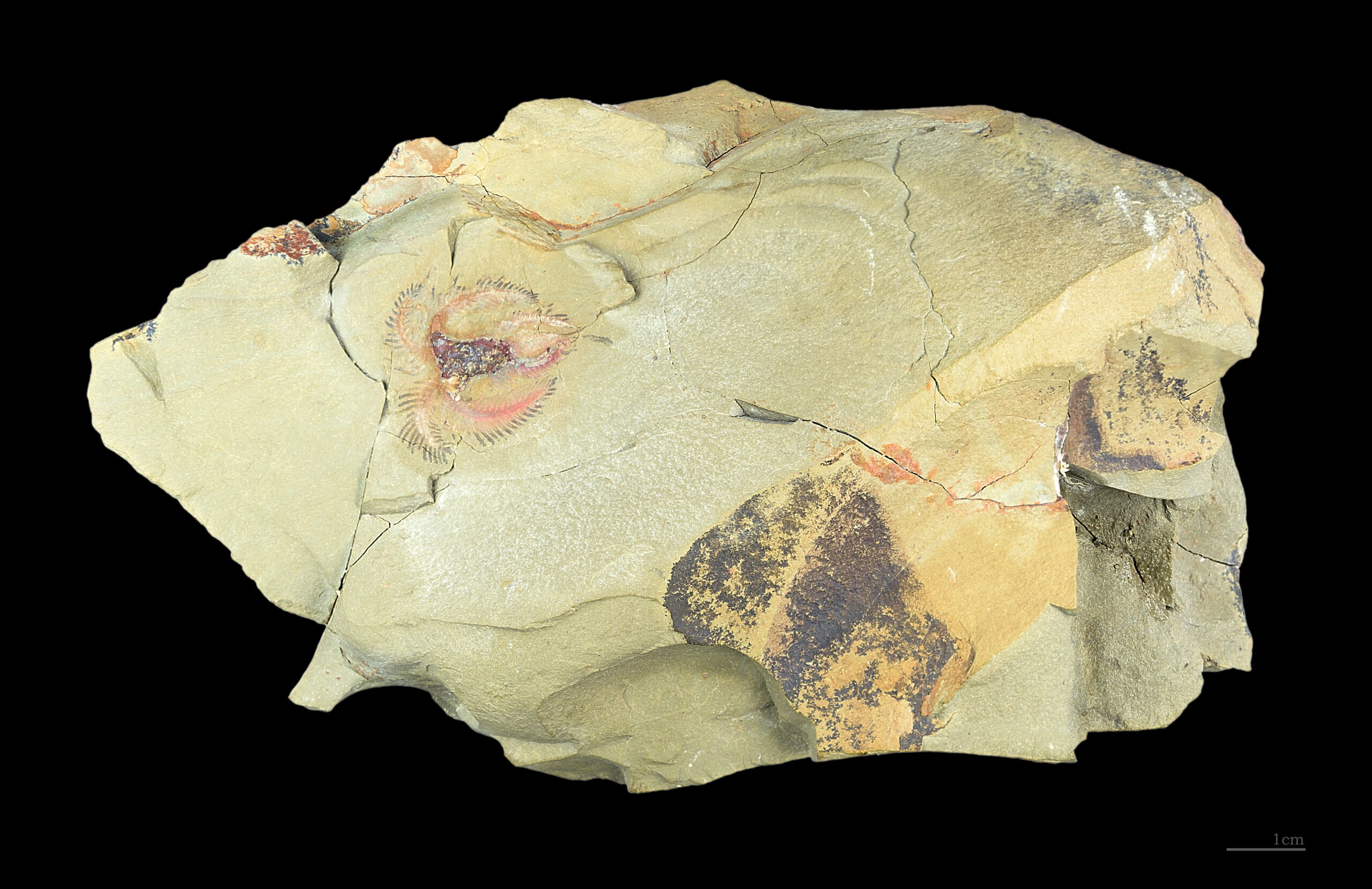

Morocco’s Fezouata fossils preserve more than shells and other hard parts. Some retain traces of limbs and internal organs, giving researchers a rare view of marine animals from the Early Ordovician, more than 470 million years ago. But even this unusually informative record does not preserve every kind of animal equally well.
A 2024 study makes that selectivity the subject, rather than treating it as background noise. Its question is not simply which animals lived in the ancient sea. It asks which parts of their bodies survived the journey from death to fossil, and how that affects the ecosystem scientists can reconstruct.
A marine archive in southeastern Morocco
The Fezouata rocks occur in Morocco’s Anti-Atlas region, including the area around Zagora. The biota is the collection of organisms recorded in them. Although the landscape is now exposed on land, the fossils document an ancient marine environment.
A 2015 scientific review traced the recognition of the exceptionally preserved fauna to discoveries by Moroccan collector Mohamed Ben Moula in the early 2000s. His collaboration with researchers helped reveal animals familiar from older Cambrian fossil assemblages alongside forms associated with later marine communities. The record complicated a simple story in which one set of animals abruptly replaced another.
That importance depends partly on what survives beyond mineralised skeletons. Soft structures can reveal how an animal fed, moved or fitted into an evolutionary family. Yet a fossil’s visible anatomy also reflects decay, burial, mineral formation and later weathering. Palaeontologists call the study of those processes taphonomy.
The best specimen is not an average animal
In Scientific Reports in September 2024, Farid Saleh and colleagues compared preservation across Fezouata animal genera, grouping them by geological interval, feeding strategy and adult mobility. They recorded five kinds of original tissue, ranging from mineralised structures to internal organs.
The unit matters. The database records the best-preserved specimen of a genus, or combines evidence from several specimens. If one specimen preserves an organ and another preserves a different structure, both can contribute to the entry for that genus. This is a way to compare the anatomical information available. It is not a count of how many individuals originally lived in the sea, or the proportion of all collected specimens that retain an organ.
Across the full dataset, predators and scavengers were better preserved than animals with other feeding strategies. But that does not establish that predators dominated the living ecosystem. The researchers found that body construction helps explain the pattern: a resistant outer covering can protect internal tissues, while exposed soft parts decay more readily.
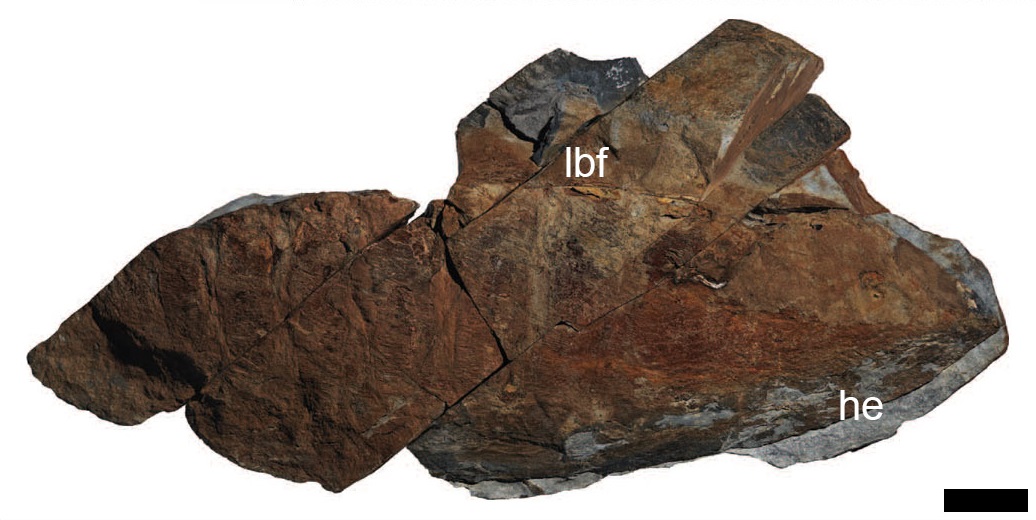

The distinction became clearer when the team restricted the comparison to panarthropods, the wider group containing arthropods and their close relatives. Within that group, the predator/scavenger difference was not statistically significant. Nor did the full analysis establish a significant preservation difference between animals that moved about as adults and those that remained attached in one place. A suggestive pattern in a collection is not automatically evidence for every proposed explanation.
A changing preservation window
The researchers also compared the Tremadocian and Floian, successive intervals within the Early Ordovician. Genera confined to the older Tremadocian interval were better preserved than those confined to the Floian. Genera occurring in both were excluded from this particular comparison, because their best-known preservation could not be securely assigned to both intervals separately.
One possible explanation is that the older beds have received more collecting and research. The authors also point to geological change: the environment became shallower, while the kinds of sediment associated with exceptional preservation became less common. Favourable conditions may have narrowed locally. That is not a claim that soft-part preservation stopped everywhere, or that the animals themselves disappeared when their record became poorer.
As with Morocco’s dinosaur footprints, the surviving evidence has to be interpreted through the conditions that produced it. A less complete trace can reflect a different route to preservation, rather than a different living body.
Another locality changes the comparison
A 2022 study of Taichoute, another locality within the Fezouata Shale, shows why researchers cannot treat the whole formation as one uniform sample. Some Taichoute deposits contain large, resistant arthropod fragments transported before preservation, unlike the more local burial described at previously studied sites.
The paper explicitly left open whether the prominence of these fragments reflected the original ecosystem or a preservation filter. Its methods also warned that collection inventories were incomplete and that recorded abundances could change with further identification and collecting. The result establishes a different fossil-bearing setting, not a settled league table of the ancient sea’s most numerous animals.
These limits do not diminish Fezouata’s scientific value. They explain how to use it. Anatomical detail, the number of recorded genera and the abundance of animals in life answer different questions. Morocco’s rocks offer evidence for all three, but not with the same completeness. As the management of geological heritage in M’Goun illustrates in a different setting, keeping that evidence available is a task distinct from interpreting it.
Sources, method and photograph credits
This explainer uses the full 2024 preservation study, the 2022 Taichoute paper and the 2015 review. They share some researchers and are not independent replications of one experiment. Sada Journal has not visited the sites, examined the specimens, interviewed the authors or rerun the statistical models. Findings retain their study dates; no new discovery, present collection total or current site-condition assessment is claimed.
Lead photograph: a Fezouata marrellomorph fossil from Zagora province, specimen MHNT.PAL.2007.39.80.1 in the Muséum de Toulouse collection, labelled Furca mauritanica in its Commons record. Photograph by Didier Descouens, dated 23 February 2013, CC BY-SA 3.0. Original uploaded unchanged; WordPress creates smaller display versions and may crop the image. Those versions remain under the same license. This is an archive specimen photograph, not a fieldwork or current-condition image.
