
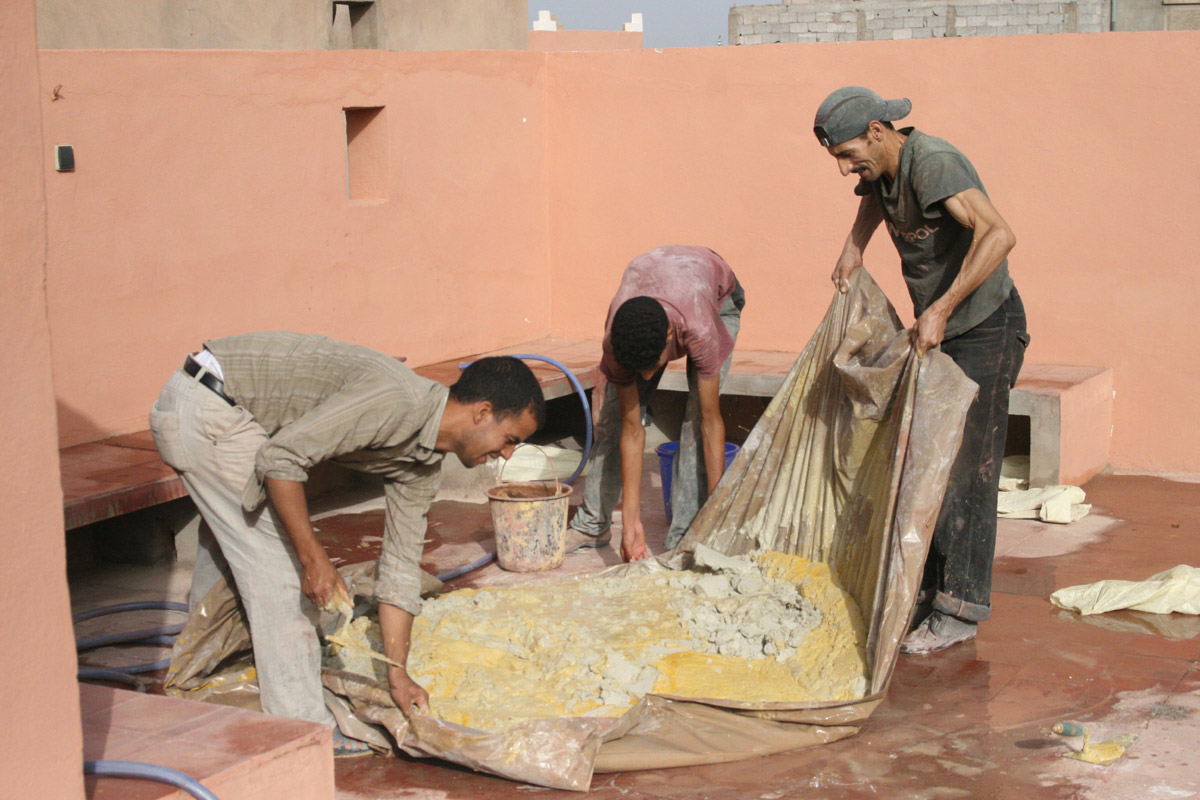

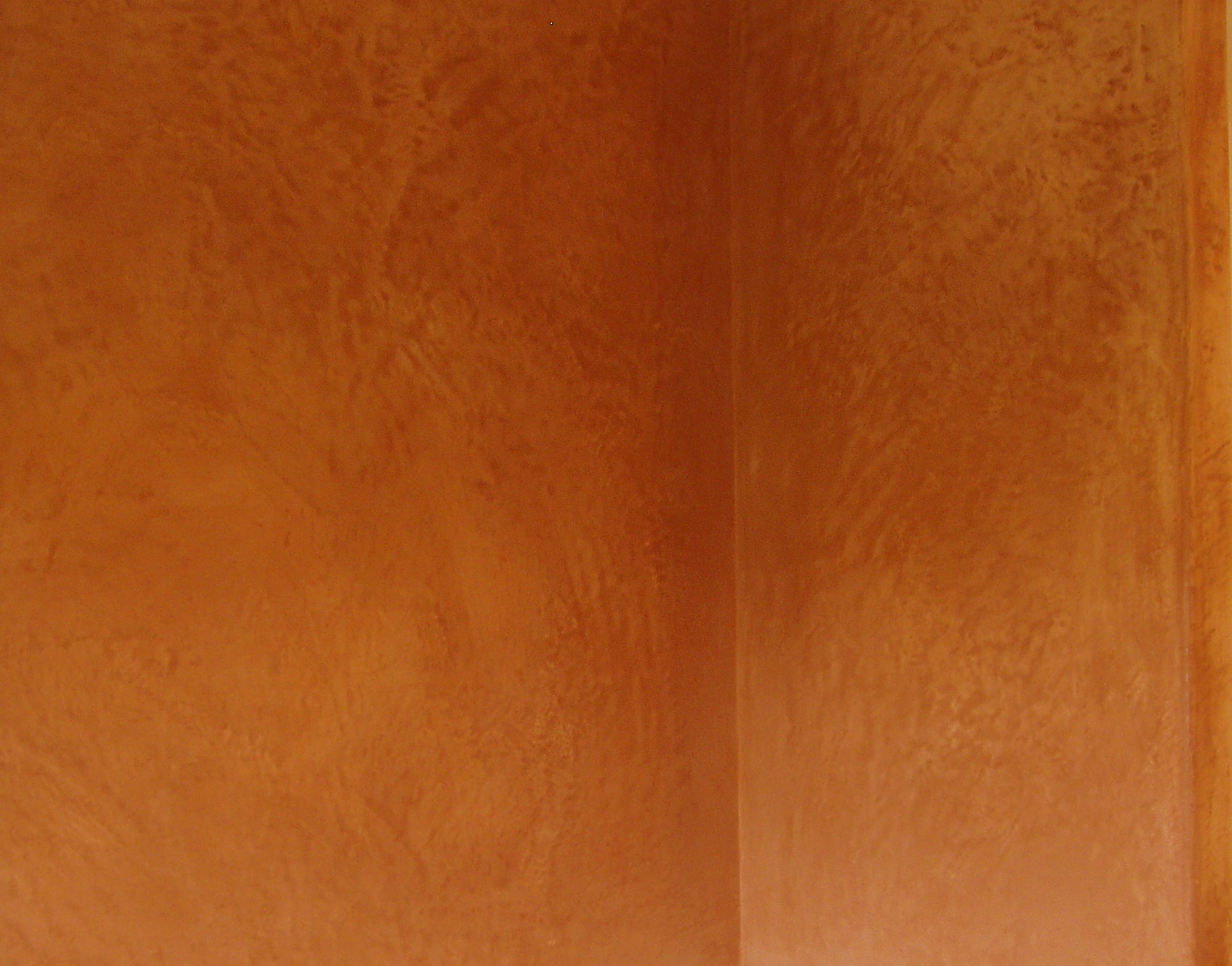
Tadelakt begins with a material that can look unpromising: lime, water and, sometimes, mineral pigment. The polished surface associated with Moroccan baths and courtyard interiors comes later, through compaction, stone polishing and treatment with soap. Its appearance is the result of work on the plaster, not a colour simply painted over a wall.
A materials study published in 2018 traced that finish back to stone quarried near Marrakech. It found a lime containing both binding material and mineral grains, with properties shaped by the rock and its firing. That gives a more useful account of tadelakt than calling it either an ancient waterproof coating or a contemporary bathroom trend. The material, the finishing technique and the wall beneath it all matter.
The stone is part of the finish
In their nine-page study, A. El Amrani and colleagues examined stone from Douar Oulad Messaoud, northeast of Marrakech, together with calcined stone, slaked lime and a plaster sample from the low wall around the Menara gardens’ basin in the city. The work appeared in the Journal of Materials and Environmental Sciences in 2018; it is not a survey of products or workshops operating today.
They used mineralogical and chemical analysis as well as microscopy. The raw stone contained carbonate minerals alongside quartz, feldspars and clay minerals. Heating and then slaking it with water produced a material with hydraulic characteristics: its setting involves reactions with water. The authors also found grains that could act as aggregate, the solid particles held together by the binder.
This matters because a bag described simply as lime does not tell the whole story. In the material studied, part of what a plasterer needs was already present in the processed rock. The researchers linked its characteristics to both the geological source and the uneven firing conditions of traditional kilns. They explicitly noted that composition varied between firing processes.
The paper makes a strong case for understanding Marrakech lime as a particular material. Its broader claim that only this lime can produce the finish should be read more cautiously. It is not a comprehensive comparison of every product sold under the tadelakt name. Two co-authors were affiliated with La Banca della Calce, a lime business, alongside university and conservation researchers. The mineral evidence is useful without turning the study into a purchasing endorsement.
What the soap changes
The finish described in the study involves applying black olive-oil soap and polishing with a smooth stone as the plaster sets. Soap is therefore part of the treatment, not simply something used to clean the finished wall. The authors investigated whether reaction products between soap and lime could be detected.
The result needs its full context. Infrared analysis did not detect the expected calcium salts in the old Menara sample. The researchers suggested that weathering might have washed them out. They then prepared a laboratory mixture using soap and high-calcium air-lime putty, left it to age for about a month and detected bands associated with calcium stearate, a calcium salt of a fatty acid.
That laboratory result supports a chemical explanation for soap treatment. It does not prove why the compound was absent from the historic sample, nor does it establish the service life of every finished wall. The laboratory lime was also not identical to the hydraulic Marrakech material examined elsewhere in the paper.

Water resistance is a specific claim
A surface that repels liquid water and a wall that allows moisture to dry are not the same thing. The UK’s Society for the Protection of Ancient Buildings explains breathability in terms of moisture transmission and drying. It cautions that vapour movement is only one mechanism: liquid water, capillary movement and the behaviour of the whole assembly also need attention.
That is general conservation guidance, not a test of Moroccan tadelakt. It nevertheless helps explain why the word waterproof cannot settle whether a particular plaster is right for a particular wall. The backing, exposure and drying conditions remain relevant.
A modern commercial example shows how narrow a performance claim can be. In its Tadelakt data sheet, the British manufacturer Clayworks describes its own soap-treated product as water-repellent but not completely impermeable. It does not recommend that product for constantly wet washbasins or bathtubs and specifies care and drying requirements. Those are instructions for that formulation, not universal rules for all Moroccan work.
The distinction cuts both ways. A traditional history of use does not certify every modern installation. A restriction on one manufacturer’s blend does not disprove the performance of an older technique. Neither source provides a basis for promising a maintenance-free coating.
Reading the craft in a Moroccan building
Tadelakt and zellige tilework can both contribute to a building’s surfaces, but they are different kinds of work. Zellige constructs a pattern from separate fired ceramic pieces. Tadelakt develops a continuous plaster finish through its material and treatment. Looking for the joins in one and the worked surface in the other makes the distinction visible.
The wider conservation question is familiar from Ait-Ben-Haddou’s earthen heritage: keeping a building usable depends on continued knowledge and care. That does not mean every earthen wall there is finished in tadelakt. It means the survival of a surface cannot be separated from how the building is made and maintained.
The most revealing questions are practical. What is the plaster made from? How was it compacted and finished? What supports it, and how can the wall dry? A glossy photograph cannot answer all of them. The attraction of tadelakt becomes more intelligible when the smooth surface is read as the outcome of geology, chemistry and skilled work.
Sources, method and photograph credits
This explainer uses the full 2018 El Amrani and colleagues paper, conservation guidance from SPAB and a manufacturer-specific data sheet. It does not report new laboratory tests, workshop visits or interviews. No present-day kiln count, national market size, environmental comparison or installation guarantee is claimed. The study’s internally inconsistent particle-size percentages and binder-to-aggregate arithmetic are not reproduced as verified measurements.
Lead photograph: mixing Marrakech lime, water and yellow pigment at Riad Dar Rita, Ouarzazate, Morocco. Photo: Joaoleitao at English Wikipedia, via Wikimedia Commons, CC BY-SA 3.0. Originally uploaded 29 July 2010; capture date unspecified. Archive photograph, not a current workshop visit. Downloaded photograph uploaded unchanged; resized or cropped displays remain under that licence.
