
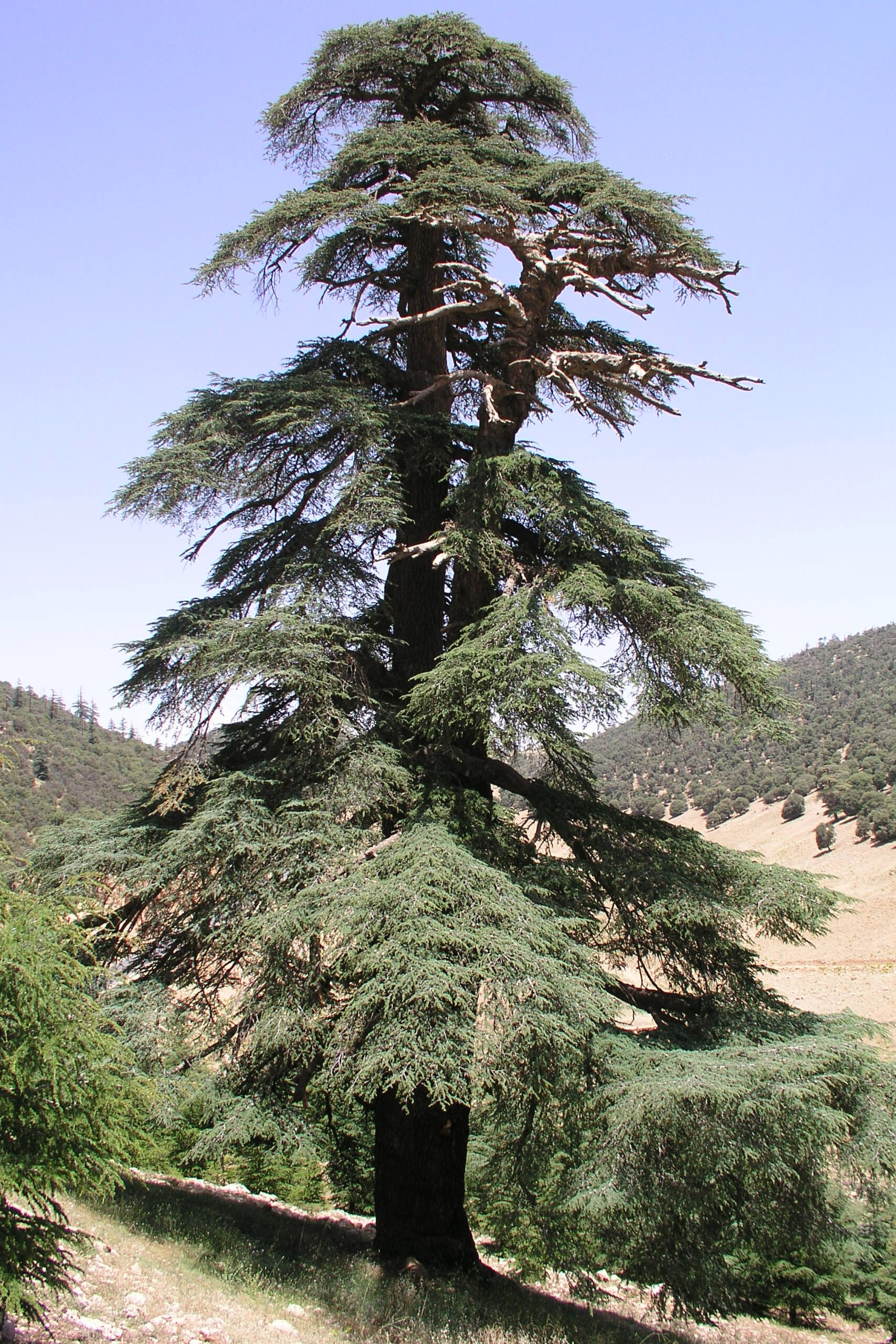

Morocco’s Atlas cedars carry a record of drought inside their trunks. Research near Ifrane and Azrou found declining wood growth and stronger drought sensitivity from the early 1980s. But the tree rings do not give a national death toll, and the forest’s history of cutting and grazing cannot be read as a single competing explanation that makes climate stress disappear.
The useful question is how these pressures interact, and what kind of evidence can separate them. A 2011 study in the journal Forests makes that question unusually visible because its methods describe both what the researchers sampled and what they left out.
A mountain tree, studied in four plots
Atlas cedar, Cedrus atlantica, is native to the mountains of Morocco and Algeria. In Morocco its natural range includes the Rif, Middle Atlas and High Atlas. The Middle Atlas is the mountain region south of Fez and Meknes that includes Ifrane and Azrou, not the coastal Maamora forest known for its cork oaks.
Juan C. Linares, Lahcen Taïqui and Jesús Julio Camarero carried out their fieldwork in 2009 and 2010 in Ifrane National Park. They selected four plots with contrasting forest structures, each about 0.13 hectares. Two were in old stands apparently exposed to heavier logging and grazing; two had a more closed cedar canopy and apparently less disturbance.
For the tree-ring analysis, they cored 32 living dominant or co-dominant cedars: trees occupying the upper canopy rather than a random sample of every age and condition. They included healthy and declining individuals, but avoided stands with very high cedar mortality because obtaining and matching usable cores from dead trees was difficult. That choice matters. This was a comparison of growth and decline among selected surviving trees, not a census of all trees lost.
Why ring width needs a correction
A ring records the wood added around a trunk in a year. Its width alone is an imperfect comparison across trees: adding a narrow outer ring around a large trunk can represent more new cross-sectional area than the same width around a small one.
The researchers therefore converted widths into basal-area increment, the annual addition to the trunk’s cross-sectional area. In geometric terms, that is the area of the outer circle minus the area inside the previous ring. This adjusts for an expanding stem; it does not turn a core into a measurement of the whole tree’s biomass or the forest’s carbon balance.
The growth series showed a long-term decline from the early 1980s, interrupted by better and worse years. Older trees and trees with lower previous growth were more prone to recent low growth and crown defoliation, the loss of needles. The authors linked the pattern chiefly to increasing climatic stress, with age and earlier growth acting as predisposing factors.
Climate evidence has its own boundaries
The study used Ifrane weather-station observations for 1958–2003, from a station 14 kilometres from the plots. The authors reported a warming and drying trend over that historical period. Those observations are not a measurement of conditions across all Moroccan cedar forests, and they do not extend to 2026.
A second comparison related growth to the Palmer Drought Severity Index, a measure of moisture conditions. Here the index had itself been reconstructed using Atlas cedar rings. The researchers explicitly acknowledged that a strong relationship was therefore expected. Their growth samples and processing differed from the earlier reconstruction, but the two records were not wholly independent evidence.
Nor did every plot behave identically: the open, old stand departed from the general pattern of increasing drought sensitivity after 1990. The result is more informative than a simple claim that every cedar responds alike. Local history and tree condition shape the response to a regional climatic pressure.
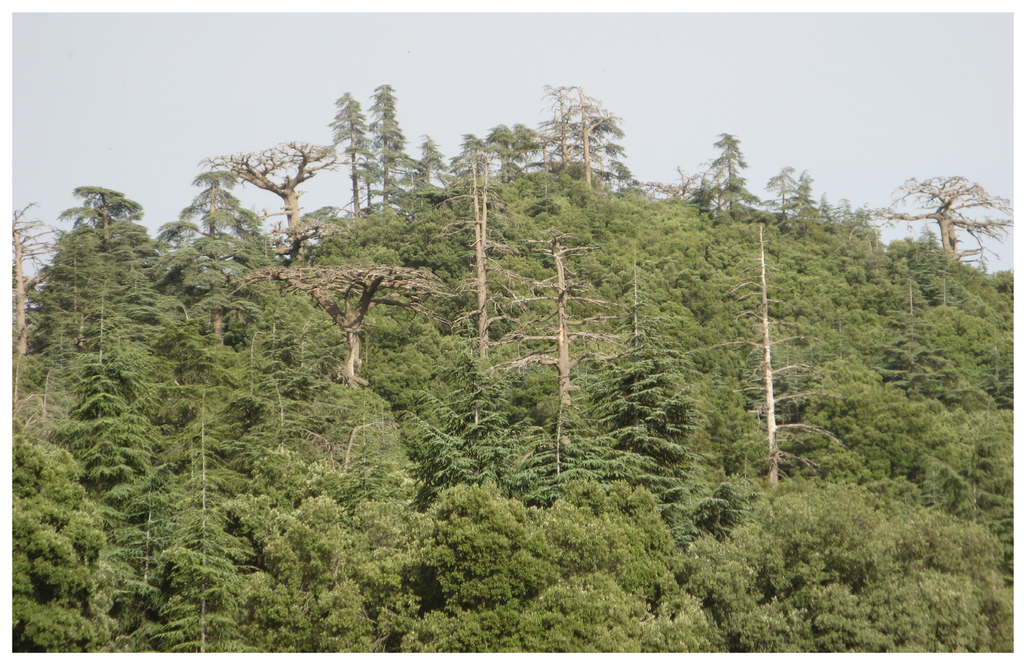
Local pressure is not a licence for a simple blame story
The researchers expected heavily disturbed stands to show stronger climate-related decline. Yet forest structure alone did not explain the differences. Once tree characteristics were accounted for, some apparent relationships weakened: surrounding holm oak had only a marginally significant association with recent cedar growth, while the measured competition index and cedar-stump neighbourhood were not significant.
That does not establish that cutting and grazing are harmless. The authors describe how canopy loss, degraded soil and a changing mixture of species can alter the setting in which cedars survive and regenerate. It means this particular analysis cannot assign a precise share of decline to each pressure, or justify blaming all local users for the condition of a whole forest.
It also offers no basis for blaming macaques generally. Although bark stripping appears in the wider literature discussed by the paper, the researchers detected no significant bark stripping in their own stands. Studies of tourist feeding and Barbary macaques address a different set of behaviours and risks, not a ready explanation for these cedar growth records.
Genes add a question, not a guaranteed remedy
A study published in September 2025 examined genetic variation in natural Moroccan cedar populations and three Spanish plantations. Its Moroccan samples came from the Rif, Middle Atlas and High Atlas. After filtering, the Moroccan analysis retained 124 individuals.
The sampled Moroccan populations were genetically distinct. The study also modelled the genetic changes associated with keeping pace with different future climates. The High Atlas population showed the greatest modelled risk under the high-emissions scenario. That is a scenario-based assessment, not an observed future death rate. Genetic similarity also suggested an origin for one Spanish plantation; it was not a documented shipment history.
The authors discuss assisted movement of trees as a possible conservation tool, while noting that plantations can have lower genetic diversity and remain vulnerable to drying. The study is not a field trial proving that planting cedars elsewhere will replace a functioning Moroccan forest. As Maamora’s cork-oak regeneration problem illustrates in a different ecosystem, establishing young trees and sustaining a forest are separate tasks.
Together, the studies argue for attention to growth, survival, regeneration and genetic variation, rather than a single reassuring planting count or alarming mortality headline. The cedar’s annual rings are valuable precisely because they offer a dated record with identifiable limits.
Sources, method and photograph credits
This historical science explainer uses the full 2011 tree-ring paper and the full 2025 genetics paper. They share a researcher and are different studies, not independent replications of one experiment. Sada Journal has not visited these plots, sampled trees, interviewed the authors or rerun their statistical or genetic models. No current national inventory, forest-health inspection or assessment of a named restoration programme is claimed.
Lead photograph: an Atlas cedar near Azrou, photographed on 6 July 2009 by Nikos D. Karabelas, Preveza, Greece, via its Wikimedia Commons record. Used under CC BY-SA 4.0. Original uploaded unchanged; WordPress creates smaller display versions and may crop the image, which remain under the same licence. An archive tree photograph, not evidence of the tree’s present condition or membership of a study sample.
