
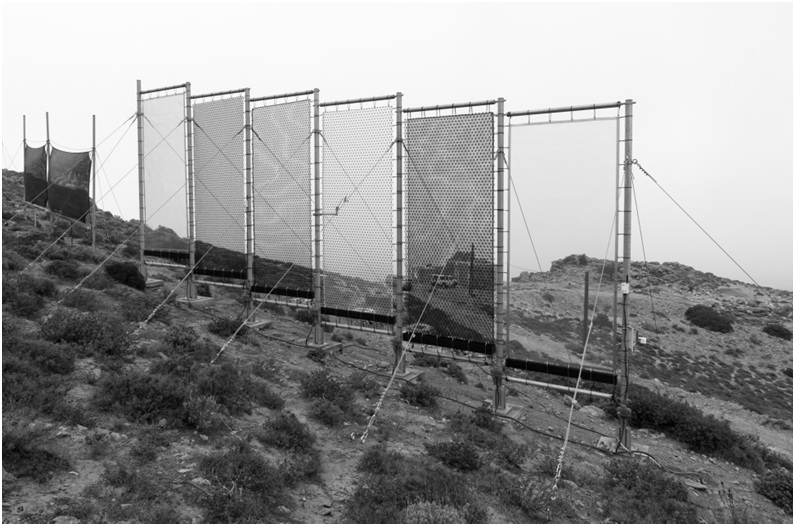

On Mount Boutmezguida in southwest Morocco, a water supply begins with wind pushing droplets through a net. Mesh intercepts the fog, droplets join and drain into gutters, and pipes carry the collected water towards storage and households. The equipment needs a particular landscape and a working service behind it: a productive net alone does not establish how much usable water reaches a home.
Research on the Aït Baamrane project, in the Anti-Atlas mountains of Sidi Ifni province, makes that chain unusually clear. A field experiment tested the durability and yield of different meshes. Other studies examined community participation and the reliability of the supply. Together, they explain both why fog collection can work here and why a striking collection figure needs context.
A mountain that catches moving droplets
The site sits near the summit of a 1,225-metre mountain inland from the Atlantic. The field study by Christian Schunk and colleagues, published in the January 2018 issue of Aerosol and Air Quality Research, describes frequent fog associated with the cold Canary Current and rising terrain. The mesh catches liquid droplets already suspended in the air. This is different from manufacturing water or extracting invisible water vapour with a powered machine.
The experiment covered two test phases between November 2013 and June 2015, rather than present-day operating conditions. Researchers compared 11 collection meshes and two supporting grids. The frame, its anchors and flexible attachments were designed to survive the strong winds that had damaged earlier collectors nearby.
Across the reported 19-month study, the pilot suffered only minor damage, without major failures of its structure or meshes. That is evidence for the tested design during that period, not a guarantee of an installation’s lifetime. Measurement equipment also needed attention: sand could block the tipping-bucket counters used to record water, and readings from malfunctioning instruments were discarded.
What a yield figure actually measures
The trial contains a useful warning about seemingly simple measurements. Its rain gauge also captured fog during intense events. The researchers therefore could not reliably separate rainfall from fog at the site. Nearby weather stations were too distant and too far below the mountain to solve that problem. The main yield analysis reports fog plus rain, not a pure fog-water total.
The unit of time matters too. A yield per fog event is different from a yield per calendar day. Fog often arrived at night, and an event could cross midnight or last longer than a day. Dividing the record into midnight-to-midnight periods could split one event across several days. A high event yield should not be read as a promise that the same amount arrives every day of the year.
Mesh performance also changed between events. Some materials generally collected more water than traditional woven fabrics in this particular reinforced setup, but the paper does not establish a universally best net for every climate. Its authors discuss how supporting grids and drainage could influence the comparison. Equipment, exposure and weather belong in the same explanation.
The first water is a separate question
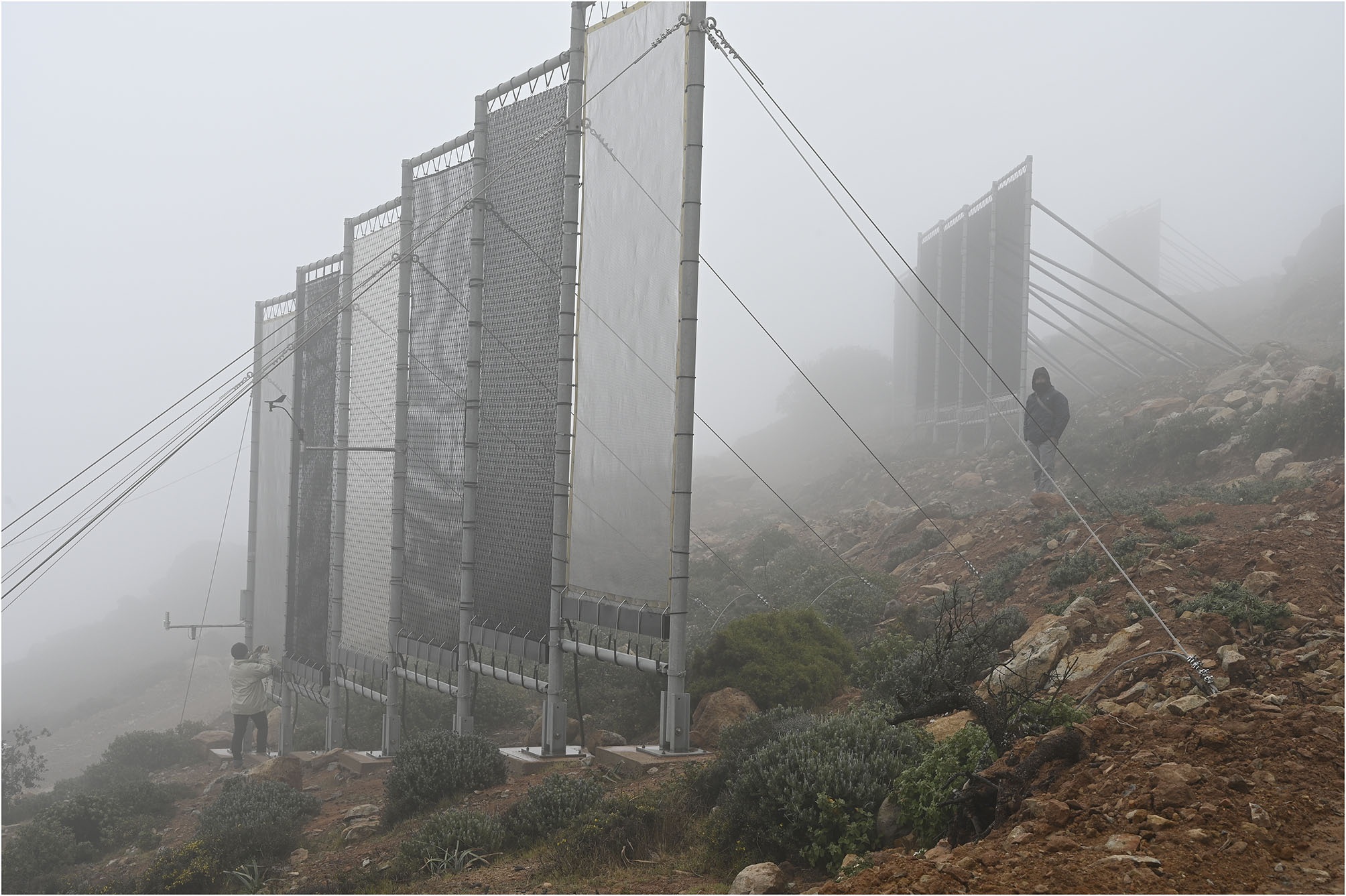
Collection and water safety need separate checks. Schunk and colleagues sampled the initial runoff, known as the first flush, during one fog event and established-flow water during another. Their chemical analysis found much higher concentrations of several substances in the initial runoff. The paper discusses deposits accumulating on the meshes between events as one possible explanation.
Those limited samples did not amount to a general drinking-water certification. The authors called for repeated checks, including organic and microbiological contamination and sampling in storage and distribution. Their conclusion concerned inorganic water quality at the collector. It cannot establish the safety of every later litre at a household tap.
A 2015 project account by Leslie Dodson and Jamila Bargach, both affiliated with the local organisation Dar Si Hmad, described filtration, reservoirs and a downhill pipe network. The account helps explain the service beyond the nets; its authors’ involvement in the project should remain visible. Gravity can assist delivery, while treatment and maintenance still require equipment and work.
Keeping the service working between fog events
A 2024 assessment’s published abstract reports improved drinking-water access, while warning that inconsistent fog yields could affect availability if fog were the only source. It also identifies sanitation and waste-management challenges. The full paper was not available for inspection here, so its reported yield range is not used as a current performance benchmark.
Independent reporting published by The Asahi Shimbun in March 2024, from L’Économiste du Maroc, described women alerting technicians when problems arose and an operator-funded maintenance team. That report’s future expansion plans and supplier claims about equipment life are not treated here as completed works or proven durability. Dar Si Hmad’s homepage continues to describe atmospheric-water work. The materials inspected for this article do not establish an independently audited daily supply record.
The value of stored water has a longer history in Morocco, from El Jadida’s fortress cistern to the changing wetlands of the Gharb plain. These are different landscapes, not interchangeable engineering models. At Boutmezguida, the distinctive resource is passing fog. Making it useful depends on catching it, checking it, storing it and maintaining the route to the people who use it.
Sources and method: This is a source-based explanation, not a site visit, water-quality test or audit of today’s household supply. The 2013-2015 field experiment, project accounts, a 2021 review and dated reporting were inspected; the 2024 assessment was available as an abstract only.No present-day output, beneficiary count, tariff, health effect or completed expansion is asserted.
Lead photograph: The six-segment pilot collector at Boutmezguida, from Schunk and colleagues’ Figure 1, reporting the 2013-2015 experiment. The paper does not identify an individual photographer or exact shutter date. © Taiwan Association for Aerosol Research; the journal’s article page licenses content under CC BY-SA 4.0, except where noted. Figure extracted and converted to JPEG; no generative changes. This photograph is distributed under the same license.