

Economy | 31 October 2026
Morocco can sell more cars and aircraft components abroad while its goods trade deficit grows. The two developments are not contradictory. Export growth describes one side of the ledger; the trade balance also depends on what the country buys, and on the prices paid for those purchases.
The Office des Changes’ January-August 2026 bulletin shows that contrast clearly. Goods exports rose 8.7% from the same period of 2025 to MAD 334.892 billion. Imports rose faster, by 15.8%, to MAD 617.508 billion. The reported deficit widened 25.4% to MAD 282.615 billion.
These are provisional eight-month figures, not a verdict on the full year. They are also values in dirhams, not a count of products shipped or a direct measure of factory productivity.
Industrial exports are growing, but unevenly
Automotive exports reached MAD 116.148 billion, up 14.5%. Both vehicle construction and wiring contributed to the increase. Aeronautics exports rose 21.5% to MAD 22.969 billion, with growth in assembly and electrical wiring interconnection systems.
That is evidence of stronger export sales in those sectors. It does not mean every export industry is moving in the same direction. Phosphates and derivatives fell 6% to MAD 61.070 billion; textile and leather exports fell 5.6% to MAD 28.729 billion. Electronics and electrical goods also declined. La Vie Eco’s report on the bulletin sets out the same sector split.
A national export headline therefore needs two checks: which industries produced the gain, and whether their growth outweighed declines elsewhere. A strong automotive result cannot, on its own, describe the entire manufacturing economy.

The import bill has several different drivers
Energy and lubricants imports rose 32.6% to MAD 96.367 billion. Purchases of finished equipment goods rose 19.3% to MAD 148.713 billion, while raw products rose 63.3% to MAD 45.880 billion. Those categories should not be treated as interchangeable.
Equipment can support production and investment. Energy is needed across transport and industry. Raw materials can be inputs for goods later sold abroad. The bulletin records particularly large increases in aircraft parts, commercial vehicles and crude or unrefined sulfur, among other products. It does not establish that every additional import creates productive capacity, or that every dirham of import growth is evidence of weak domestic industry.
Hespress’s analysis identifies energy and sulfur as major contributors to the increase. Sulfur imports reached MAD 27.232 billion, compared with MAD 9.383 billion a year earlier. That matters for an economy whose phosphate-fertilizer industry uses imported inputs. A rise in an input bill and a fall in export receipts can put pressure on the same industrial chain.
Export revenue is not the same as Moroccan value added
A product crossing the border has a gross sale value. That is different from the value created within Morocco after imported components and other inputs are taken into account.
The OECD’s 2024 economic survey described Morocco’s integration into global value chains as a strength, while arguing for more activity in higher-value tasks and stronger links between multinational operations and domestic firms. This is structural background from 2024, not a new estimate of the domestic content of 2026 exports.
For readers assessing industrial progress, the useful questions go beyond shipments: are local suppliers winning more work, are skills and productivity improving, and how much income remains in the domestic economy? The monthly trade bulletin cannot answer all of them.
What to watch in the next release
Start with the composition of imports, not just their total. Separate equipment purchases from energy costs and other inputs. Then compare sectors over the same reporting period. Do not compare eight months of exports with a full year’s imports or read a change in dirham value as an identical change in physical output.
The goods deficit is also not the whole external account. Services, transfers and investment transactions belong to different parts of that picture, as our guide to remittances, travel receipts and FDI explains.
The balanced reading is straightforward: Morocco’s industrial exporters can make gains while a larger import bill widens the goods gap. Neither fact cancels the other. The harder test is whether export growth builds more domestic value over time.
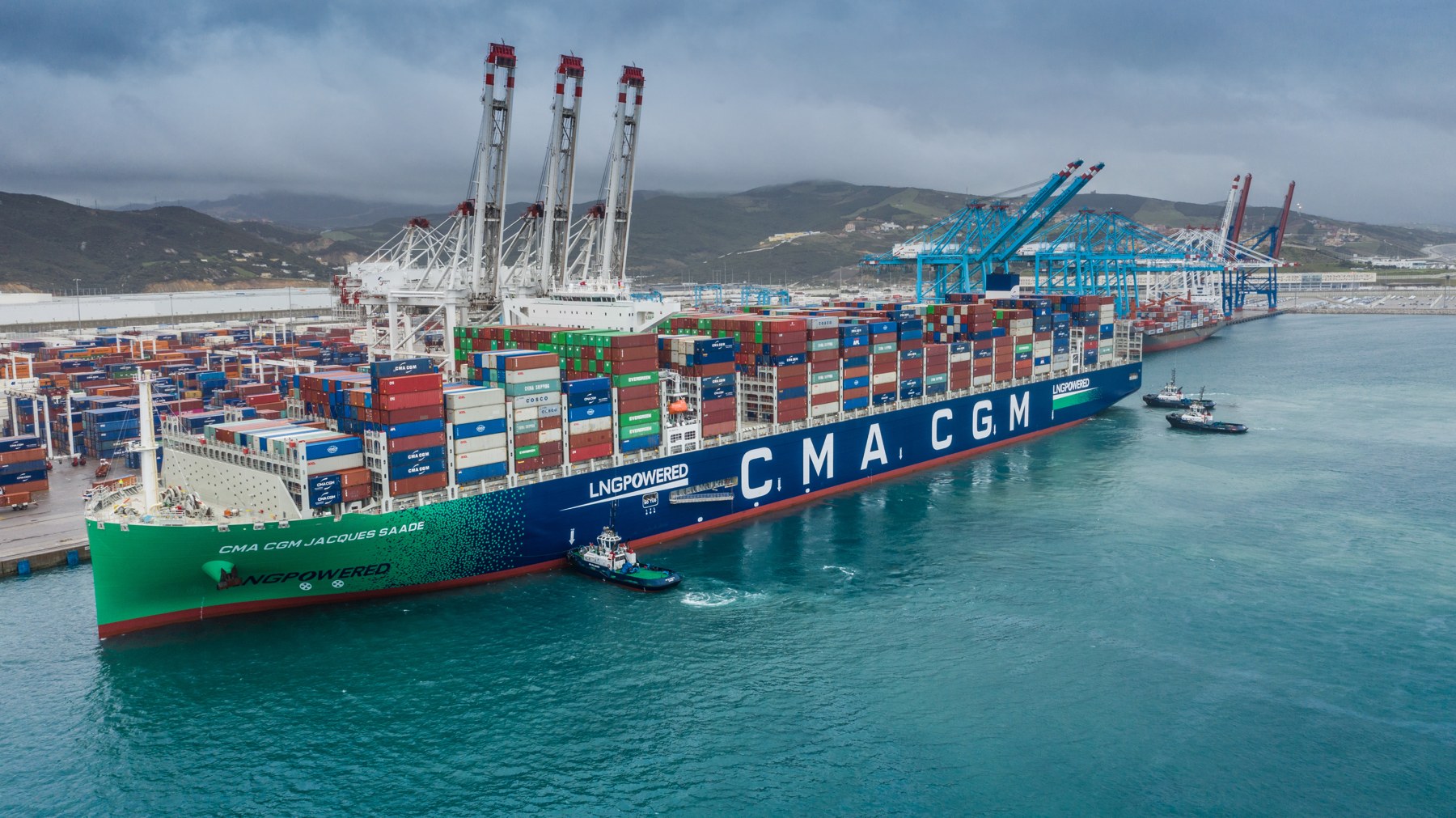
Featured photograph: CMA CGM Jacques Saadé at Tanger Med, 8 February 2021. Archive context image, not evidence of 2026 cargo volumes. Photo: Nadinasol, Wikimedia Commons, CC BY-SA 4.0. Resized; display crops under the same license.
