

Morocco’s national railway operator ONCF and Danish shipping and logistics group Maersk have signed a memorandum to explore closer links between the country’s ports and inland industrial centres. The announcement sets out a direction for cooperation, not a new freight-service timetable.
In its 24 November announcement, Maersk says the partners will examine rail transport and integrated logistics, with the aim of moving more containerised cargo by train. The Office National des Chemins de Fer, or ONCF, operates Morocco’s national railway network.
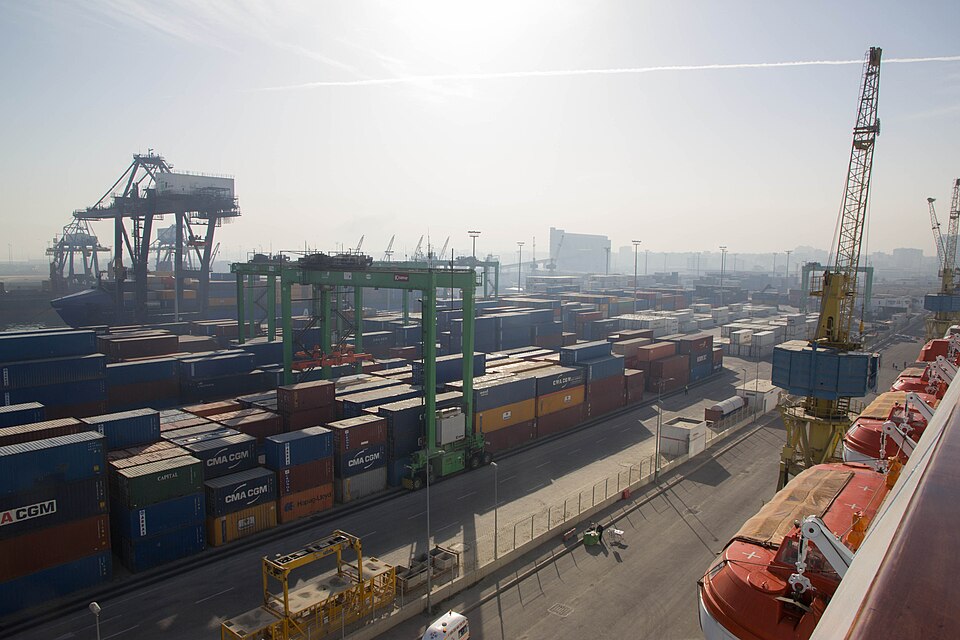
Archive photograph above: containers and railway tracks at Casablanca’s docks, photographed on 17 March 2014. It shows port infrastructure, not the signing or a service created by this agreement. Full credit below.
What the agreement covers
The partners intend to examine how ONCF’s railway network and experience combining transport modes can work with Maersk’s shipping and logistics network. The stated focus is connectivity between Morocco’s main ports and its industrial and economic regions.
Integrated logistics means linking stages of a cargo journey, rather than treating the sea crossing and the inland movement as separate services. Rail can be one stage alongside shipping, storage, customs handling and final delivery by road.
The companies also identify lower-emission inland transport as an objective. That is an ambition in the announcement, not a measured reduction in emissions. The release gives no emissions baseline or quantified savings for the proposed cooperation.
Not the first Tangier-Casablanca rail link
The memorandum should not be confused with the launch of Morocco’s first port-to-inland rail service. In an announcement dated 14 August, Maersk already described its Tangier-Casablanca rail service as fully operational, alongside customs-clearance options, storage and final-mile trucking.
That earlier company account establishes that a service was being offered before this memorandum. It does not independently establish its current frequency, reliability or capacity. The November announcement does not publish a replacement schedule or identify a new route opening.
For the wider context, Sada Journal’s explanation of Tanger Med’s container figures distinguishes cargo transferred between ships from traffic moving into Morocco’s economy. Our examination of ONCF’s train procurement programme concerns a separate passenger-fleet investment, not this freight memorandum.
What remains open
Maersk’s release gives no investment amount, implementation deadline, named additional corridor or committed cargo volume. It also does not publish the signed memorandum itself. Those omissions limit what can be concluded about delivery, costs or the scale of any expansion.
Sources and limits: this report is based on Maersk’s November announcement, compared with Port Technology International’s account, and the company’s August service announcement. The trade publication reports the same announcement, rather than providing independent evidence of implementation. No new service or environmental outcome has been independently observed.
Photograph: Morocco Casablanca containers 1403, Industrial Wales, 17 March 2014, via Wikimedia Commons, CC BY-SA 2.0. Supplied 960-pixel photograph reproduced unchanged. Website display may resize or crop it; display adaptations remain under the same licence. No endorsement by the photographer or operators is implied.
