

Opinion / Geopolitical Analysis. This is analysis, not straight news. Documented facts, interpretation and forecasts are labelled. Sources are listed at the end.
The documented result is that no mandate was adopted. Both drafts would have kept a mission in some form, so in our reading the end of MINURSO is the product of incompatible texts, not proof that either capital wanted it closed. What follows from it, for Rabat’s room to move the Western Sahara file and for the UN’s monitoring presence along the ceasefire line, is interpretation.
On October 30 the UN Security Council voted on a US draft (S/2026/868) that described Morocco’s autonomy proposal as the “only basis for negotiation” and genuine autonomy under Moroccan sovereignty as “the most feasible solution” (Security Council Report describes the text in the same terms). It failed. Algeria had called the text excessively biased towards Morocco. The same day Morocco’s Royal Cabinet welcomed the outcome, and on Monday both houses of Parliament met to hail a new phase. A welcome of the mission’s non-renewal is not the same as support for Russia’s veto. We have not seen an official Moroccan statement that endorses the veto, and we do not say Rabat did.
Governments rarely celebrate the defeat of a draft that leaned their way. The explanation lies in what the vote ended, which is the mission, and what it left untouched, which is a good part of the UN’s role.
What happened
Documented.
- October 25-28. Algeria’s Parliament approved sending troops to Niger on October 25. On October 27, Algerian Foreign Minister Ahmed Attaf met Russia’s Sergey Lavrov in Moscow and discussed the trans-Saharan gas pipeline and the Sahara, according to Algerian outlet TSA. On October 28, Morocco’s Nasser Bourita met Lavrov one-on-one at the Russia-Africa summit; Rabat gave no details.
- October 30. The US draft (S/2026/868) received 11 votes in favour, one against and three abstentions (China, Pakistan and Somalia, per Security Council Report). The one against was Russia’s veto. The draft that was voted (the second revised text) would have extended the mission to October 31, 2027, renamed it the UN Mission in Western Sahara (MINUSO) from November 1, 2026, asked the Secretary-General for proposals by January 30, 2027 on its structure and staffing, “including a reduction of authorized uniformed personnel and the closure and/or consolidation of team sites” (operative paragraph 2), with the Council signalling it would then decide on the mission’s future, including transforming its mandate, and asked UNHCR to register the refugee population in the Tindouf area within six months. The text makes two separate statements about the autonomy proposal. Operative paragraph 7 calls on the parties to engage “using Morocco’s Autonomy Proposal as the only basis for negotiation”, and paragraph 5 says the proposal “would be the only basis for continuing these discussions”. Paragraph 8 considers that genuine autonomy under Moroccan sovereignty “is the most feasible solution”, alongside a reference to the principle of self-determination. One phrase is about the basis for talks, the other about the solution. We read these in the UN’s PDF of S/2026/868; quotation marks in this article are used only for the draft’s own words. An earlier draft went further. According to Security Council Report, the initial US draft of October 22 proposed ending the peacekeeping mandate on April 30, 2027 and converting the mission into a special political mission, with a phased drawdown of uniformed personnel and closure of team sites, and called autonomy under Moroccan sovereignty the “only feasible solution”. The April 2027 end date and the special political mission were removed in the first revised draft and are not in the text voted. The voted text still asked for proposals that include a reduction of uniformed personnel and the consolidation of team sites, but did not decide it. An earlier version of this article relied on Al Jazeera’s description of the draft (“sole basis”, “refugee census”); we now use the draft’s own terms as reported by Security Council Report.
- The rival draft. Russia’s text (S/2026/870) proposed, as Security Council Report describes it, a one-page straightforward renewal until October 31, 2027 (the vote count comes from the UN press record; the draft’s own wording is at the S/2026/870 link). By the UN’s own record, it received three votes in favour (China, Somalia, Russia), one negative vote from a permanent member (the United States) and 11 abstentions. Al Jazeera, relaying AP, reports two votes in favour; we use the UN record. Either way it fell short of the nine needed.
- The same day. A first Algerian army convoy reached Niger, which Reuters described as Algeria’s first foreign troop deployment since 1973.
- October 31 – November 3. The mandate expired. On November 1 the UN began liquidating the mission; the Secretary-General said its departure does not abrogate the Sahrawi people’s right to self-determination and expressed concern about the security situation. On November 1 Bourita said Morocco would seek to take the file out of the General Assembly’s Fourth Committee, arguing this is easier than winning a Council resolution. On November 3 the Assembly’s president called a plenary for November 10 under the agenda item “Use of the veto”.
What lies beneath
Interpretation. Separate behaviour, stated position and inference. Behaviour (documented): the United States voted against Russia’s rollover; Russia vetoed the American text. Both texts would have extended the mission. Russia’s ran to October 31, 2027, and its delegate called it “the last opportunity to extend the life of MINURSO”. Stated positions (documented): the American delegate said renewing mandates “that haven’t worked or cannot work” was not something Washington could support; Russia said the American text “could have reversed the entire resolution process” and that it wanted MINURSO to continue. China abstained, citing insufficient consultations. See the UN meeting record and Russia’s explanation of vote.
Inference. Three readings fit. (1) Unintended consequence: each side blocked the other’s text and the mission lapsed with the deadline. Both drafts extending it, and Russia’s “last opportunity” wording, point this way. (2) Accepted cost: one side judged losing the mission tolerable. The American statement fits this for Washington; Russia’s statements argue the opposite. (3) Preferred outcome: one side wanted it gone. We have no evidence for this and do not adopt it. The record cannot separate (1) from (2): votes show what each side was willing to block, not what it intended.
Why did Moscow veto? Three explanations compete, and they are not mutually exclusive.
- Principle. Russia says the Council cannot predetermine questions of sovereignty. This matches its public explanation. It has a limit: in October 2025 Russia merely abstained when the Council backed negotiations based on autonomy. So the objection is to how far the 2026 text went (autonomy as the sole basis, a renamed mission), not to autonomy itself. That narrows the principle explanation without ruling it out.
- Protecting a relationship. Algeria is negotiating a pipeline contract that could involve Russian firms, and Attaf met Lavrov three days before the vote. This is circumstantial. A meeting and a pending negotiation are not evidence of a deal. We have found no public evidence that the two issues were traded, and sequence is not causation.
- Cheap positioning. The veto may have cost Moscow little with Rabat, since we found no Moroccan official criticism of Russia, though no Moroccan source we saw endorses the veto either, while it denied Washington a win and kept Algiers close. This is a hypothesis. It fits the reactions but cannot be tested from public documents.
The American position was explicit about what it would not support: an unchanged renewal. Washington said the status quo was unacceptable and that any drawdown should be orderly. Whether that meant it accepted losing the mission, or expected Russia to yield, is not established by the record.
Moscow’s two relationships
Documented. On October 23, at Morocco’s initiative, Lavrov and Bourita discussed “key regional issues … including at the United Nations”, per the Russian foreign ministry. They met again on October 28; Attaf met Lavrov on October 27. After the vote Russia said it was in close contact with its Algerian and Moroccan partners, as relayed by Morocco World News (original not seen). A secondary report citing SIPRI puts Russia’s share of Algerian arms imports at 39% in 2021-25, down from earlier periods.
Interpretation. Moscow’s possible gains from both ties need no hidden deal: arms and energy business with Algiers; a working channel to Rabat; a consistent UN line (its statement defends the self-determination framing and says the US lost its neutrality as penholder by recognising Moroccan sovereignty); and the ability to block a Western-led text without ending dialogue with Rabat. There are costs: one Moroccan opinion piece already calls for reviewing the fisheries agreement. We found no evidence that Russia coordinated its vote with Algiers or promised Rabat anything.
The bigger picture: Algeria in Niger
Official explanation. Algeria’s presidency said Niger had requested military assistance to protect shared energy and economic interests; a senator named “oil facilities in Niger” (AP). Parliament approved on October 25; the president announced it on October 26 (Al Jazeera).
Reported, not independently confirmed. A first convoy reached Niger on October 30 (Reuters). Euronews reports Sonatrach drilling at Kafra, about 85 kilometres from the border, and Niger as the corridor for the Trans-Saharan gas pipeline, whose Algerian section began in June. Troop numbers, locations and the terms of Niger’s request have not been published.
Interpretation. The stated reasons point to Sahel security, energy assets and a thaw with Niamey. Some commentators call it a warning to Morocco. We found no document linking it to Morocco or Western Sahara and do not adopt that reading. The public record shows only that these moves and the UN veto fell in the same week, which is not a causal link.
The energy backdrop explains why this matters beyond the region. The IEA’s Oil Market Report of March 2026 says the war in the Middle East is creating the largest supply disruption in the history of the global oil market, with flows through Hormuz sharply reduced. (An IEA commentary on the region uses broader wording covering oil and gas markets; we rely on the narrower oil-market statement.) In that setting every alternative supply corridor to Europe gains value. Morocco’s own Atlantic gas pipeline project with Nigeria is part of the same contest. Moroccan officials say an intergovernmental agreement has been signed; reports differ on when, so we treat the date as unconfirmed.
What the end of MINURSO does not end
Documented. The mandate expired at midnight on October 31 and liquidation began on November 1. The Secretary-General said the departure “does not abrogate” the Sahrawi people’s right to self-determination, and UN News reports the UN will keep working towards a political solution through his Personal Envoy, Staffan de Mistura. Three roles stay separate. The Personal Envoy facilitates talks and needs no peacekeeping mandate. The Security Council can still adopt a new text (our forecast F1 says it will not by January 31, 2027). The General Assembly holds the November 10 plenary, and the territory remains on the UN list of non-self-governing territories, as the BBC notes below.
Interpretation. The UN loses ceasefire monitoring and its presence on the ground, and keeps its diplomacy. The Envoy no longer has observers to report incidents, and we do not know whether the Council will give him anything new to work with.
The Moroccan dimension
- The venue is shifting. The November 10 General Assembly plenary is held under the agenda item “Use of the veto” (Veto Initiative, Resolution 76/262) and follows the Western Sahara votes. It is a discussion of the veto, not a General Assembly vote on the territory’s status. Morocco’s separate aim of removing the file from the Fourth Committee is a different procedure.
- Legal status is unchanged. The BBC notes the territory remains on the UN list of non-self-governing territories and that the African Union recognises the Sahrawi republic. The end of a UN mission is not recognition of Moroccan sovereignty.
- Security loses a referee. MINURSO was small: about 160 military observers and some 180 civilian and affiliated staff at the end, according to UN News (Al Jazeera cites 155 military personnel and a $62 million budget). Its value was monitoring and de-escalation, as Oxfam and a Moroccan analyst both acknowledged. Low-level fighting has continued since 2020, and Morocco says it remains committed to the ceasefire. Without UN monitors, claims about incidents will be harder for neutral parties to check.
- Domestic framing. The Speaker of the House of Representatives said Morocco should move from managing the dispute to implementing its autonomy plan. That is a political goal, not a legal change.
What comes next
Forecasts. The assumption behind all three scenarios is that the Council stays split between Washington and Moscow. The percentages are our subjective judgments, not measurements, and we have not built a base rate for any of them. When first published they had no definitions or horizon. On November 4 we added the following as a dated amendment, not as the original specification: they cover the period to February 28, 2027 and exactly one applies: scenario 3 if the Council adopts any new text on Western Sahara; otherwise scenario 2 if a lethal incident meets the two-source test used in F3 below; otherwise scenario 1. We recorded them in the ledger after publication and will score them with the four forecasts.
- Mission without a referee. More likely than the alternatives (about 55%). Diplomacy continues through the Personal Envoy, the General Assembly and bilateral channels, the Council adopts no new text, and no lethal incident meets the two-source test. Indicators: the tone of the November 10 session, Fourth Committee scheduling, and the absence of reported attacks.
- Friction without a monitor. Plausible (about 30%). The Council adopts no new text, but a lethal incident meets the two-source test after unverified claims multiply. Indicators: reported attacks near the berm, drone use, sharper Moroccan-Algerian rhetoric.
- The Council track reopens. Low probability (about 15%). The Council adopts a new text on Western Sahara, a resolution of any kind and not necessarily one creating a mission, if Washington and Moscow find common language. Indicators: a circulated draft, Russian statements that soften on autonomy language.
The four ledger forecasts, with reasoning:
- F1, no new Council resolution creating a Western Sahara mission by January 31, 2027: about 90%. Both drafts failed, the mandate has ended, and adoption needs nine votes and no veto, so one side would have to reverse within about three months. Not 99%: a short technical text could emerge if Washington and Moscow trade positions. Not 80%: no new draft or consultations are reported. Revise down on a circulated draft or reported US-Russia consultations; up if the November 10 plenary passes with no Council move.
- F2, no General Assembly decision removing Western Sahara from its agenda or the non-self-governing list by December 31, 2026: about 90%. Removal needs a Fourth Committee and plenary decision and no draft is on record. We have not yet checked the Fourth Committee calendar item by item. Revise down if a removal draft is tabled.
- F3, at least one lethal incident in or near the territory reported by two independent outlets or the UN by February 28, 2027: about 30%. Claims have been frequent and contested since 2020, but the two-source test is a high bar without monitors. We have not counted past incidents that met the test, so the base rate is missing and 30% is judgment. Revise up on reported attacks near the berm or drone use; down after a quiet January and February.
- F4, an Algeria-Russia trans-Saharan pipeline contract announced as signed by March 31, 2027: about 45%. Definition (clarification added November 4; probability unchanged): this counts only if Algeria’s state or Sonatrach and a Russian company or the Russian state announce a signed, binding agreement, in an official statement or two major news agencies, covering construction or supply work on the Trans-Saharan Gas Pipeline (Nigeria-Niger-Algeria). A memorandum, letter of intent, talks or a report that a contract is being finalised does not count, and reports that Russian firms may take part are not evidence that signature is near. Algerian-side works and Russian firms’ involvement are reported, but no signed contract appears in an official source and the main report is secondary. Revise up on an official signing announcement; down if the reports prove unfounded.
How the scenarios and F3 relate, and a dated amendment. The full definitions and scoring rules are on the forecast methodology page. A lethal incident counts only if it meets the two-source test in F3. Scenario 2 requires such an incident, so scenario 2 is a subset of F3 and F3 must be at least as likely. Amendment, November 4, 2026: the published pair, scenario 2 at about 30% and F3 at about 30%, implies a 0% chance of a qualifying incident in a world where the Council adopts a new text (scenario 3). We did not state or weigh that implication when we set the numbers. It is an inconsistency in the original pair, not an assumption we held. Both original numbers stay on record and will be scored as published. Separately, our current estimate for F3 is about 33%: scenario 2’s 30% plus about 3 points for an incident alongside a new text (roughly a one-in-five chance within scenario 3’s 15%, a judgment with no base rate behind it). The 33% is reported next to the published 30%, and does not replace it in scoring. All seven published numbers are scored with the Brier method; originals are never rewritten, only annotated.
Our assessment
Interpretation. The end of MINURSO moves risk, not sovereignty. Rabat gains room to argue that the Council machinery is exhausted and to work in forums without a veto. It did not obtain Council endorsement of its preferred text, and the legal status of the territory is exactly where it was. Algiers and the Polisario Front keep Russian cover but lose a UN presence that was part of the settlement framework. MINURSO had ceasefire-monitoring and referendum-related functions in that framework. It did not decide sovereignty and did not validate either side’s legal claim. This is neither a Moroccan triumph nor an Algerian defence. It is a phase with fewer mechanisms for managing a dispute that has not ended.
The test is the next 90 days. Does the line stay quiet, does the General Assembly produce anything beyond statements, and does Russia’s alignment with Algeria harden into contracts?
We would be wrong if Washington and Moscow agree a new text within months, if the line stays quiet through February while the parties accept a new talks format, or if Russia signs on to autonomy language.
What we do not know. Whether Russia’s veto was linked to any Algerian deal, and whether either capital intended the mission to close; the size of Algeria’s deployment in Niger; which of the two tallies reported for the Russian draft is correct (we use the UN record); and the date of the Atlantic gas pipeline accord.
Corrections and updates
Updated November 4, 2026 (UTC) after an editorial review. URL and publication date are unchanged; the earlier text is kept in the site’s revision history. Changes: added the section on the UN’s continuing role; replaced the claim that each side “accepted no mission” with separate behaviour, stated positions and inference, noting both drafts kept a mission; added the Russia section; split the Niger passage into official, reported and interpretation; added reasoning and revision indicators for each forecast; corrected the scenario heading “Migration without a referee” to “Mission without a referee”; corrected MINURSO’s size to UN figures; added definitions and a February 28, 2027 horizon to the three scenario weights, which were first published without them (a methodological amendment, not the original specification); clarified the November 10 plenary wording.
Second update November 4, 2026 (UTC), after a further review. URL and date unchanged. Changes: separated Morocco’s welcome of the mission’s non-renewal from support for Russia’s veto; described the voted US draft from Security Council Report (the “only basis” for continuing discussions, “the most feasible solution” for the outcome, no drawdown or special political mission in the voted text, which had appeared only in the initial October 22 draft); reworded the sentence on what MINURSO’s role was; restricted the IEA statement to the oil market; defined what counts as a signed pipeline contract for F4; defined “any new text” versus “mission resolution” and checked the forecasts against each other; added direct links to S/2026/868, S/2026/870, the Council meeting record and Security Council Report; added that a meeting is not evidence of a deal. Forecast probabilities and the original forecast records are unchanged.
Third update November 4, 2026 (UTC), after a final review. URL, byline and publication date unchanged; earlier notes kept. Changes: the Western Sahara session is identified as the Council’s 10260th meeting, with the official meeting page linked, a note that the UN transcript page is mistitled “10259th” and that the transcript is automated and not an official record, and a note that the official verbatim record (S/PV.10260) was not yet available in the UN Official Document System when we checked; the draft’s wording about Morocco’s autonomy proposal is now quoted from the text of S/2026/868 itself: “only basis for negotiation” (paragraph 7) and “only basis for continuing these discussions” (paragraph 5); this replaces our earlier description of Security Council Report’s phrase as a paraphrase; a statement in the Second update that the voted text had no drawdown was incomplete: the voted text asks the Secretary-General for proposals that include a reduction of uniformed personnel and the consolidation of team sites (paragraph 2), although the April 2027 end date and the special political mission are not in it; the inconsistency between scenario 2 and F3 is stated and a separate current F3 estimate of about 33% is recorded without changing the published 30%; the source list now begins with the two draft resolutions, the meeting page, Security Council Report and the Russian explanation of vote; the detailed forecast definitions moved to a methodology page, with a summary kept here. No published forecast probability was changed.
Fourth update November 5, 2026 (UTC). URL, byline and publication date unchanged; earlier notes kept. The official verbatim record of the meeting, S/PV.10260, is now available through the UN Digital Library (record 4131906) and is linked in the source list. We read the English text. It confirms the tallies reported in this article: draft resolution S/2026/868 received 11 votes in favour (Bahrain, Colombia, Democratic Republic of the Congo, Denmark, France, Greece, Latvia, Liberia, Panama, United Kingdom, United States), one against (Russian Federation) and three abstentions (China, Pakistan, Somalia), and was not adopted owing to the negative vote of a permanent member; draft resolution S/2026/870 received three votes in favour (China, Russian Federation, Somalia), one against (United States) and eleven abstentions, and failed for want of the required nine votes in favour. This closes the open question noted above about which of the two reported tallies for the Russian draft is correct: the official record gives three in favour, one against, eleven abstentions.
Sources
- Draft resolution S/2026/868 (United States), October 30, 2026 (we read the UN’s PDF of the text): docs.un.org/S/2026/868
- Draft resolution S/2026/870 (Russian Federation), October 30, 2026: docs.un.org/S/2026/870
- UN Security Council, 10260th meeting (MINURSO), October 30, 2026, official Council programme page: main.un.org/securitycouncil/en/events/10260th-meeting-minurso. The official verbatim record, S/PV.10260, was not yet available in the UN Official Document System when we checked on November 4, so it is not linked here.
- UN Security Council, verbatim record S/PV.10260, 10260th meeting, October 30, 2026, UN Digital Library record 4131906 (retrieved November 5, 2026; we read the English text): digitallibrary.un.org/record/4131906
- Security Council Report, “Western Sahara: Vote on a Draft Resolution Renewing MINURSO’s Mandate”, October 30, 2026: securitycouncilreport.org; and the October 2026 Monthly Forecast
- Permanent Mission of the Russian Federation to the UN, Explanation of Vote by Vassily Nebenzia, October 30, 2026: russiaun.ru
- Automated UN transcript of the Western Sahara meeting, October 30, 2026 (machine speech recognition, not an official UN record): transcripts.un.org/en/sc/10259. The page is titled “10259th meeting”, but the Council’s own page numbers this meeting the 10260th, following the adjournment of the 10259th, a separate meeting held earlier that day, and the transcript’s opening line also says 10,260th. We use it for the vote sequence and statements, and check tallies against the UN press record.
- IEA, Oil Market Report, March 2026: iea.org/reports/oil-market-report-march-2026
- UN Security Council meeting coverage, “Following Contentious Debate, Security Council Fails to Adopt Resolution to Extend UN Mission”, October 30, 2026: press.un.org/en/2026/sc16498
- UN Secretary-General spokesperson statement on MINURSO liquidation, November 1, 2026: press.un.org/en/2026/sgsm23355.doc.htm
- Al Jazeera (AP and Reuters), “Rival US and Russian resolutions on Western Sahara fail at UN”, October 31, 2026: aljazeera.com
- BBC, “Western Sahara: Morocco celebrates end of the UN mission Minurso”, November 3, 2026: bbc.com
- AP via NPR, “UN’s peacekeeping mission in disputed Western Sahara ends after 35 years”, November 2, 2026: npr.org
- Reuters via ThePrint, “First Algerian troops arrive in Niger”, October 30, 2026: theprint.in
- Euronews, “Algeria approves troop deployment to Niger: what is their mission?”, October 26, 2026: euronews.com
- RFI, “Algerie: pourquoi le Parlement a vote pour l’envoi d’unites militaires au Niger”, October 27, 2026: rfi.fr
- Afreeque, based on TSA and Observ’Algerie, “Algeria finalises Russian firms’ role in trans-Saharan gas pipeline”, November 1, 2026 (secondary report; original TSA: tsa-algerie.com): afreeque.com
- Morocco World News, “Bourita Meets Russia’s Lavrov Ahead of UN Western Sahara Vote”, October 28, 2026: moroccoworldnews.com
- Hespress English, “Russia-Africa summit opens in Moscow”, October 28, 2026: en.hespress.com
- Assahifa, “Bourita Says Morocco Seeks to Remove Sahara Issue from UN Fourth Committee”, November 1, 2026: en.assahifa.com
- Yabiladi, “After Russian and American vetoes, UN General Assembly to meet on Sahara”, November 3, 2026: en.yabiladi.com
- IEA, “How the energy crisis is redefining energy security in the Middle East and North Africa”, November 3, 2026: iea.org
- ONHYM director on the Nigeria-Morocco pipeline accord, marocnewspaper.ma, November 3, 2026: marocnewspaper.ma
- UN News, “Western Sahara: UN ‘stands ready’ to keep supporting peace efforts as MINURSO mission ends”, November 1, 2026: news.un.org
- Russian Ministry of Foreign Affairs, press release on the Lavrov-Bourita telephone call, October 23, 2026: mid.ru
- Morocco World News, “Russia Recognizes Algeria’s Regime Role as ‘Directly Concerned’ Party”, November 2, 2026 (relays a Russian foreign ministry statement we have not seen in the original): moroccoworldnews.com
- AP, “Algeria to send troops to Niger in first foreign deployment in over 50 years”, October 25, 2026: apnews.com
- Al Jazeera, “Algeria’s president orders troop deployment to neighbouring Niger”, October 26, 2026: aljazeera.com
- Defence MENA, “Russia’s Arms Deals With Algeria: What Is Delivered”, September 25, 2026 (secondary report citing SIPRI): defencemena.com
Related Sada Journal reporting: Western Sahara Explained | UN Begins MINURSO Liquidation | Bourita on the Fourth Committee | Parliament’s joint session | After the UN deadlock
Claims were checked against the sources above before publication. Forecasts are recorded in our ledger and reviewed monthly. See our Editorial Policy and Corrections Policy.
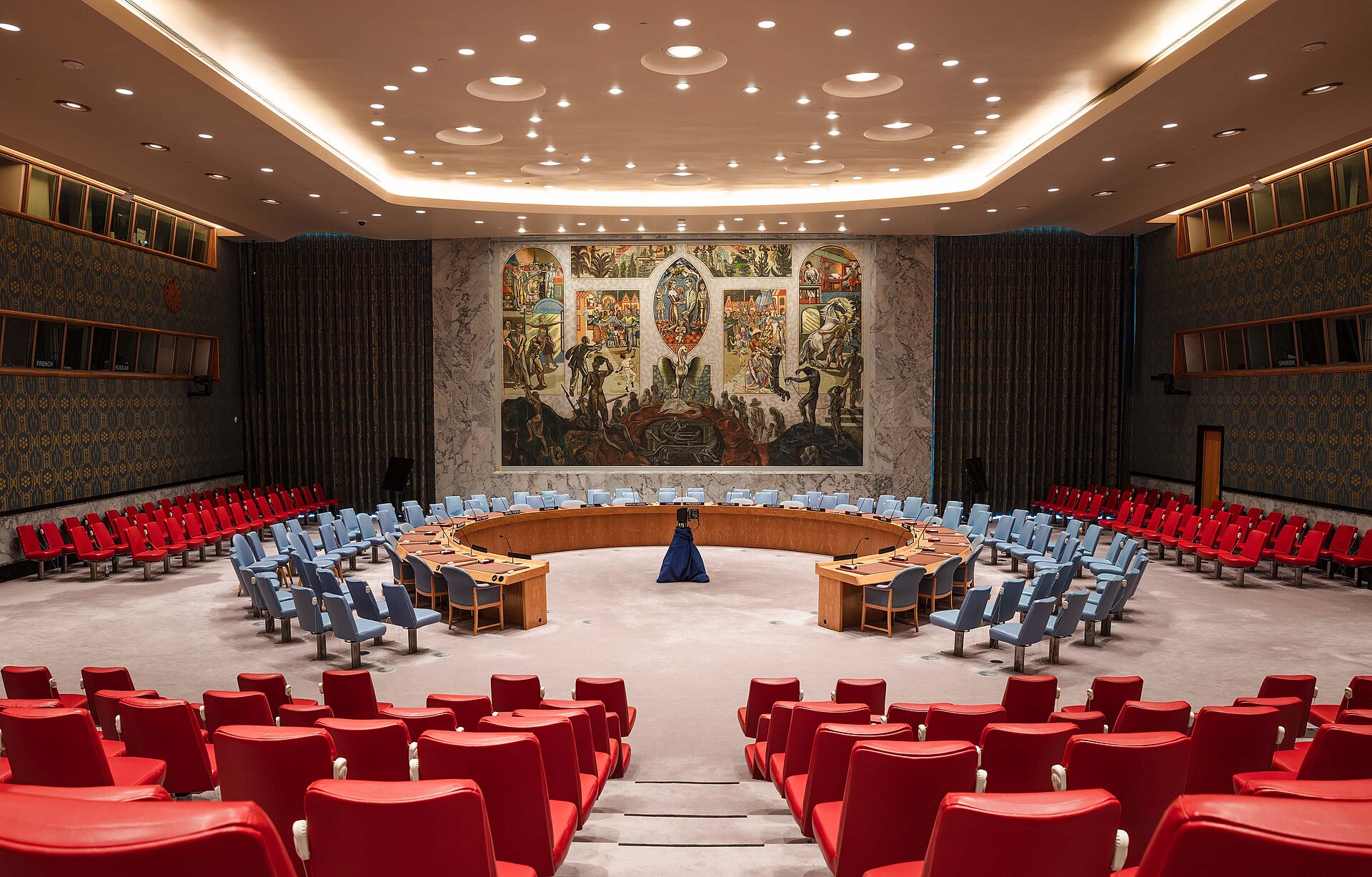
Featured image: file photo of the UN Security Council chamber, New York, taken on November 16, 2023. It is context only and does not show the October 30, 2026 session discussed here. Photo by Wikiweeki via Wikimedia Commons, licensed CC BY 4.0.
