
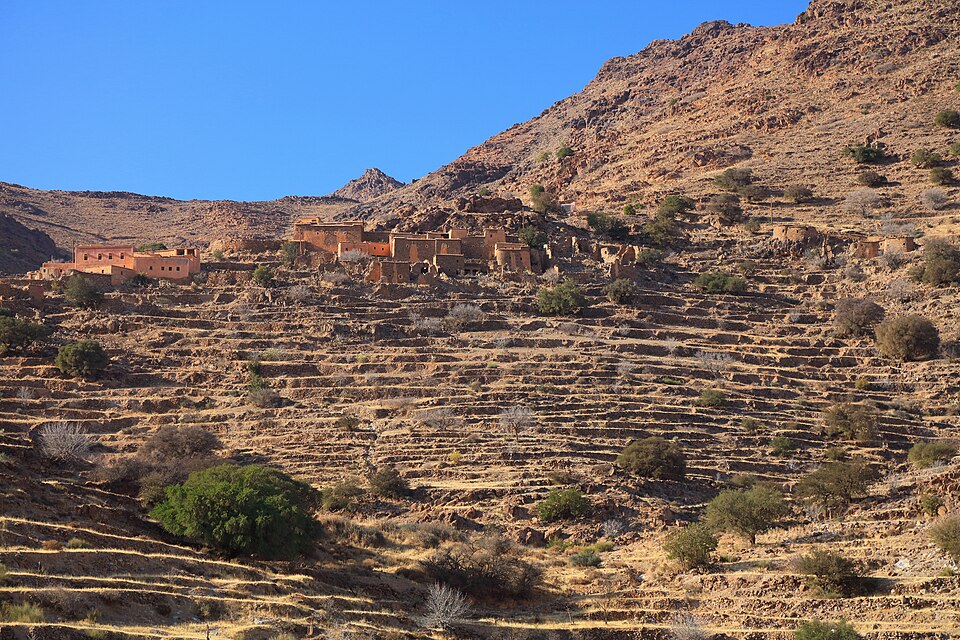

In Morocco’s western Anti-Atlas, a terrace wall can remain visible after farming has stopped, while the soil behind it changes. A local study published in 2021 found much lower water-infiltration rates on abandoned plots than on cultivated ones. The finding makes the care of the soil, as well as the survival of the stonework, part of the story of these stepped hillsides.
The evidence comes from Tizerkine and Timzemzit, two villages near Ait Baha in south-western Morocco. It is a dated, small-scale comparison, not a measurement of the condition of all Anti-Atlas terraces today. Its value is in showing what can change when a working landscape loses its regular maintenance.
The surface matters as much as the wall
Terraces create cultivable steps on sloping ground. In the study area, stone walls support plots used for crops including barley, within a landscape of argan trees. Mohamed Sabir’s 2021 paper in the journal Water describes farming that involved ploughing, removing stones and adding manure, alongside maintaining the retaining walls.
Those activities affect the surface through which rainfall must pass. The study associated abandonment with less ground cover, a more compact surface and crust formation. A crust is a thin, hardened surface layer that can make it harder for water to enter the soil. A hillside may still look terraced even when that surface is behaving differently.
That is a different question from the cultural and processing knowledge behind Morocco’s argan oil. Here the focus is the ground between the trees and the work needed to keep cultivated slopes functioning.
What the infiltration tests measured
The study compared ten terraces: two in each of five categories, from still ploughed to abandoned for at least 20 years. Three infiltration tests were made on each terrace. Concentric rings inserted into the ground allowed water movement into a small patch of soil to be measured over 45 minutes.
The paper’s table gives a mean final infiltration rate of 301.8 millimetres per hour for cultivated terraces, using 2017/18 as the reference period. The mean was 129.6 for terraces classified as abandoned for one year and 62.9 for those classified as abandoned for five years. Rates in the ten-year and oldest categories were similar to the five-year value.
These are rates measured under the test conditions, not rainfall totals or volumes of water saved across a valley. They do not mean that a whole hillside absorbs a storm at the same rate. Nor did the study follow the same plots continuously from cultivation through five years of abandonment: it compared different plots assigned to different abandonment ages.
The distinction matters. Abandonment ages were estimated with residents’ help, and the author acknowledged uncertainty in those estimates, variation between soils and difficulty establishing cause and effect. Erosion was assessed with a qualitative surface-condition index rather than by directly weighing soil washed away. The paper supports concern about runoff and soil degradation; it does not quantify the contribution of these terraces to a particular flood.
Abandonment has more than one possible outcome
The same study mapped roughly 284 hectares across the two villages’ territory. Its table classified 24.9% as still ploughed in 2017/18. That local, historical proportion should not be read as a current abandonment rate for the mountain range.
Nor does stopping cultivation always produce the same ecological result. Sabir reported little spontaneous vegetation recovery on the abandoned terraces studied, linking this to aridity and depleted soils. A separate 2021 review of Mediterranean terrace research, by Emanuela Cicinelli and colleagues, found that vegetation and species diversity can increase after abandonment in some settings. It discussed both continued cultivation and managed recovery of vegetation among possible conservation approaches.
Climate, soil, wall condition and subsequent land use therefore matter. The Anti-Atlas results are not an instruction to plough every abandoned terrace. They are a reason to examine what is happening on a particular slope before assuming that either cultivation or abandonment will protect it.
Conservation needs a maintenance plan
The Mediterranean review identified practical tasks such as repairing damaged walls and keeping waterways clear, while noting how little research described maintenance strategies in detail. It also argued for involving farmers in decisions about the future of terraced landscapes. Preserving a pattern of walls without considering who can maintain it leaves part of the problem unanswered.
Morocco has explored financial incentives for environmental care. A UN Development Programme project in the Souss-Massa-Draa region set out to introduce payments for ecosystem services within the argan ecosystem. Such payments seek to reward benefits that land management provides beyond the farm. The project page describes objectives and lists the project as completed; that is not, by itself, proof that terrace maintenance or downstream water conditions improved.
As with the local rules behind Morocco’s seasonal agdal pastures, protecting a landscape involves sustaining the arrangements that make its use possible. For terraces, the useful questions concern soil cover, drainage, wall repairs and the people able to carry them out. Counting standing walls alone cannot answer them.
Sources and method: this explanation uses the full 2021 Water paper, including its methods and tables, the Mediterranean research review and the UNDP project account. The paper’s table and results section are used for infiltration values; its conclusion gives a different first-year percentage, which is not reproduced here. The study is not a current-condition survey. Sada Journal has not visited the villages, repeated the tests or independently evaluated the UNDP project’s outcomes.
Lead photograph: agricultural terraces near Tafraoute in the Anti-Atlas, photographed on 15 February 2022 by Marek Ślusarczyk, via Wikimedia Commons: Agricultural terraces in Anti-Atlas mountains near Tafraoute, Morocco, CC BY 3.0. Archive landscape, not the study plots at Tizerkine and Timzemzit and not evidence of current cultivation status. Reduced-resolution reproduction; display cropping may occur. No generative changes.
