

A Moroccan sourdough starter is more than a way to make dough rise. It is a living mixture in which yeasts and bacteria change sugars, acidity and aroma. Studies of starters collected in Morocco show why the organisms matter, but also why a promising laboratory culture is not the same thing as a better loaf in every bakery.
The useful distinction is between a community maintained by a baker and individual strains selected by a researcher. The first is carried forward from one batch to another. The second can be tested under controlled conditions to find out what it does. Moving between them requires choices about flavour, fermentation and consistency, not simply finding the yeast that produces the most gas.
What the starter carries forward
Sourdough contains a community of microorganisms in a flour-and-water mixture. Yeasts release carbon dioxide as they use fermentable sugars, helping dough expand. Lactic acid bacteria contribute acids and other products of fermentation. Keeping some fermented material to begin another batch carries part of that community forward, a practice researchers call back-slopping.
A Moroccan study published in 2023 illustrates how varied the starting material can be. Khaoula El Khaider and colleagues examined nine traditional sourdough samples from central Morocco, the south-east and the north. Their sample list includes flour and water, but also preparations involving whey, barley, dates, broad bean or couscous. These are the ingredients recorded for those samples, not a national recipe.
The researchers worked at the Hassan II Institute of Agronomy and Veterinary Medicine in Rabat and the National Institute of Agronomic Research. Their purpose was to select combinations of yeast and lactic acid bacteria for more controlled bread production. They were not measuring how many Moroccan households use sourdough today.
A Fez experiment separated the yeasts
A separate study published in 2021, by Mouna Aouine and colleagues at Sidi Mohammed Ben Abdellah University, began with 12 sourdough samples collected around Fez in February 2017. Fez is the historic city in northern inland Morocco. The researchers recovered 32 yeast isolates and tested their ability to expand dough.
An isolate is a culture separated from the mixed community so that it can be examined on its own. This changes the question. Rather than asking how a household starter behaves with all its organisms together, the experiment asks what a particular yeast can do in a specified dough.
The test used a common flour and fixed additions of salt, sugar, water and yeast, with fermentation at 30C. The researchers identified selected isolates using DNA sequences. They included strains of Saccharomyces cerevisiae, the familiar baker’s yeast, and Kluyveromyces marxianus. Selected strains were also tested for growth under salt, sugar, heat and acidity stresses.
That is evidence of potentially useful baking traits, not proof that a species name predicts the result of every loaf. A strain is a particular biological line within a species. Its performance also depends on the ingredients and conditions in which it is used. The study itself noted that added sucrose could help explain the performance of yeasts that did not use maltose in its tests.

More gas is not the only target
The 2023 research took the next step by combining selected yeasts and bacteria. It assessed gas-related fermentation performance alongside acid production, then used a chosen mixed starter in bread-making trials against a commercial-yeast reference.
The authors reported differences in aroma, crumb, crust and shape, and preferred the selected mixed starter in their evaluation. The point is not that a laboratory has established one ideal Moroccan bread. It is that selecting organisms for a mixed starter involves several outcomes. A culture that changes acidity and aroma is doing something different from merely speeding up expansion.
Gas production and a finished loaf’s structure are related, but they are not identical measurements. Dough must also retain gas. Flour, mixing, fermentation time and baking remain part of the process. Results obtained with one flour and a controlled procedure cannot be treated as a ranking of all bakers, household starters or commercial yeasts.
The two Moroccan papers also used different testing arrangements. Their numerical results should not be put on one league table as though the experiments measured the same thing in the same way. Neither establishes that the selected cultures are now widely sold or routinely used in Moroccan bakeries.
Moroccan origin is not a microbial certificate
There is a further reason to resist turning a starter into a simple geographical label. A 2021 study in eLife examined 500 sourdough starters and found only a limited relationship between geography and the composition of their microbial communities. Interactions between organisms also helped explain which microbes occurred together.
That collection was heavily weighted towards the United States and included no Moroccan samples. It cannot settle the geography of Moroccan sourdough. It does show why a claim that a city automatically confers one unique microbial identity needs direct evidence, rather than an attractive story about local air.
Morocco’s bread traditions remain cultural practices even when their microorganisms are not exclusive to the country. The comparison with the work involved in couscous is useful: ingredients become food through a sequence of learned actions. Fermentation adds a biological community to that work.
As with the knowledge behind argan oil, a finished product does not reveal every stage of its making. For bread, useful questions concern the starter actually used, how it is maintained and how the dough is fermented. A round shape, a rustic crust or an old oven cannot answer those questions on its own.
Sources, method and photograph credits
This explainer draws on the full 2021 Fez yeast study, the full 2023 Moroccan mixed-starter paper and the inspected main findings and methods of the 2021 international study. It reports no new bakery visits, interviews or laboratory tests. Collection dates for the 2023 Moroccan samples were not established. The small studies are not national surveys. Inconsistent isolate totals in the 2023 paper are not reproduced as verified counts. Laboratory findings are not presented as medical, food-safety or universal shelf-life guarantees.
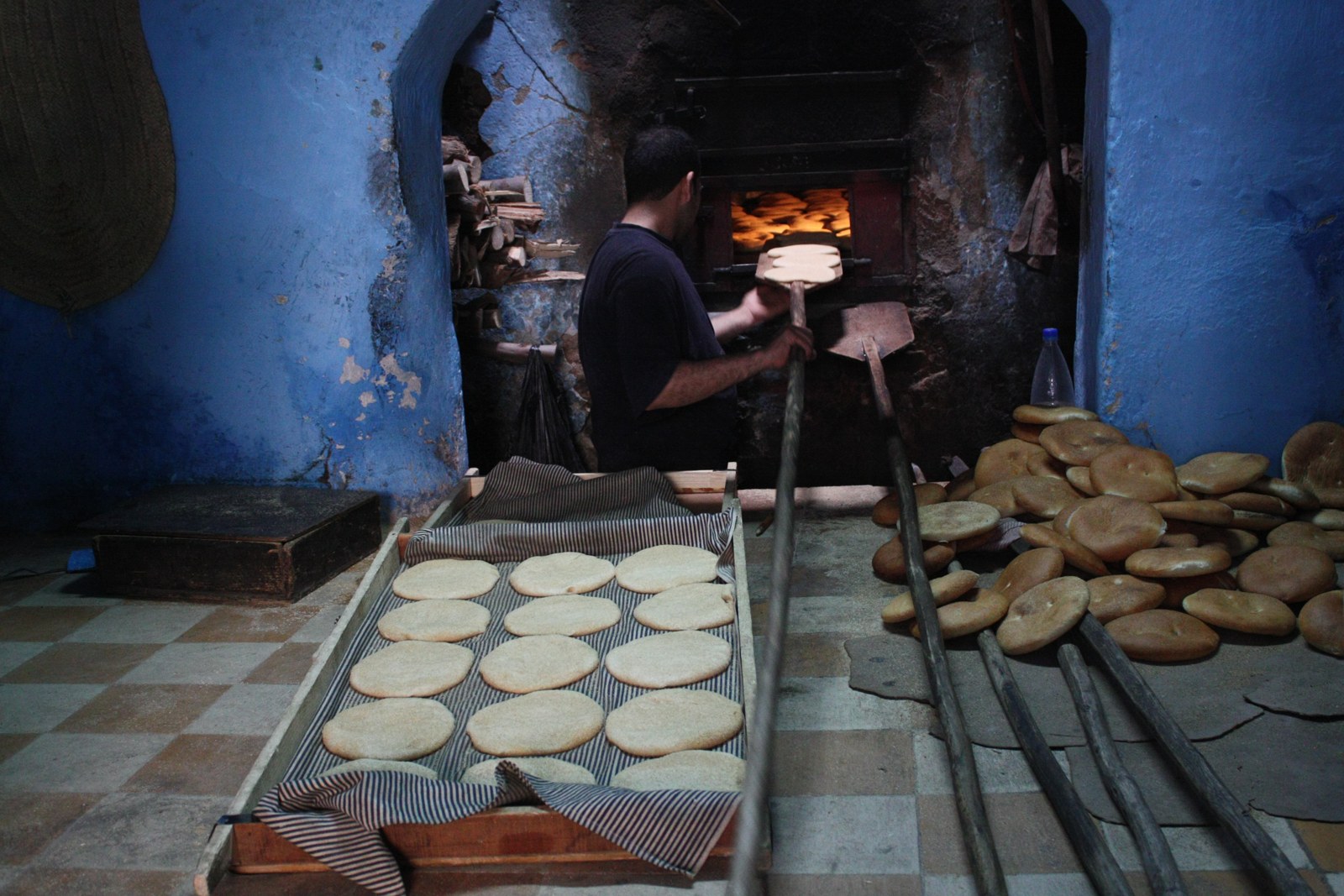
Lead photograph: bread being prepared and baked in Fez, 5 June 2009. Photo: nathalie_r, Wikimedia Commons, CC BY 2.0. Resized for publication; template may crop the display. Archive photograph, not a visit for this article. The photographed bread’s fermentation method is not established.
