
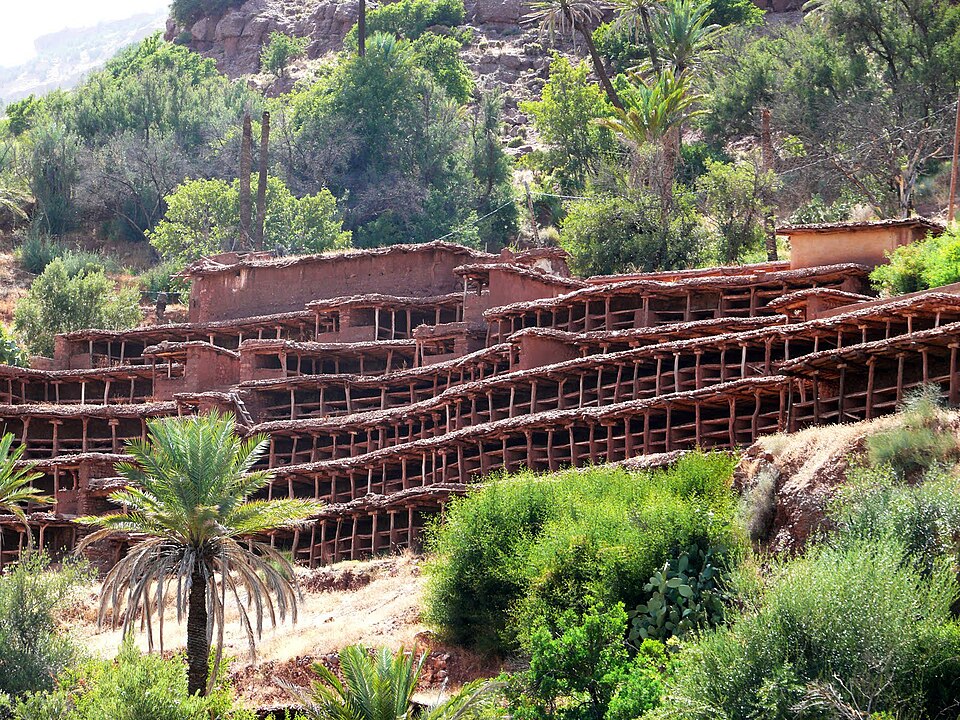

Inzerki’s hillside apiary brought separate family hives under a shared set of rules. The arrangement governed who could place bees there, how neighbours should behave at harvest and how a guardian was paid. Its earthen terraces are the visible part of a social institution, not a measure of how many colonies are thriving today.
In the Souss area of southwestern Morocco, north of Agadir, the collective apiary offers a specific example of cooperation: families retained recognised places for their hives while accepting obligations towards other keepers and the bees. Understanding that distinction is more useful than treating the complex simply as an unusually large beehive.
Archive photograph above: Inzerki’s terraced apiary, by Argana92. The Commons file’s camera metadata records July 2010. It is not evidence of present occupancy or condition. Full source and rights information below.
Separate hives, shared obligations
The clearest detailed account comes from Salah Chafik’s ethnographic study of Inzerki. Its on-site research took place in September and October 2021, followed by remote interviews over the next six months. The study describes families holding allocations of huts, with permission required before someone else could put hives in those spaces.
In that account, the apiary did not charge a placement fee or take a commission on honey. Instead, keepers were expected to give part of the first harvest of each season to its guardian as payment. Cooperation therefore had a cost, but it was organised through an obligation in kind rather than a deduction from every sale.
The study also records expectations of sharing honey or hive space when asked, and of settling outstanding disputes before harvesting. These practices concerned relationships between keepers as well as the production of honey. A common enclosure did not erase household rights or the need for permission.
There is a parallel with Morocco’s collective granaries, where family stores could sit within a jointly protected building. The protected resource is different at Inzerki: living colonies require forage and repeated care, rather than simply a secure room.
Why the cylinders matter
The apiary’s compartments accommodated traditional cylindrical hives. The regional tourism account describes cylinders woven from reeds, covered with mud and closed at their ends, leaving an entrance for the bees. The hives and the terraced structure around them are different things. An empty place in the building is not an active colony.
Chafik’s research records a rule allowing only traditional cylindrical hives. Keepers described these as better suited to their way of working and believed they produced better honey. Those are the participants’ judgments, not the results of a controlled comparison of hive designs.
The same distinction applies to harvest practices. The study describes working on one hive at a time, close to sunset, and limiting disturbance to neighbouring colonies. It also documents religious requirements, including ritual washing and invoking God’s name. The author’s account places the welfare of bees, obligations to colleagues and Islamic practice together, rather than treating faith as an incidental decoration.
This helps explain why preserving the institution cannot be reduced to replacing its equipment with whichever hive has the highest stated output. It does not establish that every inherited practice improves bee health. That is a separate question requiring ecological evidence.
A building cannot certify a recovery
The sources describe a place exposed to repeated disruption. The regional tourism account records damage from floods in 1990 and 1996 and a rehabilitation programme launched in 2005. AFP’s reporting published in April 2022 documented keepers losing hives during drought and trying to protect the colonies that remained. These are dated accounts, not a survey of conditions this November.
More recent reporting published by LeNew with MAP in April 2026 still described restoration efforts and pressure from drought and changing beekeeping practices. It did not provide an audited current count of active colonies or a measured recovery in household income.
Even physical capacity needs care. Sources use different numbers and labels for huts, compartments, hives and active use. Those figures cannot be combined into a single occupancy rate without establishing that they count the same objects over the same area and period. No such rate is calculated here.
As with the seasonal rules governing High Atlas agdal pastures, the important question is how a community manages access to a resource that changes through the year. The comparison does not mean Inzerki follows the same calendar or institutions as a pastoral agdal.
Inzerki’s terraces make the shared undertaking visible. Its family allocations, guardian and harvest obligations explain how that undertaking worked in the research period. Establishing its present strength would require another kind of record: active colonies, available forage, maintenance and the people able to keep doing the work.
Sources, method and photograph
This is a source-based heritage explainer, not a site visit or new interviews. Chafik’s study records local perspectives through short fieldwork and follow-up interviews; the author acknowledges not attending the seasonal rituals. Its questions about ecological benefits are not treated here as proven results. Publication records differ: the PDF identifies a 2022 journal issue, while the journal page lists online publication in April 2023. Exact foundation dates, world-size rankings, therapeutic claims, output and income estimates are excluded. No current colony census or completed restoration is claimed.
Photograph: Inzerki3.jpg, Argana92, Wikimedia Commons, CC0 1.0. The file’s camera metadata records 13 July 2010; it was uploaded in December 2010. Archive photograph, not a current-condition assessment. Supplied 960-pixel display photograph reproduced without generative changes; the website may resize or crop its display.
