
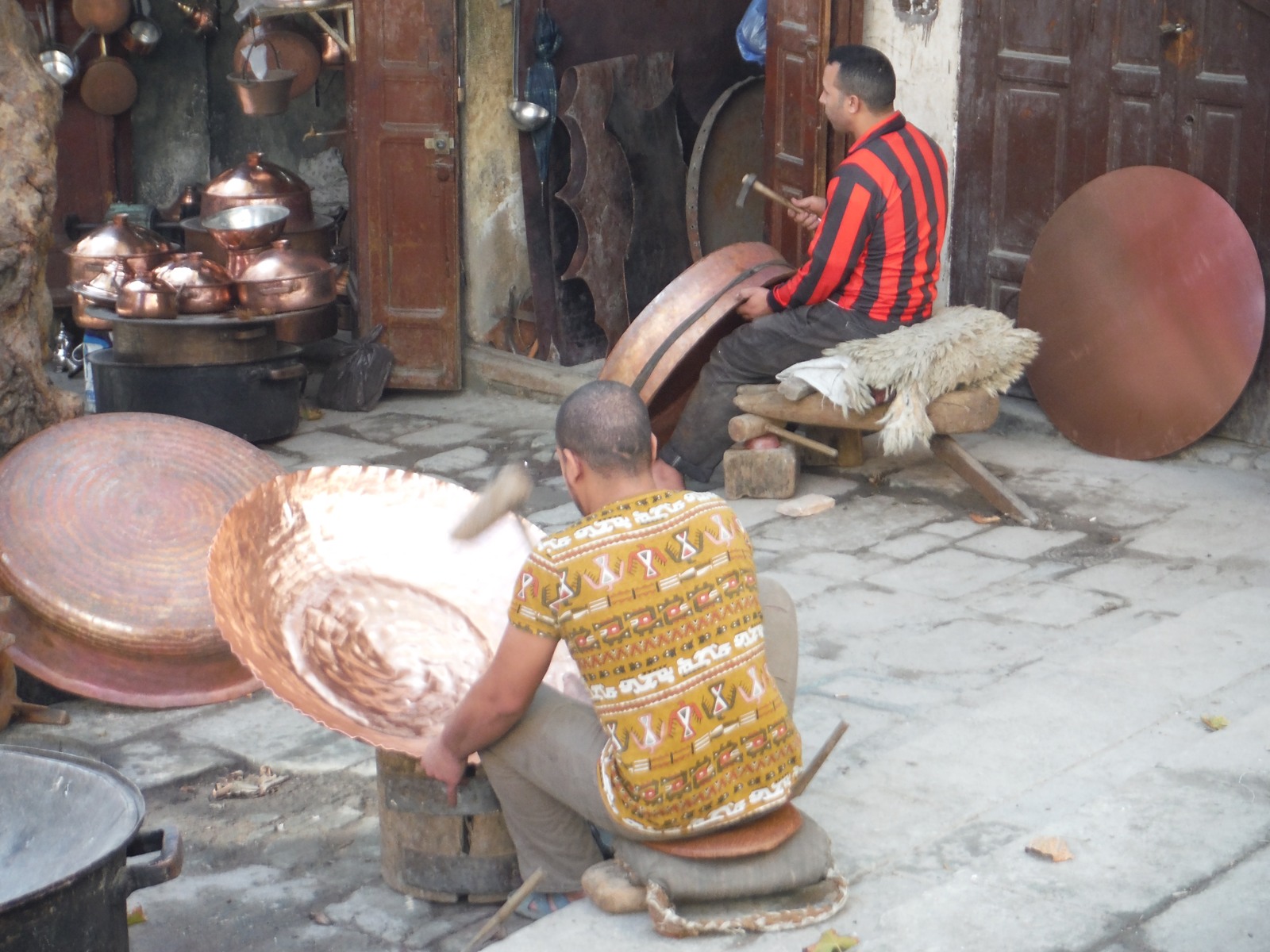

An oval tea tray in Fez can be the product of a journey through several workshops, not a single maker’s bench. In research published in 2009, anthropologist Baptiste Buob described thirteen phases in the manufacture of these trays. More than thirty workers each performed at least one operation in the process documented by his film Ovales, dated 2006.
That account changes what there is to notice in Moroccan metalwork. A finished tray brings together the cutting of sheet metal, decoration, shaping, joining and surface finishing. Skill lies in the individual operation and in getting one stage ready for the next. The research is a historical account of production in the Fez medina, the city’s old urban district, not a census of workshops or working conditions in 2026.
A tray moves before it reaches the table
Buob’s original ethnographic article follows a manufacturing system in which manual work and machinery coexist. In the oval-tray sequence described in its first note, workers cut the tray bottoms, decorate them with punches and flatten them in a rolling mill. Other operations make and join the surrounding bands, add rims and handles, polish the assembled elements, prepare the underside for feet and finish the piece through electroplating.
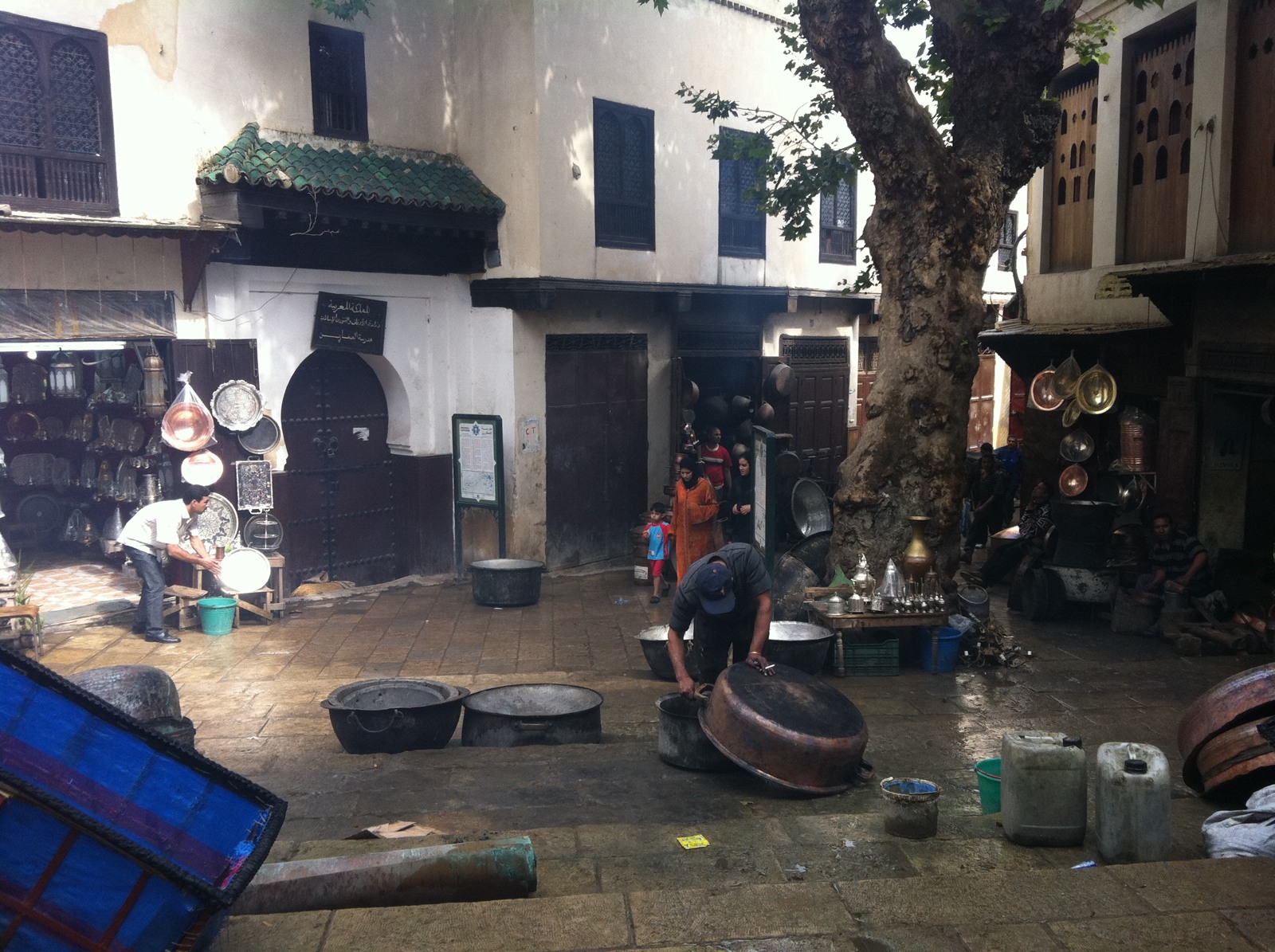
The sequence is distributed through the city. Buob writes that, apart from assembly and brazing, each phase takes place in a different production space. In his example, more than 600 metres separated the decoration workshop from the rolling workshop. Some specialists worked close together in former caravanserais, courtyard buildings once associated with lodging and trade; others occupied more distant rooms.
This is a practical geography. A tray has to leave one work station in a condition that permits the next operation. The medina is therefore part of the manufacturing arrangement, not simply a picturesque setting around it. Our guide to the working city behind the Fez medina explains why its streets and courtyard buildings are best understood through the activities they connect.
Metalworking is wider than engraving
The French term dinanderie covers the making of copper and brass objects. It should not be reduced to the decoration on their surfaces. Morocco’s inventory entry on metal engraving and chasing, submitted with a UNESCO nomination, describes makers using yellow and red copper for objects including trays, kettles, candlesticks, mortars, teapots and tea or sugar boxes. It records the use of punches and hammers to decorate objects supported on an anvil.
In Buob’s study, cutting sheet, rolling metal, working cast components, decorating and shaping trays were distinct specialities. Machines did not erase the need for people; they changed which operations people performed and how work was divided. Calling an object handmade, without asking which part was done by hand, leaves much of that organisation unexplained.
Nor did every product follow the same arrangement. In his 2011 review of Buob’s book, anthropologist Jean-Charles Depaule distinguishes the highly divided manufacture of ordinary oval trays from the engraving and final shaping of large circular trays, or tifor. He describes the latter work as less fragmented and more personally involving for its skilled makers. That distinction prevents one production sequence from becoming a claim about every metalworker in Fez.

The tea service has a history of adaptation
Buob also challenges the idea that this production system has survived unchanged from a distant past. His article connects the development of Fez tea-service utensils to imported British forms and the expansion of tea consumption. Depaule’s review describes local manufacturers responding to imported silverware with objects made in plated or unplated metal, alongside changes in materials, joining techniques and machinery.
The point is not that Moroccan skill is less genuine because makers adapted outside forms. It is that adaptation belongs to the history of the craft. A familiar tea tray can embody local choices about manufacture, decoration and use without requiring an origin story in which nothing ever changes.
The research also has a social dimension. Buob documented subcontracting and a sharp division between making and selling, alongside repetitive work and low pay among many of the workers he studied. Those findings belong to his published research, not to a new investigation by Sada Journal. They do not establish the wages, employment status or circumstances of the people in this article’s archive photographs.
A shared inscription, a specific skill
In 2023, UNESCO inscribed the arts, skills and practices associated with engraving on metals on its Representative List of the Intangible Cultural Heritage of Humanity. Morocco was one of ten submitting countries. This is a shared inscription concerning a practice, not an exclusive national claim to all metalwork or a certificate for each object sold.
The committee’s decision identifies transmission through families and formal education, with practitioners, workshop owners, experts and raw-material traders among those involved. Safeguarding therefore concerns people and the conditions for passing on knowledge, as well as finished objects.
As with the separate pieces and operations behind Moroccan zellige, the useful starting point is a specific process. For a tea tray, ask how it was formed, which surfaces were decorated, how the parts were joined and who carried out those stages. The finished object remains worth looking at. Its workshop journey makes it more intelligible.
Sources and method: This explainer draws on Buob’s 2009 ethnographic article and its notes, published scholarly reviews of his book, Morocco’s inventory entry and UNESCO’s inscription record and decision. The complete book and accompanying films were not independently reviewed. No workshop visit, interviews, current wage survey or verification of individual makers’ circumstances was conducted by Sada Journal.
Lead photograph: metalworkers in Fez, November 26, 2014. “FesCopperMaking”, © Elgaard, Wikimedia Commons, CC BY-SA 4.0. Resized and recompressed; this version and any display crops remain under the same licence. Archive illustration of metalworking, not evidence that the pictured workers made the tray in the research or experienced the conditions it describes.
