
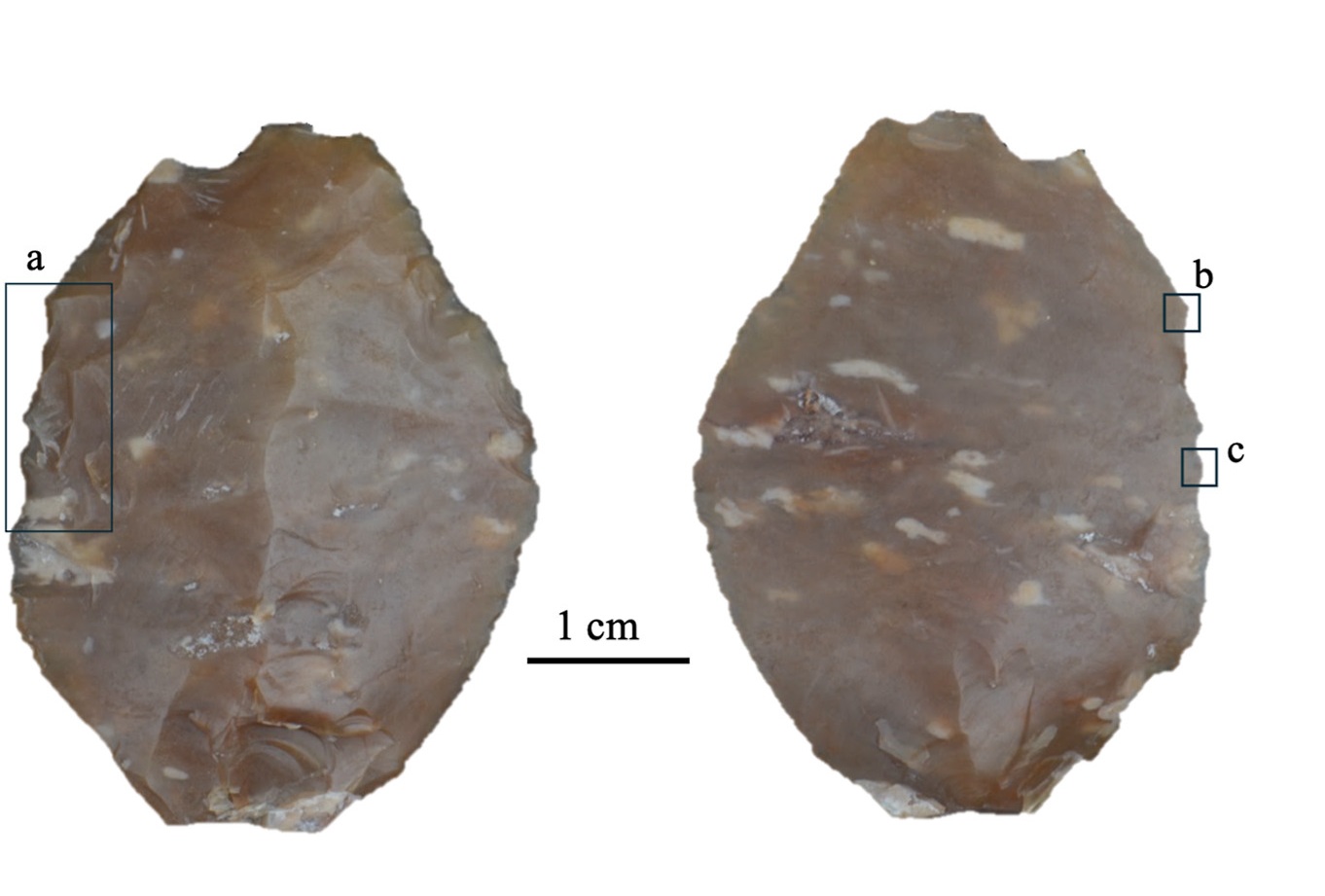

Stone tools from Bizmoune Cave near Essaouira preserve traces of work that rarely survives in its original material. A new study identifies woodworking as the largest activity category among the tools with readable use-wear, adding a view of daily life to a Moroccan site better known for ancient shell ornaments.
The paper in the November 2026 Journal of Human Evolution, published online on October 13 and led by Youssef Djellal, interprets the combined evidence as repeated residential use rather than visits devoted to one narrow task. That does not mean a community lived there without interruption, or that archaeologists can identify the wooden objects people made.
From a stone edge to a worked material
Bizmoune lies about 15 kilometres northeast of Essaouira, on Morocco’s Atlantic coast. The study concerns layer 4c, an archaeological deposit the authors place broadly between about 142,000 and 110,000 years ago. That broad dating rests on the site chronology, not a separate date for each tool. The paper notes that lower-layer luminescence dates disagree with uranium-series estimates, a discrepancy attributed to changes in local radiation exposure. Its tools belong to the Aterian, a North African Middle Stone Age tradition often associated with implements that have a projecting tang at one end.
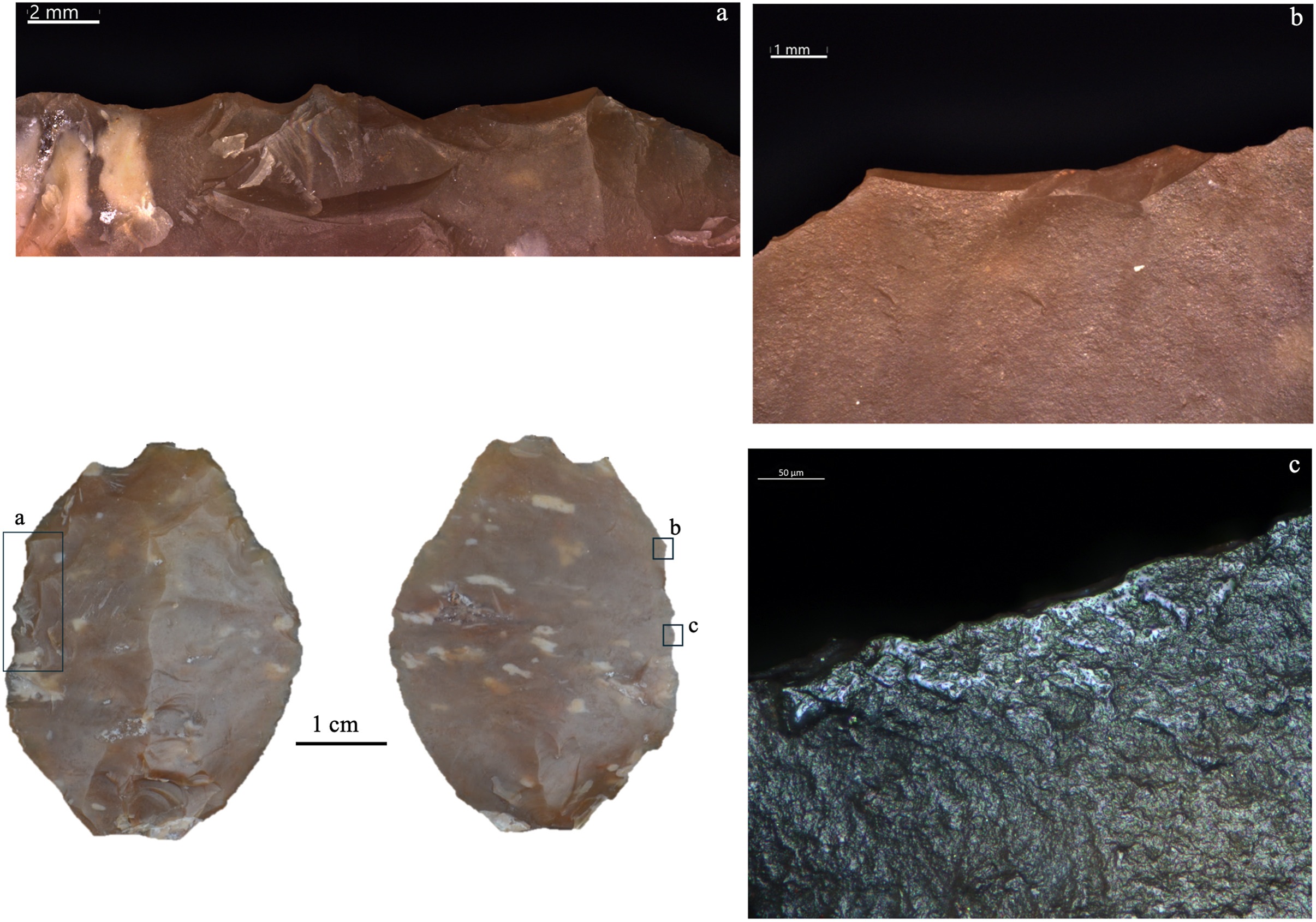
A shape is not a complete job description. Researchers examined edge damage, polish, blunting and fine scratches, comparing them with experimental tools used on known materials. Their reference material included 180 flint tools made mainly from stone from the same geological region, supplemented by a larger comparative collection.
The analysis did not treat every damaged surface as evidence of ancient work. Heat, sediment abrasion and carbonate deposits can alter a stone after burial. Pieces whose working surfaces could not be read reliably were excluded from functional attribution.
The denominator changes the finding
The sample narrowed in stages. The team first examined 1,287 individually recorded stone artefacts, selected 780 for further assessment, and took 499 sufficiently preserved tools into detailed analysis. Of those, 190 yielded traces that could support a functional interpretation. They were excavated between 2014 and 2022, not discovered in a single new field season.
Woodworking accounted for 78 of those 190 tools, about 41%. It was the largest category, not a majority of the interpreted sample and not 41% of everything people did in the cave. Twenty-five tools were associated with hide processing, nine with nonwoody plants and ten with bone processing. Four were interpreted as hunting-related and three as butchering tools.
Another 61 showed use without a securely identified material: 45 involved an undetermined hard material and 16 remained more generally uncertain. Those unknowns are part of the result, not empty spaces to be filled with a plausible story.
A residential interpretation, not a timetable
The woodworking signal came from several tool forms, including scrapers, flakes, blades and tanged implements. Some edges had been maintained repeatedly. Alongside the range of worked materials, the researchers considered animal remains, stone procurement, shell ornaments, ochre and evidence of a repeatedly used hearth.
Together, they argue, those findings fit a place where people returned to carry out varied domestic and subsistence work. But the paper explicitly says the available dating and layering cannot distinguish individual occupation episodes or establish their duration. Repeated use across an archaeological deposit is not evidence for one uninterrupted settlement.
Nor does scarce hunting-related wear show that hunting was unimportant. Some activity may have happened elsewhere. Perishable weapons may leave little trace, while meat processing can produce weak polish that later alteration obscures. The authors discuss wooden spears, handles and structural elements as possible uses of wood, not recovered objects identified by this analysis.
More than the best-known objects
Bizmoune became widely known through a 2021 study of perforated shell ornaments. The new work asks a different question: what activities can be reconstructed from the stone tools found with such material? The ornaments do not by themselves explain the full routine of the people who used the cave.
An October 2026 review by several of the same researchers describes how scarce and geographically uneven functional studies of Aterian tools remain. It supplies context, not independent replication of the Bizmoune results. One cave and a preservation-selected sample cannot stand for all North African communities.
Sada Journal’s account of bone retouchers at Taforalt follows a different link in a working system: animal bone used to maintain stone edges. At Jebel Irhoud, the much older fossils and their archaeological setting address human origins. Bizmoune adds something more specific: evidence that stone tools can preserve traces of a substantial wooden technology after the wood itself has disappeared.
Sources and method: The full accessible publisher text, including methods, results, tables and discussion, was inspected alongside the linked 2021 paper and 2026 review. The research centre’s summary was also checked. Supplementary files and original specimens were not independently examined. The 41% figure is 78 divided by 190, rounded; it describes the interpreted sample, not time spent on tasks. This is published-research explanation, not field reporting or a new excavation announcement.
Lead photograph: Two views of BZM_7858, cropped from Figure 5 of Djellal and colleagues’ 2026 paper, © 2026 The Author(s), CC BY 4.0. Original specimen photographs, not a reconstruction; the full plate and licence link appear above. Cropped and recompressed. No individual photographer or shutter date is supplied, and no current site condition is implied.