
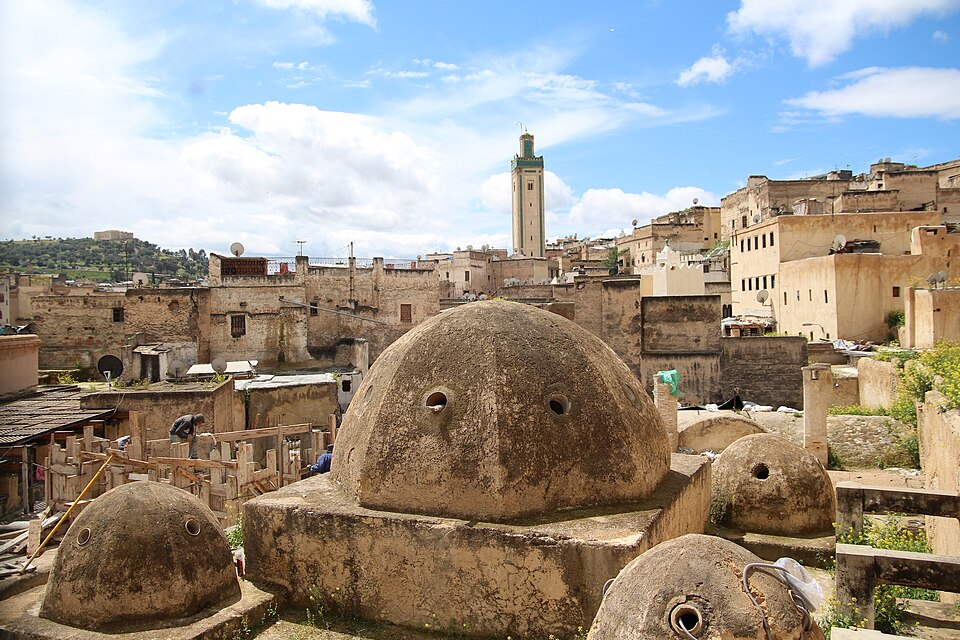

The roof of a Moroccan hammam does more than hold in warmth. Small openings in its vaults and domes also bring daylight into the bathing rooms below. When those openings are blocked during repairs, or shaded by new equipment, part of the building’s lighting system disappears even if its architectural outline survives.
A study published in 2018 by architectural researcher Magda Sibley makes that system visible. It combines a survey of historic bathhouses in Marrakech with a separate daylight-restoration case in Rabat. Its most useful finding is practical: caring for a hammam means understanding how its roof works, not simply preserving the shape of a dome.
Archive photograph above: Hammam Seffarine in Fez, April 2018. This is neither the Marrakech survey site nor the monitored Rabat bath. Full credit and licence below.
Small openings, different arrangements
A hammam is a public bathhouse. In the buildings examined in Sibley’s study, the bathing sequence passes through rooms described as cold, warm and hot. Daylight enters from above through circular openings known as oculi, rather than through large windows in the outer walls. Blown-glass caps cover the openings while allowing light through.
The Marrakech work documented the architecture of 13 functioning heritage hammams. It did not survey every modern bath in the city, and its findings are not a count of facilities operating today. Rows of eight small openings recur in the vaulted rooms, but the roofs are not interchangeable: domes, central spaces and different building histories produce other arrangements.
That distinction matters when reading a roof from a photograph. A group of circular holes is evidence of a lighting arrangement, not proof that every bath follows one standard plan. The relationship between the openings and the room underneath is what gives the pattern meaning.
At the time of the Marrakech survey, Sibley found that none of the original blown-glass caps survived in the baths examined. Some openings had poor replacement covers; others had been narrowed or blocked by successive cement repairs. A roof could therefore retain its recognisable form while admitting much less light.
A separate test in Rabat
The measured restoration case was not one of those Marrakech baths. It was Hammam Rjafalla in Rabat, a building dating from the 1950s. The study describes the reopening of its roof openings and installation of 48 locally made recycled-glass caps in July 2016, with two rows of eight above each of three bathing rooms.
The full paper’s methods and results show the limits as well as the value of that exercise. Synchronized instruments recorded light on the roof and inside the three rooms at 20-minute intervals from 19 July to 30 September 2016. The indoor instruments were fixed about two metres above the floor. Those readings describe particular measurement positions, not a complete map of light at every place where someone might sit or work.
The resulting record shows daylight changing with time, sky conditions and the room concerned. It also identifies a very concrete obstruction: two solar panels cast shadows over the warm room’s openings. Equipment intended to improve one aspect of the bath’s operation could interfere with another when both occupied the same roof.
This is not an argument against solar heating. It is an argument for checking the paths of light before deciding where equipment belongs. Nor did reopening the holes make electric lighting unnecessary. The paper reports continued demand for supplementary light, particularly as daylight declined towards the end of summer.
The roof is a working surface
Hammam modernisation has good reasons to concern itself with more than daylight. The French Global Environment Facility’s account of its completed 2014-2018 Moroccan programme describes work on fuel supply, the production and distribution of heat and hot water, and hot-water management. These are related parts of a working bath, not separate decorative features.
The Rabat case adds a small but useful test for that wider work: does a new installation leave the existing daylight openings able to do their job? A clear glass cap cannot compensate for an opening buried beneath a repair or shaded from above. Equally, preserving an old lighting arrangement does not by itself demonstrate lower fuel consumption or a satisfactory result for every user.
The same care with claims is useful inside the building. The polished finish of tadelakt depends on its material and skilled treatment; a photograph of a smooth wall cannot establish the performance of the whole wall. In a hammam roof, a visible dome cannot establish how much useful light reaches the room beneath it.
What should be preserved?
The strongest lesson is about documenting function before changing fabric. Recording where openings are, how they are covered and what stands above them gives a repair team something more useful than a general instruction to retain a traditional appearance. Comparing conditions afterwards can then establish what the intervention actually achieved.
There is a parallel with Mehdya’s research linking surveyed walls to their condition: documentation helps when it connects a visible shape to evidence about the building. And, as with the continuing care of Ait-Ben-Haddou’s earthen architecture, survival is a repeated task rather than a finished visual effect.
The 2016 Rabat measurements do not establish the condition of Moroccan hammams in 2026. They offer a more modest and durable insight. A roof opening, its glass cover and the space around it form a working relationship. Preserving that relationship can matter as much as preserving the silhouette.
Sources, method and photograph
This is a source-based architectural explainer using Sibley’s 2018 study and the funder’s programme record, not a new bathhouse survey, site visit or interview. The Marrakech architectural sample is distinct from the single monitored Rabat case. No national bath count, current opening arrangements, measured bill saving or health benefit is asserted.
Lead photograph: roof of Hammam Seffarine, Fez, photographed 7 April 2018. Gonzalo Riestra, via Wikimedia Commons, CC BY 2.0. Commons-resized photograph; no scene alteration. Archive illustration of roof openings, not the Marrakech survey or Rabat monitored bath, and not a record of present conditions.
