
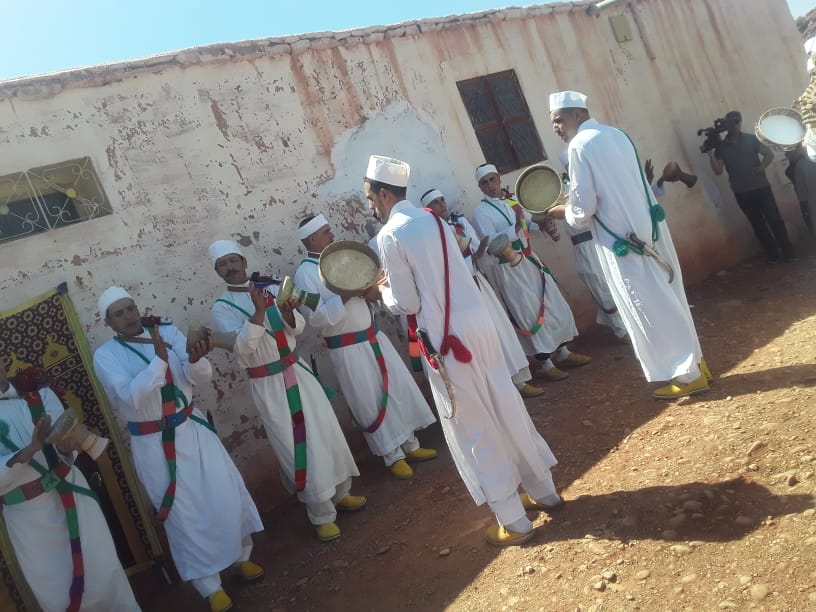

A Taskiwin performance in a High Atlas village can last at least four hours, moving through roughly forty rhythms in a set order. On a festival stage, the same dance is often shortened. That distinction, described in Morocco’s 2022-2025 safeguarding report hosted by UNESCO, explains why keeping a tradition visible is only part of keeping it usable.
The report describes renewed activity, new associations and younger performers joining older dancers. It also acknowledges that no detailed statistical study has yet measured the effectiveness of safeguarding. The result is a more interesting story than either inevitable disappearance or a completed rescue.
A dance carried on the shoulder
Taskiwin belongs to the western High Atlas, the mountainous region around and north of Taroudant in southwestern Morocco. Its name comes from the tiskt, a decorated horn-shaped accessory carried by the dancer. Shaking the shoulders to tambourines and flutes is a defining part of the performance, as UNESCO’s heritage record explains.
The word “martial” in its official name describes a historical association, not a present-day combat display. UNESCO’s 2017 inscription decision describes social functions that had developed around celebrations, community integration and the peaceful resolution of tensions. The dance was placed on the List of Intangible Cultural Heritage in Need of Urgent Safeguarding, not simply given an award for spectacle.
Its knowledge reaches beyond visible steps. Morocco’s nomination file includes the people who make costumes, accessories and instruments within the community concerned. As with the distinct local forms of ahwash, coordinated movement depends on skills and relationships that an audience may not immediately see.
What the short set leaves out
The 2022-2025 report makes the contrast unusually concrete. It describes long village performances for the community and festival appearances adapted to a modern programme, where the dance is no longer performed in full. The four-hour duration and approximate forty-rhythm sequence are the report’s description, not a rule independently checked across every troupe.
This does not make festivals the enemy of transmission. The same report describes workshops led by experienced practitioners alongside performances in Taroudant, and young people helping with organisation and documentation. A stage can provide work, recognition and a meeting place. It cannot, by itself, establish that the complete sequence is being learned.
That is a familiar distinction in Moroccan performance. A concert also offers only one setting for Gnawa. The traditions are different, but neither is fully explained by the length of a festival slot.
Learning requires people and occasions
In the 2017 nomination, learning mainly happened informally, through direct participation with experienced dancers. The later state report describes school and extracurricular activities, including at Roudani high school and Talmakant secondary school, as additional routes. It also says transmission is not automatic in every family.
The physical objects need teachers too. The report describes documentation of the wooden tiskt, decorated with silver plates, and earthenware tambourines, alongside work to identify their makers. An archive of performances and an archive of making skills preserve different parts of the same practice.
The emphasis on learning has a longer history. In 2017 interviews with Yabiladi, anthropologist Lahcen Hira argued for transmission followed by practice, as well as research into traditions passed on largely by word of mouth. These were proposals made at the time, not an assessment of today’s programmes.
A revival to document, not declare complete
UNESCO’s 2022 committee decision noted efforts involving a federation, a national festival and educational institutions. It encouraged further youth training and documentation, including craft knowledge, and attention to communities’ mother tongue.
Morocco’s subsequent report says the September 2023 earthquake slowed some inventory and documentation work, even as performances and teaching continued. Its account of revival is valuable evidence of what the state and participating associations report. It is not an independent survey of how often every village dances, how much of the repertoire younger people command, or whether makers can earn a reliable living.
The useful test is therefore broader than whether Taskiwin can still fill a stage: whether people have the time, teachers, objects and occasions to carry the longer dance forward.
Source note: This explanation draws on nomination documents, committee decisions, Morocco’s safeguarding reports and dated published interviews. The 2022-2025 report was inspected in UNESCO’s HTML record; its downloadable file was not accessible. Reported activities are attributed, not independently audited. No field visit, interviews or musical transcription were undertaken, and no claim is made that planned 2026 activities have been completed.
Photograph: Taskiwin performers in Irohalen village, Chichaoua province, September 2021, according to the Commons description. Photo by EL-MASOUDYMOHAMED, own work, via Wikimedia Commons, CC BY-SA 4.0. Original 816 × 612 photograph reproduced without editing; photograph and any display crops remain under the same licence. Archive illustration, not a photograph of the programmes assessed in the report. The description gives 27 September while the date field gives 28 September.
