

A sardine landed at a Moroccan port is part of a commercial catch. The fish still at sea belong to a different measurement: biomass, the estimated weight of a population. Confusing the two makes it harder to understand whether a fishery is changing because of fishing, ocean conditions or both.
A 2026 study in the ICES Journal of Marine Science shows how difficult it is to separate those influences in the Canary Current ecosystem off northwest Africa. Its results point to regional differences in the environmental conditions associated with sardine abundance. They do not establish the cause of a change in Morocco’s latest landings.
Three measurements, three questions
Landings describe fish brought ashore. Catch records describe removals by fishing, although their coverage depends on what is recorded. Biomass estimates ask how much fish is present in a defined area. A change in one measure cannot simply be read as the same change in another.
Fishing effort matters too. The Food and Agriculture Organization’s fisheries methods manual explains how catch per unit of effort can serve as a relative abundance measure, but only with attention to the gear, fishing power and other conditions behind it. More effective vessels can change the relationship between a tonne landed and the fish available to catch.
That distinction is practical rather than semantic. To interpret a landing series, readers need its species, geographical coverage and period, alongside evidence about effort and the population being fished. A port total alone cannot supply all of those answers.
How the study looked beneath the catch
Juncal Cabrera-Busto and colleagues studied European sardine, Sardina pilchardus, and round sardinella, Sardinella aurita. These are different species, not interchangeable names for the same fish. The analysis combined research-vessel acoustic biomass estimates with catch databases and environmental observations or reconstructions.
Acoustic surveys use sound to estimate fish abundance. They provide evidence separate from commercial landings, but remain estimates with survey and interpretation limits, not a complete count of every fish. In this paper, sardine biomass series ran from 1995 to 2018; primary-production data covered 1998 to 2018. Publication in 2026 does not turn those observations into a survey of present conditions.
The authors compared subregions rather than treating the entire coast as one uniform fishery. They distinguish a South Morocco study area from a Western Sahara study area, as well as tropical waters farther south. Western Sahara is a disputed territory; the paper’s geographical labels should not be mistaken for a settlement of its political status.
The ocean changes the conditions for fish
One important process is upwelling. As the US National Oceanic and Atmospheric Administration explains, winds can move surface water away, allowing colder, nutrient-rich water to rise from below. Those nutrients can support biological production and the food web on which fisheries depend.
The study did not find one simple environmental relationship everywhere. In its South Morocco sardine models, the proportion of suitable habitat was associated with biomass, alongside the previous year’s biomass. The habitat measure combined temperature and salinity. It was not a direct census of spawning grounds or a test of temperature alone.
In the Western Sahara sardine models, the previous year’s biomass and primary production were more informative than the habitat measure. Primary production describes the formation of organic matter at the base of the food web. These regional differences are a reason to examine local conditions, rather than assume that stronger upwelling always produces more sardines.
Why the models do not acquit fishing
The catch component proved difficult to estimate. Some fitted relationships were physically implausible, and the authors explored models in which the catch effect was fixed at alternative values. This is a modelling workaround, not evidence that catching fish has no effect on the population.
The paper discusses incomplete catch information and mismatches between the areas covered by catch databases and biomass surveys as possible explanations. Those possibilities cannot be converted into a verified estimate of unreported fishing in Morocco. Nor can the analysis isolate a single cause for a current change in catches.
The authors also acknowledge simplified habitat definitions and linear models constrained by the available data. Their structural causal models organise assumptions about how variables affect one another; they are not controlled experiments. The findings are useful evidence about mechanisms and research questions, with limits on how confidently they can be extended.
What a useful fisheries account should show
For readers following Morocco’s fisheries, the most useful account puts commercial catches alongside survey estimates, fishing effort and environmental information, with dates and areas kept consistent. It identifies the species and separates observed results from explanations that remain under investigation.
The shore-side economy has its own history and evidence. Sada Journal’s account of Essaouira’s working port examines the harbour as a place of work, while its report on fish processing and trade at ancient Lixus follows a much earlier supply chain. Neither a busy harbour nor surviving processing infrastructure is, by itself, a measure of the fish population offshore.
The central lesson is to ask what each number measures before deciding what it explains. A landing total records an outcome of fishing. Understanding the resource behind it takes more than that total.
Sources and method: This explanation draws on the full linked 2026 ICES paper, including its methods and limitations, and the linked FAO and NOAA explanations. It is not a new stock assessment, an analysis of current landing figures or on-the-ground reporting.
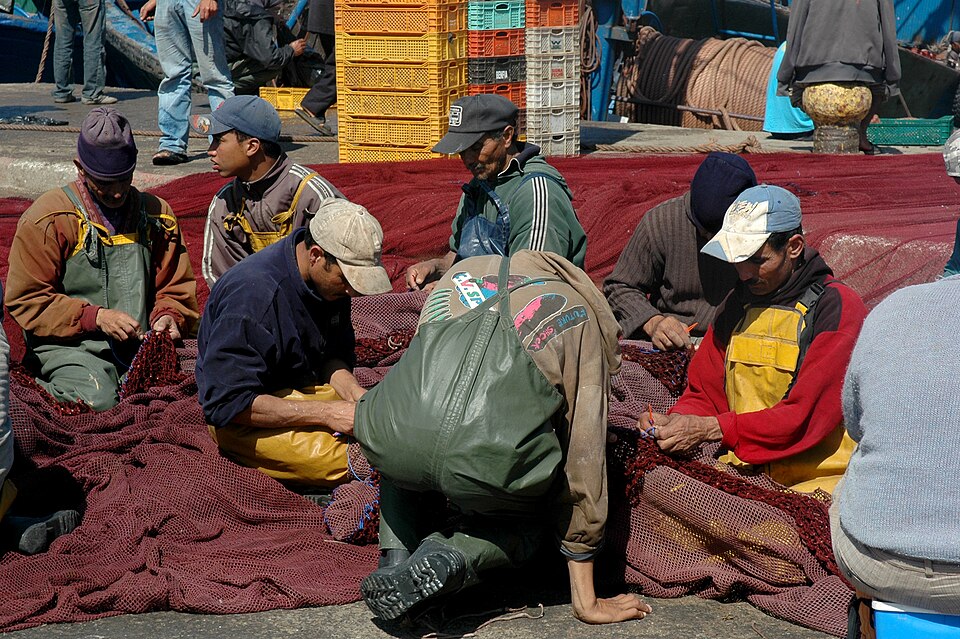
Lead photograph: Fishers mending nets in Essaouira, 15 July 2008, by DimiTalen, via Wikimedia Commons, CC0 1.0. Archive illustration of fishing work, not a sardine catch, a research survey or current harbour conditions. Reduced-resolution reproduction; no generative changes.
