

A village tree nursery can look like an obvious investment in Morocco’s cedar forests. In a new planning toolkit illustrated with Khénifra National Park, it receives 16 points out of 20 overall, but just one out of five for its economic dimension. The problem identified is practical: someone still has to pay to establish and maintain it.
That is a planning judgment, not a result from a nursery trial. It shows what the November 2026 toolkit from the International Union for Conservation of Nature’s Mediterranean centre and Shared Planet asks restoration teams to consider alongside ecological promise: finance, local livelihoods, decision-making and the conditions attached to a proposal.
IUCN presented the toolkit and a companion comparative study in Rabat on November 10-12, reporting their release on November 17. They were produced for FERMA, the Resilient Women in the Middle Atlas project, implemented by the Canadian development organisation SOCODEVI with Morocco’s National Agency for Water and Forests, ANEF, and Canadian government funding.
A forest shared with other uses
Khénifra National Park lies in Morocco’s Middle Atlas mountains. The toolkit’s worked example treats its cedar and oak forests, wetlands, livestock and local livelihoods as connected parts of a territory, rather than separate subjects for separate projects. Its proposed account of the place is explicitly marked for validation with residents.
In this approach, a nature-based solution means protecting, managing or restoring ecosystems to address a social challenge while benefiting people and biodiversity. Calling an activity restoration does not establish that it has delivered those benefits. The guide asks teams to explain the connection and gather evidence.
Grazing makes the issue concrete. The Khénifra example considers limiting livestock numbers in a grazing area, but flags the possible loss of income for herders. It proposes consultation with pastoral development associations and measures such as fodder support or help obtaining more value from products. These are conditions to work through, not proof that a restriction has been agreed or compensation paid.
Morocco’s pastoral agdal systems show why access rules matter: setting land aside changes where animals can feed. The toolkit refers to traditional pastoral knowledge, while leaving the identity of knowledge-holders and their current roles to be documented. It does not supply a confirmed grazing calendar for Khénifra.
What the nursery score actually says
The worked example assesses options across ecology, economics, equity and inclusion, and implementation risk. Village nurseries receive three scores of five and an economic score of one, adding to 16. That makes them a priority with a reservation under the guide’s rules: any dimension below three requires a measure to address the weakness before implementation.
For nurseries, the guide suggests sharing resources with existing ANEF nurseries and checking where the planting material comes from. Its example action plan still labels the budget as unconfirmed. Needs for plants, water, equipment and training remain to be specified.
The proposed monitoring is more demanding than a production total. It includes the number of plants produced, their establishment rate, their origin and their water needs. Research on Morocco’s cedar growth and drought sensitivity addresses the ecological pressures in a different way; a promising planning score cannot replace evidence about what survives.
The same example gives cooperative governance a high overall priority but identifies funding for training, accounting and mediation as a gap. In other words, the organisation responsible for a restoration activity needs resources of its own. A cooperative’s presence on a partner list does not by itself show that its members can influence decisions or maintain the work.

Learning from elsewhere without importing a recipe
The companion study examines seven cases in depth: four in Morocco and one each in Lebanon, Spain and Portugal. Its recommendations range from terrace restoration and community nurseries to farming practices, ecotourism, controlled burning and microfinance. Those are options for assessment, not a list of newly completed works in Khénifra.
The report states that it did not undertake diagnostic fieldwork before preparing its analysis. It relies on available documents and reports, and calls for local validation. That limit belongs to the comparative study; it should not be mistaken for a claim that the separate toolkit team never visited Khénifra. The toolkit acknowledges a visit and presents its park example as a working process with information still to confirm.
Nor does the appearance of controlled burning in the comparative report make it a general instruction for this park. The authors say recommendations must be adapted to individual sites, including ecological conditions, water availability, existing land use and community capacity.
From a worksheet to an accountable project
SOCODEVI’s 2025-2026 project account reports support to 33 selected cooperatives, including 22 with support plans and 16 assisted with climate-smart products and services. These categories should not be added together as separate groups. They describe reported support, not independently measured forest recovery or household income gains.
The toolkit leads towards a first action plan specifying responsibilities, resources, timing and monitoring. It also says it prepares teams for IUCN’s formal nature-based-solutions self-assessment rather than replacing it. Separately, IUCN describes Khénifra as engaged in its Green List process, with a baseline assessment and participatory action planning. Entering that process is not the same as receiving the designation.
For readers assessing the next restoration announcement, the nursery example offers a useful set of questions. Is the budget confirmed? Who has agreed to the land-use choices? Who maintains the activity? And which observations will show whether it works? The toolkit makes room for those answers. Its publication does not provide them in advance.
Sources and method: This article examines the toolkit’s guidance and worked Khénifra example, the comparative study’s scope, recommendations and stated limitations, IUCN’s release and project pages, and SOCODEVI’s project account. These are largely sources from organisations involved in FERMA, not independent evaluations of its impact. No field visit, interviews, nursery inspection, financial audit or verification of local consent was conducted by Sada Journal.
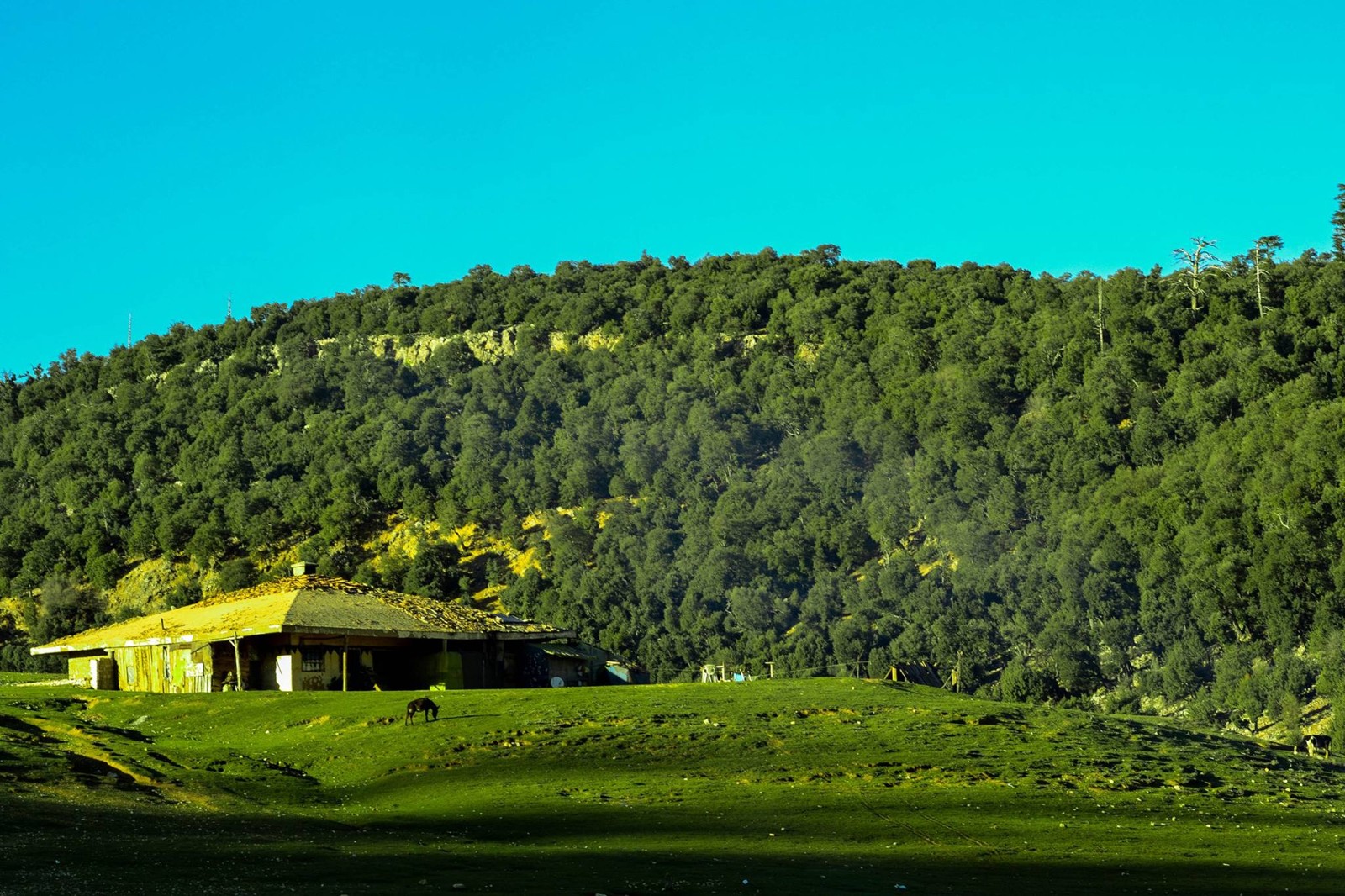
Lead photograph: a wooded landscape at Aguelmam Azegza near Khénifra, photographed on March 11, 2015. “Home alone”, © Loutfi souidi, Wikimedia Commons, CC BY-SA 3.0. Resized and recompressed; this version and any display crops remain under the same licence. Archive landscape context, not a FERMA activity, nursery site or assessment of current conditions.
