

Spain’s National Intelligence Center (CNI) has told the judge investigating July’s mass crossing of migrants into Ceuta that it has found no evidence the events were instigated, planned or coordinated by the Moroccan authorities, according to a classified report dated November 11 and reviewed by El País, even as police reports filed in the same case describe a more complicated picture on the ground.
Executive summary
- In a report to National Court judge María Tardón, the CNI said that “no evidence has been obtained to date” that the July 30-31 crossing, in which more than 80,000 people entered the Spanish enclave, resulted from “an action instigated, planned or coordinated by the Moroccan authorities.”
- The agency drew ten differences from the May 2021 crossing, which it assesses was a deliberate Moroccan state operation, and traced this year’s surge to a viral social-media call, a Spanish Supreme Court ruling barring summary returns of migrants arriving by sea, weather conditions and reduced border surveillance during Morocco’s Throne Day.
- A separate Guardia Civil field report documented Moroccan agents directing some migrants toward the sea and removing sub-Saharan migrants from the crowds, while cautioning that these were specific episodes and not proof of a general order from Rabat.
- Spain’s National Center for Immigration and Borders (CENIF) named 18 senior Moroccan police and Interior Ministry officials as alleged facilitators in its own report; the CNI said biometric data did not match those officers.
- Judge Tardón has kept open a “hybrid warfare” hypothesis based partly on one police officer’s testimony about radio malfunctions, which the public prosecutor’s office suggested could be a “subjective assessment by the witness.”
The intelligence finding
The CNI’s conclusion is contained in a document dated November 11 and submitted to the Audiencia Nacional, Spain’s National Court, where Judge Tardón is investigating the crossing. “No evidence has been obtained to date that allows us to state” that the events were “the result of an action instigated, planned or coordinated by the Moroccan authorities,” the agency wrote, according to El País, which reviewed the report. The finding was also reported by El Mundo, Cadena SER, EFE and Euronews.
The agency acknowledged that, “from a purely theoretical or hypothetical point of view,” a movement of that magnitude could be designed and driven by a state apparatus as “a tool of hybrid action,” requiring authorization “at the highest level.” But it said its agents’ investigations found no evidence pointing directly at Rabat. The mobilization, it concluded, was the product of a social-media call that reached “an extraordinary level of virality,” with no single identifiable instigator and no direct link to “the Moroccan state apparatus.”
Ten differences from 2021
In a second report, also reviewed by El País, the CNI set out ten differences between the July crossing and the May 2021 episode, when some 10,000 people entered Ceuta in two days. The agency assesses the 2021 events were “a direct and deliberate state operation” by Morocco aimed at pressuring Madrid during a bilateral crisis, a claim Morocco has rejected. This July, it said, relations were “at an excellent level politically, diplomatically and in terms of security”; the crowds were far larger and more varied, including women and entire families; no trafficking networks induced or organized the movement; and Moroccan forces, though reinforced with anti-riot units, were “overwhelmed.”
According to Morocco World News, which reviewed accounts of the filings, declassified CNI intercepts from November 11 capture a senior Moroccan police commander ordering officers to hold their posts, including those whose shifts had ended, and the Royal Moroccan Navy ordering flotation devices along the border removed or punctured. An earlier CNI report dated July 30 described Moroccan officers as “reasonably cooperative, although overwhelmed.” The return of migrants began the next day, July 31, with Moroccan authorities facilitating public transport away from the border area.
The police reports
Police findings in the case are less clear-cut. A Guardia Civil field report dated August 6, described by La Voz de Galicia and El Correo, documented Moroccan agents preventing some migrants from advancing along the beach toward the border breakwater and instead channeling them toward the sea, and intervening to “extract from the flow individuals of sub-Saharan origin,” a selection investigators said they observed directly from the border zone. The same report cautioned that these were specific episodes that “do not allow, by themselves, establishing that there was a generalized order from the Moroccan authorities,” nor what the purpose of the selection was.
ABC reported that, according to Guardia Civil documents, Moroccan authorities resumed control of the border around 9 p.m. on July 30, nearly ten hours after the crossing began, following “conversations at the political level.” The documents also noted that Moroccan forces had been “proactive and collaborative” the day before, and listed possible explanations for the thin deployment, including the redeployment of some 1,000 gendarmes and soldiers for Throne Day events. State broadcaster RTVE reported that the Guardia Civil considered the CNI’s information insufficient, while the Civil Guard’s own intelligence headquarters reaffirmed in its filings that Morocco’s security forces “remained committed to migration control” in the hours before the crossing, according to accounts of the documents.
The CENIF report and the judge’s direction
A separate body, the National Center for Immigration and Borders (CENIF), named 18 senior Moroccan police and Interior Ministry officials as alleged “facilitators” in its second report to the judge, citing their positions, photographs and recorded coordination, according to Morocco World News. The CNI’s November 11 report found that its databases did not match the biometric facial-recognition data of the officers CENIF identified.
In a further 77-page supplementary report, the CENIF said it had identified 97 telephone connections between the administrators and promoters of the messaging groups that drove the crossing and phone numbers associated with Moroccan security and intelligence structures, RTVE reported. Police based the link on contact-list entries under explicit security-force titles and on matches with a leaked Moroccan police database, and asked the judge to request identifying data from Google and Meta; the report describes a scheme of “diffuse authorship” and does not conclusively establish who took part or to what degree, as Sada Journal reports separately. Tardón has also summoned Spain’s consul in Tetuan at the time of the crossing and the former chief of staff of the government delegation in Ceuta to testify on November 26, at the prosecutor’s request.
Judge Tardón, a former People’s Party councilor in Madrid, has nonetheless kept the case oriented toward a possible “hybrid warfare” operation, according to Spanish media reports. Her reasoning rests partly on testimony from a police officer who said communications systems suffered serious malfunctions for several days around the crossing. The public prosecutor’s office suggested the account could be a “subjective assessment by the witness” reflecting border congestion, and asked the CNI, the National Cryptologic Center, the Civil Guard’s intelligence headquarters and the Joint Cyberspace Command to determine what caused the problems; according to La Razón, cited by Morocco World News, the judge has not yet ordered those inquiries. In her preliminary conclusions, Tardón concedes there is “no objective evidence” that Morocco sabotaged communications infrastructure, while suggesting the crossings may not have been a “spontaneous phenomenon.”
Background
The July 30-31 crossing was the largest into the enclave on record. Reuters reported the death toll had risen to 72 by August 2; Ceuta’s president later said 100 people had died, while a Moroccan rights body put the toll at 14. The investigation before the Audiencia Nacional continues. Moroccan authorities had not publicly commented on the latest filings as of Wednesday.
Editorial method: This report is based on Spanish media accounts of classified and judicial filings, principally El País’s review of the CNI reports, COLPISA’s account of the Guardia Civil field report, ABC’s reporting on the border-control timeline, and RTVE’s account of the CENIF’s supplementary report and the court’s witness summonses; the underlying documents have not been independently reviewed by Sada Journal. All findings, quotations and characterizations are attributed to the bodies or outlets reporting them, including the CNI’s assessment of the 2021 crossing, which Morocco disputes. Death-toll figures are attributed to their respective sources and vary widely. Editorial responsibility remains with Sada Journal.
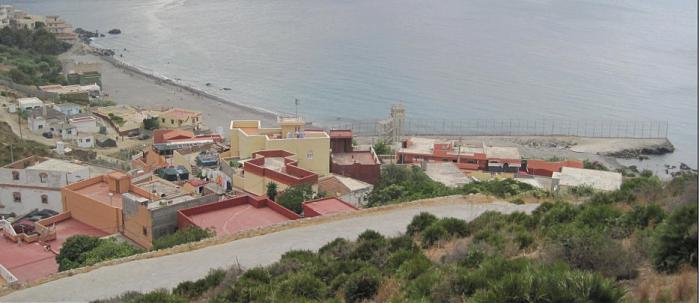
Wikisoriano, Wikimedia Commons, CC BY-SA 3.0. File photo showing the border area at Benzú, near Ceuta, seen from the Spanish side. Header may crop.