

Morocco’s 2027 Budget: Who Pays for the Social State?
Opinion / Budget Analysis. This is analysis, not straight news. Documented facts, official statements, interpretation and forecasts are labeled separately throughout. All figures are dated and attributed to their issuer; where sources conflict, we say so rather than choosing silently.
At nine o’clock this morning, the House of Representatives opens the plenary that decides the first reading of Morocco’s 2027 finance bill. The chamber’s own agenda lays out the sequence: the government answers the parliamentary groups, the House votes the first part of bill 60.26, hears the standing committees’ reports on the sectoral budgets, votes the second part, then votes the entire text. By tonight, the first budget of Fatima Ezzahra El Mansouri’s government should be through its first chamber.
What the House votes on this morning is no longer quite the text the government deposited in October. On Thursday, the finance committee adopted the first part by 23 votes to 17 – the coalition holding, the RNI, the PJD and the Left Alliance voting against – after working through 290 amendment proposals, ten of them from the government itself and 42 from the majority groups. The record of that committee stage, reported by Le Matin and detailed by SNRT, is the first hard evidence of what the new majority’s “change of course” means when it has to be written into tax articles. It is worth reading closely, because it answers the question the October speeches left open: who pays for the social state.
What is being voted on
The spending side is unchanged from the text this desk analyzed on November 7: 825.6 billion dirhams in state charges, up 8.4 percent; the income-tax exemption for salaries below 10,000 dirhams a month from January 1, 2027, which the ministry says takes 87 percent of salaried workers fully out of income tax at a 2027 cost of 5.5 billion dirhams; the minimum pension raised to 1,700 dirhams; widows’ survivor pensions doubled from 50 to 100 percent; electricity bills up to 100 dirhams covered; the direct-aid floor raised from 500 to 600 dirhams; 34,454 new budgeted posts, including 8,000 in health and 17,874 in education (figures and presentation). The macroeconomic frame is also intact: 3.7 percent assumed growth, a 3 percent deficit, debt easing from 67.5 to 66.9 percent of GDP (hypotheses).
What the committee changed
The amendments adopted on November 11 and 12 draw a precise map of where the majority was willing to look for money.
Fuel distributors move to the top rate. Importers and distributors of hydrocarbon products with annual net profit of at least 100 million dirhams will be taxed at 40 percent, up from 35 – aligned with banks, insurers and the CDG. This settles the question Lekjaa had left open in committee on October 30, when he said the targeting criterion, net profit or turnover, was still negotiable. The sector now carries the bill’s only corporate-rate increase. The political logic is not hidden: fuel distribution has been the most contested concentration of profit in the Moroccan economy since the 2022 price spike, the same constituency this desk covered when the government extended diesel support to transport operators rather than touch pump prices.
Small self-employment gets relief. The annual-turnover threshold at which auto-entrepreneurs fall under the flat withholding tax rises from 80,000 to 100,000 dirhams, and the withholding rate itself drops from 30 to 20 percent – a majority amendment the government approved, extending the purchasing-power story below the salaried class.
Vices and luxuries pay more. The consumption tax on cigars and cigarillos rises sharply (the specific levy from 750 to 1,125 dirhams per thousand units, the ad valorem share from 35 to 50 percent); the e-cigarette tax doubles from 50 to 100 dirhams and is widened to refillable devices, components and empty capsules – explicitly to close the workaround of selling disassembled products; syrups and concentrates used in fast-food soda fountains are brought into the consumption-tax net for the first time; wine and beer move to a 30 percent ad valorem rate with per-hectolitre minima, some spirits to 50 percent. First registration of luxury cars carries new progressive stamp duties of 5 to 25 percent, for an estimated yield of 1.045 billion dirhams.
The border becomes a compliance instrument. A 5 percent deposit on the customs value of goods imported for resale will apply to newly established traders and those with irregular tax situations – a formalization measure dressed as a customs one, and consistent with the revenue engine the whole budget leans on. In the other direction, the bill exempts FIFA, its affiliates and the 2030 legacy fund from customs duties on imports from January 1, 2027 through the end of 2032 – the customs chapter of the World Cup package this desk tracked when it was tabled in early November.
Food supply stays a managed market. The exemptions from import duties for live cattle, sheep, goats and camelids, and for their meat and offal, are kept – but Lekjaa attached two commitments: the agriculture minister will present updated herd data to the committee, and the exemptions themselves are now explicitly revisable – their duration, volumes and management adjustable if the national herd recovers. Read together with the minister’s October 30 remark that export volumes after drought years should be formally monitored, the pattern this desk flagged in the tomato export rationing is becoming a standing toolkit: drought-era emergency instruments turning into permanent levers over the food market. Aquaculture feed keeps its 2.5 percent preferential tariff quota of 15,000 tonnes through 2029. A proposed VAT exemption on sand sales was dropped.
What the committee did not change
The more instructive half of the record is what failed. The majority’s own groups proposed submitting telecom operators, cement producers and oil companies to the same 40 percent rate as the banks. The PJD proposed 40 percent for telecoms and cement, and a restored 10 percent rate for companies earning under 500,000 dirhams. The Left Alliance proposed 45 percent on hydrocarbons, cement, sugar refining and wholesale pharmaceuticals, and 50 percent on credit institutions. The RNI proposed a progressive 35/40 percent structure for oil companies, then withdrew. The Popular Movement proposed the opposite direction – cutting fuel distributors back to 35 percent to protect purchasing power.
None of it passed. Lekjaa’s answers in committee, reported verbatim by Le Matin, amount to a doctrine. The rate architecture – 0, 20, 35 and 40 percent, harmonized from a system that once had more than fourteen brackets – is the settlement reached at the national tax conference, and it is not reopening. Telecoms stay at 35 percent, plus what the minister noted is another 3 percent of turnover in universal-service and research levies. And then the sentence that frames the whole bill: “When the social dimension meets the economic dimension, it must be handled through support mechanisms rather than through taxation.”
In our reading
Three weeks ago, presenting this bill, Lekjaa promised a “genuine social state” that would break with “the logic of monopoly and exclusion.” The committee record shows how that sentence survives drafting. The break with monopoly logic does not run through the tax code: the sectors every Moroccan consumer recognizes as quasi-monopolies – telecoms and cement – keep their rates, on the government’s own insistence, against its own majority’s amendments. The one corporate rate that rises belongs to the fuel distributors, the single concentration of private profit that has become politically untouchable in the other sense since 2022. There is a real argument for this design, and the minister made it: redistribution through transfers is faster, better targeted and less distortionary than redistribution through rate schedules, and the pension floors, the widow’s benefit and the aid floor are exactly that. But it converts the government’s most quotable line into a spending promise rather than a structural one – and a spending promise lives or dies on the revenue line.
That line remains the bet we described on November 7: ordinary revenue up 14.5 percent in a 3.7-percent-growth year, corporate tax up 31.8 percent. The committee stage added a small irony worth noting: invited to dissect the bill for Le Matin, a Baker Tilly partner reached for the same base-effect defense of that 31.8 percent figure that the minister used in committee – it is measured against the initial 2026 law, not the expected 2026 outturn. The arithmetic question we posed then stands, and it now has its answer on where the government will and will not look for the difference: excises on vice and luxury, a deposit on irregular importers, one windfall tax on fuel margins, and otherwise the formalization machine. If the machine slows, the social floor has no second engine.
What to watch
- Today’s vote. Three votes in sequence – first part, second part, entire text. Adoption is the working assumption given the coalition’s 207 seats, but the margin and any abstentions will measure how the RNI opposition intends to fight the Senate round.
- The Council of Advisors. The second chamber’s finance committee is where rejected amendments can return; the government has now stated, on the record, the doctrine it will use to resist them.
- Promulgation. The constitutional calendar requires the law in force by December 31. This desk’s standing forecast F6 (recorded November 7) prices promulgation by that date at high confidence; today’s edition adds the checkpoints below.
Forecasts
- F24 – 0.90. The House of Representatives adopts bill 60.26 at first reading in the November 14, 2026 plenary. Check: chamber record and press reports, by November 15, 2026.
- F25 – 0.85. The 2027 finance law as promulgated does not raise the corporate-tax rate on telecom operators or cement producers above its current level (35 percent for telecoms). Check: promulgated text, by January 5, 2027.
- F26 – 0.80. The promulgated 2027 finance law retains the 40 percent corporate-tax rate on hydrocarbon importers and distributors with net profit of at least 100 million dirhams, as adopted in committee on November 12. Check: promulgated text, by January 5, 2027.
Sources
- House of Representatives, plenary sitting agenda, November 14, 2026 – https://www.chambredesrepresentants.ma/en/Seance1-141126 (accessed November 14, 2026, ~05:40 UTC)
- Le Matin, “PLF 2027 : la première partie adoptée en commission à la Chambre des représentants,” November 12, 2026 – https://lematin.ma/nation/plf2027la-1ere-partie-adoptee-en-commission-a-la-chambre-des-representants/375379 (accessed November 14, 2026, ~06:30 UTC)
- SNRT News, “PLF 2027 : auto-entrepreneurs, voitures de luxe, cigarettes électroniques, voici les principales mesures fiscales adoptées,” November 13, 2026 – https://snrtnews.com/article/plf-2027-auto-entrepreneurs-voitures-de-luxe-cigarettes-electroniques-voici-les-principales (accessed November 14, 2026, ~06:30 UTC)
- LeNew, “Auto-entrepreneurs, importations, tabac : les amendements majeurs du PLF 2027,” November 13, 2026 – https://lenew.ma/auto-entrepreneurs-importations-tabac-les-amendements-majeurs-du-plf-2027/ (accessed November 14, 2026, ~06:30 UTC; corroboration)
- Medias24, “Les chiffres détaillés du budget de l’État pour 2027,” October 24, 2026 – https://medias24.com/2026/10/24/les-chiffres-detailles-du-budget-de-letat-pour-2027-1783584/ (accessed November 14, 2026, ~05:35 UTC)
- Medias24, “Les salaires inférieurs à 10.000 DH seront totalement exonérés de l’IR dès le 1er janvier 2027,” October 23, 2026 – https://medias24.com/2026/10/23/les-salaires-inferieurs-a-10-000-dh-seront-totalement-exoneres-de-lir-des-le-1er-janvier-2027/ (accessed November 14, 2026, ~06:25 UTC)
- Medias24, “Croissance, inflation, agriculture, énergie : les hypothèses du PLF 2027,” October 26, 2026 – https://medias24.com/2026/10/26/croissance-inflation-agriculture-energie-les-hypotheses-du-plf-2027-1784016/ (accessed November 14, 2026, ~06:20 UTC)
- The Daily Perspective (internal), “Morocco’s 2027 Budget: Where the New Majority’s Promises Meet the Arithmetic,” November 7, 2026 – https://sadajournal.com/morocco-2027-budget-new-majority-promises-arithmetic/
- The Daily Perspective (internal), “Morocco’s Fuel Protest and the Diesel Arithmetic,” November 8, 2026 – https://sadajournal.com/morocco-fuel-protest-diesel-arithmetic/
- The Daily Perspective (internal), “Morocco Rations Tomato Exports: Africa Takes the Cut, Europe Doesn’t,” November 6, 2026 – https://sadajournal.com/morocco-rations-tomato-exports-africa-takes-the-cut-europe-doesnt/
- The Daily Perspective (internal), World Cup financing analysis, November 9, 2026 – https://sadajournal.com/morocco-2030-world-cup-off-budget-arithmetic/
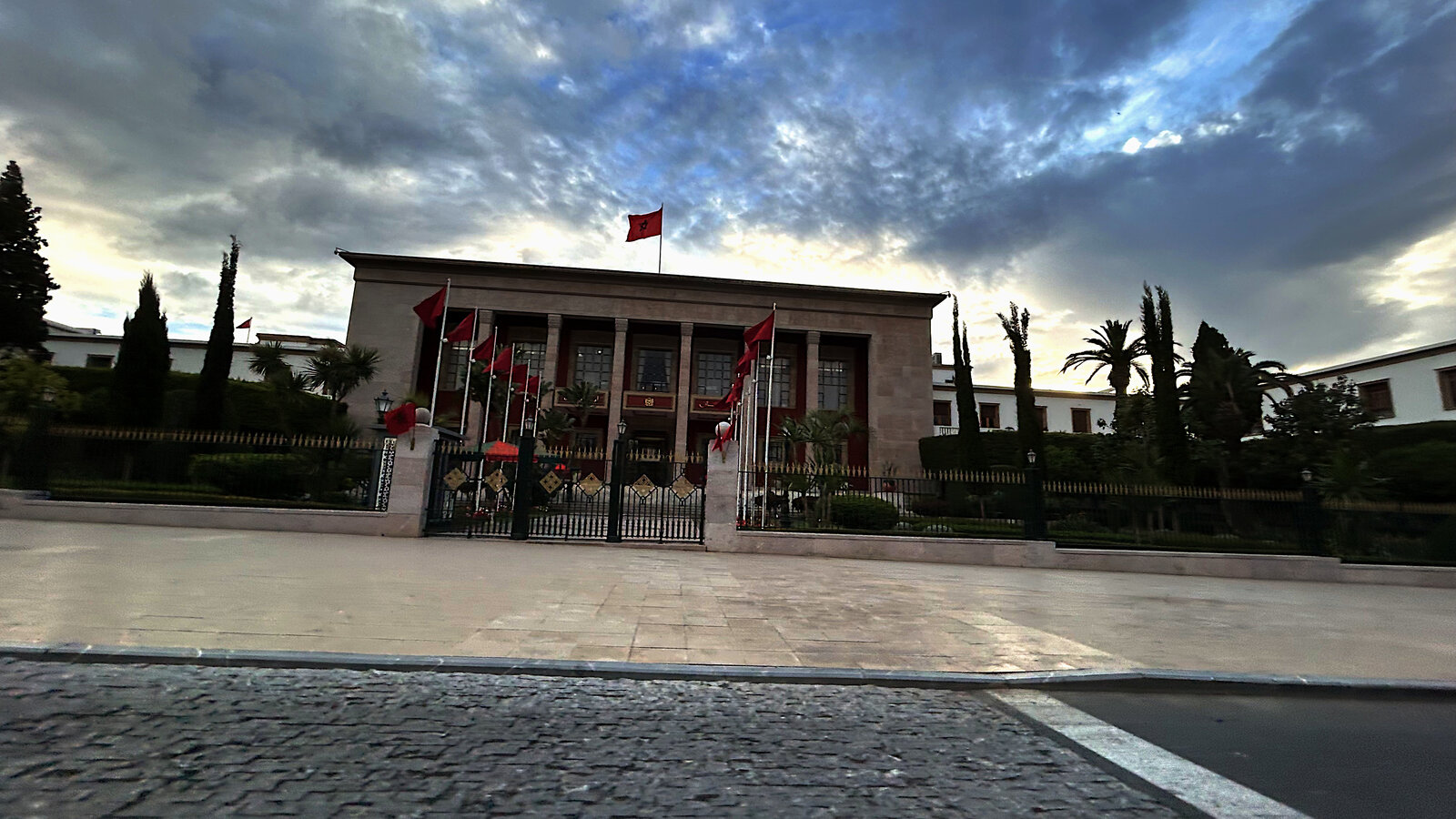
Featured image: The Moroccan Parliament building in Rabat. Photo: Serrarmohamesomar, via Wikimedia Commons, CC BY-SA 4.0. Illustrative image; it does not depict today’s sitting.
Method note: Sources are named in the text and listed above so readers can check our work; editorial responsibility rests with the publication.