

Opinion / Economic Analysis. This is analysis, not straight news. Documented facts, official statements, disputed claims, interpretation and forecasts are labeled separately throughout. All figures are dated; where sources conflict, we say so rather than choosing silently.
Between noon and 6 p.m. today, an unknown number of Moroccans will leave their cars parked. The Citizens’ Initiative Committee for Fuel Price Caps – a citizens’ group with no party machinery behind it – has called for “Six Hours Without Transport,” a voluntary, explicitly peaceful protest against fuel prices that have climbed past what many households say they can absorb. Motorists, employees, civil servants, taxi drivers and truckers are invited to join; roadblocks are explicitly ruled out; ambulances and trucks carrying perishables are asked to keep rolling.
As a piece of political theater it is modest. As a signal it is not. It is the second such action in three weeks – a consumer protection association called a one-hour “car-free” pause on October 18 – and it lands four days after the government, through Budget Minister Fouzi Lekjaa, formally closed the two doors the protesters are pushing on: there will be no cap on fuel prices, and no return to subsidies. The question worth asking this Sunday is not whether parking a car for six hours works. It is whether the arithmetic on each side of this argument survives contact with the numbers.
The price at the pump, dated
Start with what is documented. On November 1, distributors applied a fresh adjustment: ordinary diesel rose by about 1.00 dirham to roughly 16.30 dirhams per litre (16.75 for premium), while ordinary petrol eased 0.10 to 15.65 (16.35 premium), according to pump-price tracking published November 2. Because the market is liberalized, the increase did not land uniformly – and this week’s variance is itself part of the story. Actual readings in Casablanca on November 1 ran from 16.40 dirhams at Afriquia to 16.99 at TotalEnergies, with yoom, Winxo, Shell and Petromin in between; in other cities diesel crossed 17. The 59-centime spread between two brands in the same city is, according to the national federation of station owners and managers, the widest the market has ever seen between distributors – the first visible crack in the lockstep pricing that has defined this market since 2015. The honest summary: early-November diesel sits somewhere between 16.30 and 17 dirhams depending on brand and city, at or near its highest level of the liberalized era.
The decade comparison is stark. Bank Al-Maghrib data drawn from the old Compensation Fund put the 2015 average at 8.50 dirhams for diesel and 10.10 for petrol. Against roughly 16.30 and 15.65 today, diesel is up about 90 percent and petrol about 55 percent over ten years – a period, it is worth adding, when official annual inflation has mostly been low: the High Commission for Planning put September 2026 consumer-price inflation at 0.5 percent year on year, even as food jumped 1.6 percent in a single month. The pump, not the CPI basket, is where Moroccan households feel prices.
Anatomy of a litre
Why does diesel cost what it costs? The most useful public decomposition comes from Les Inspirations Éco, which modeled the chain in late August when diesel sold around 14.90. Morocco imports finished fuel, not crude: since the SAMIR refinery at Mohammedia stopped refining in 2015, there is nothing to refine here. Importers buy refined diesel quoted in dollars on the Rotterdam hub and CIF Northwest Europe markers. On a reference price of about $1,250 a tonne, plus freight, insurance and port costs, the model put the landed cost at the Moroccan dock at roughly 10.11 dirhams per litre – before a single dirham of tax or margin.
Then the state and the supply chain take their layers. The Taxe Intérieure de Consommation (TIC) is fixed at 2.42 dirhams per litre of diesel. Logistics, storage, and the gross margins of the distributor and the station manager add roughly another dirham. Value-added tax – a reduced 10 percent rate on fuels, applied on top of everything including the TIC – closes the stack. In the August model: 10.11 + 2.42 + about 1.00, taxed at 10 percent, gives 14.88 dirhams, almost exactly the observed pump price. The same arithmetic makes the recurring fantasy of a “9-dirham litre” impossible without a subsidy: the product alone, untaxed, at the dock, already costs more than that. One caution, and it matters: this is an August calibration, not a current reconciliation. Run at today’s 16.30, the same stack implies a landed cost near 11.40 dirhams per litre – about 1.30 above the August model, the right order of magnitude given the rise in international product prices since. But distributors do not publish what they actually pay per cargo, so a complete reconciliation of today’s price is not possible from public data; the model shows the structure, not the exact sum.
Every import-cost term in that equation has moved against the consumer since August. International product prices were then heading toward $1,300 a tonne; Brent crude settled at $98.32 a barrel on Friday, November 6, the last trading session before this article was written, with Middle East supply tensions keeping refined-product premiums elevated. The November 1 increase was the mechanical result.
The government’s answer, in its own numbers
This is where official statements begin, and they should be labeled as such. Speaking November 4 before the finance committee of the House of Representatives, during the detailed review of the 2027 finance bill, Lekjaa ruled out both a price cap and a return of diesel and petrol to the compensation system. A generalized fuel subsidy, he estimated, would cost the state 50 to 70 billion dirhams a year – money he framed as coming directly out of hospitals, public services and social programs. He added that the old system had disproportionately rewarded the biggest consumers: households with several vehicles and long commutes.
On taxes, his figures deserve exact quotation because they cut against the protest’s central demand. Scrapping the TIC entirely, he told the committee, would lower the pump price by only about 1.20 dirhams per litre. And the fuel companies’ alleged windfall? Revenue of the tracked distributors rose from 99.52 billion dirhams in 2017 to 131.365 billion in 2025, but their combined profits fell from 8.505 billion to 7.69 billion over the same period – a margin rate down from about 8.6 percent to 5.85 percent. It was not his first pass at the argument: in May, before the Chamber of Councillors, he had already stressed that the TIC is levied on volume, not price, so the state gains nothing from it when world prices rise, and that the VAT generated by this year’s price surge came to about 0.46 dirhams per litre of diesel – small change next to the roughly 3.7 dirhams per litre he attributed to the international shock itself. The state’s real energy outlays, in his telling, flow elsewhere: about 600 million dirhams a month to hold down butane, 650 million to stabilize transport fares, 300 million for electricity.
The protesters’ arithmetic
The other side has its own numbers, and they are not all wrong. The demands circulating with the protest call – catalogued this week by sector press – include scrapping the taxes at the pump, which organizers put at about 4 dirhams per litre of diesel and 5 per litre of petrol; restarting refining at SAMIR, whose hypothetical refining margin is claimed at nearly 6 dirhams per litre; and ending liberalization outright in favor of strict price control.
Take each in turn. On taxes, both sides are arithmetically defensible and still talking past each other. The protesters’ 4-dirham figure checks out on its own terms: 2.42 dirhams of TIC plus 10 percent VAT on the full stack comes to roughly 3.90 dirhams on a 16.30-dirham litre. Lekjaa’s 1.20-dirham figure measures something different – his estimate of what completely abolishing the TIC would actually shave off the pump price, offered without published methodology. Both can be true, and neither delivers what the street wants: the TIC’s full nominal value is 2.42, not 4, and the remainder is VAT the state is unlikely to surrender while it funds butane, transport and electricity support. The SAMIR number is the weakest leg: a closed, liquidated refinery (liquidation was pronounced in March 2016) has no margin at all, and restarting one would take years and billions before its first litre. The consultancy Vivae Capital put the decade-long economic cost of SAMIR’s absence at 197.3 billion dirhams in a June report – a striking figure, but an estimate, not an audited fact. What restarting SAMIR would genuinely change is not next month’s pump price but Morocco’s strategic stock cover and its exposure to the Strait of Hormuz. Which is not nothing.
As for price caps: parliament already walked this road once. An opposition bill to regulate fuel prices was tabled in early January 2022, before the Ukraine invasion; on March 3, 2022, days into the post-invasion price spike, the government of the day refused capping outright, and the bill died. The Competition Council – the referee created by the same 2015 liberalization law – has consistently preferred fixing the market’s structure to freezing its prices.
The structural trap
And that structure is the part of the story where the protesters and the ministry should be able to agree, because the documented facts are damning on their own. Morocco’s fuel market is an import oligopoly sitting on concentrated storage. The Competition Council’s monitoring report for the first quarter of 2025 puts national storage capacity at 1.57 million tonnes at end-March 2025, with the nine reporting operators holding about 81 percent of it. Their average gross commercial margins in that quarter were 1.24 dirhams per litre on diesel and 1.95 on petrol. On actual stock levels, the audit cited here concerns end-2015: the Court of Auditors’ December 2016 security-stocks report found that at that time, diesel stocks covered an average of 24.1 days of consumption and petrol 34.8 days, against a regulatory level it put at 60 days for refined products at distributors (an obligation rooted in decrees of 1961 and 1977, since amended). No public source we reviewed answers whether distributors meet their stock obligation today, and we cannot rule out that a newer audit exists that we did not find; that gap in what we can see is itself part of the structure. And it is a market with a proven collusion problem: on November 23, 2023, the Competition Council unanimously validated settlements with nine distributors and their professional organization totaling 1,840,410,426 dirhams, ending the anticompetitive-practices proceedings; the quarterly reporting that produced the margin figures above exists because of the behavioral commitments attached to that settlement.
A country that imports every litre it burns, keeps four-fifths of its storage capacity in nine hands and prices it off a dollar market it cannot influence has, in effect, chosen its vulnerability. That choice was defensible in 2015, when diesel cost 7.98 dirhams and the Brent curve was benign. It is harder to defend in a year when a shipping lane on the other side of the world decides what a Casablanca taxi driver earns – and when the public cannot see whether the legal stock cushion exists.
What would actually move the price
This is interpretation, offered as such. The honest menu is short, and none of it is free. A generalized subsidy would work immediately and bankrupt slowly – Lekjaa’s 50-to-70-billion figure is plausible, and it would indeed flow disproportionately to heavy consumers, as he says. A TIC cut would deliver a visible but small relief – somewhere between his 1.20 dirhams and the tax’s nominal 2.42, and permanently narrow the tax base for a symbolic gain. A cap without subsidy mostly produces shortages and gray markets; 2022’s shelving of the cap law was the system’s quiet admission of that.
What the evidence actually supports is the unglamorous middle the Competition Council keeps recommending and the ministry now claims to pursue: publish a current public audit of compliance with the strategic stock obligations in force, and close whatever gap it finds, so Morocco buys insurance instead of panic; open storage to independent stockists so additional independent importers can enter the market; publish a transparent, regular pass-through account so the public can audit whether international decreases reach the pump as fast as increases do – the Council’s own periodic notes suggest they do not; and direct whatever fiscal room exists at the people the price shock actually breaks – transport workers, farmers, low-income commuters – rather than at the litre, where most of the benefit leaks to those who need it least. None of that makes diesel cheap. All of it makes the price honest.
What we expect
Forecasts, stated with probabilities and dates so they can be scored later, not vibes:
- 85 percent: no generalized diesel or petrol subsidy is reinstated before the 2027 finance law is promulgated (deadline December 31, 2026). The government has said so, repeatedly and on the record, in the middle of the budget’s parliamentary passage.
- 70 percent: no fuel price-cap mechanism becomes law before June 30, 2027. The 2022 precedent and the Competition Council’s doctrine both run against it.
- 60 percent: the average pump price of ordinary diesel remains at or above 15 dirhams per litre through March 31, 2027, absent Brent below roughly $80 a barrel. The pass-through arithmetic leaves little room for anything else.
Six hours of parked cars will not change any of these numbers. But a protest does not have to move a price to matter. The minister’s arithmetic is on the parliamentary record, and the structure of this market – the missing refinery, the storage cushion the public cannot see, the nine names – is on the public record alongside it. That is true before a single car is parked. What the organizers’ six hours add, and how many answer the call, the roads will tell us tonight.
Sources
- Hespress English – “Moroccans urged to stop using vehicles for six hours in fuel price protest” (November 3, 2026): the Citizens’ Initiative Committee for Fuel Price Caps’ call, timing (noon-6 p.m., November 8), and conduct rules.
- Bladi.net – “Moroccans urged to leave cars at home for one hour on October 18” (October 13, 2026): the earlier consumer-association action.
- TelQuel (March 3, 2022): the Akhannouch government’s refusal of fuel price caps and SAMIR renationalization; Le Matin (January 4, 2022): the PPS price-regulation bill.
- Moteur.ma – “Carburants au Maroc: nouvelle hausse du gasoil à la pompe” (November 2, 2026): November 1 pump prices (diesel 16.30/16.75; petrol 15.65/16.35) and the transport sector’s demands.
- L’Oeil d’Afrique (November 2, 2026): Casablanca pump readings by brand (16.40-16.99 diesel), the record 59-centime inter-brand spread, and the station owners’ federation reaction.
- LeNew.ma (November 1, 2026) and LesMRE (November 3, 2026): diesel approaching/at 16.90-17 dirhams at some distributors.
- Le360 / Les Inspirations Éco (August 30, 2026): the litre-price decomposition – landed cost ~10.11 dh, TIC 2.42 dh, logistics and margins ~1 dh, VAT 10%.
- Le360 – interview with economist Khalid Doumou (June 29, 2026): VAT at the reduced 10% rate, TIC’s volumetric design, liberalization date and 2015 prices, and the Vivae Capital SAMIR report (June 2026). TIC at 2.42 dh/l corroborated by EcoActu (December 1, 2025) and Consonews (August 31, 2026).
- Conseil de la concurrence – official communiqué (November 23, 2023): transactional settlements with nine fuel companies and their professional organization totaling 1,840,410,426 dirhams, with behavioral commitments including quarterly reporting.
- Conseil de la concurrence – Q1 2025 gasoil/petrol monitoring report (July 2025): average gross commercial margins 1.24 dh/l diesel and 1.95 dh/l petrol; imports ~1.62 Mt; storage 1.57 Mt at end-March 2025, 81% held by the reporting operators.
- Cour des comptes – Rapport sur les stocks de sécurité au Maroc (December 2016): regulatory level put at 60 days of consumption for refined products at distributors (basis: 1961 and 1977 decrees, later amended); actual cover at end-2015 averaging 24.1 days (diesel) and 34.8 days (petrol).
- Maroc Diplomatique (November 4, 2026): Lekjaa’s statements to the House finance committee – no cap, no compensation, 50-70 billion dh subsidy cost, ~1.20 dh TIC-removal effect, distributor revenue/profit/margin figures, Q1 2025 margins (1.24/1.95 dh), storage concentration (81%), Court of Auditors stock cover (24.1/34.8 days).
- Hespress (May 12, 2026): Lekjaa at the Chamber of Councillors – TIC levied on volume, VAT on the diesel price surge ~0.46 dh/l, crisis surcharge ~3.7 dh/l, monthly support for butane (600M dh), transport (650M dh) and electricity (300M dh).
- Industrie du Maroc (October 16, 2026): decade comparison using Bank Al-Maghrib/Compensation Fund 2015 averages (diesel 8.50, petrol 10.10); December 1, 2015 liberalization; 2014 subsidy elimination.
- Hespress English (October 22, 2026): HCP September 2026 CPI – annual inflation 0.5%, food +1.6% month on month.
- FXNews.ai and Investment Digger (reported November 7, 2026): Brent settled at $98.32 on Friday, November 6, 2026, the week’s last session.
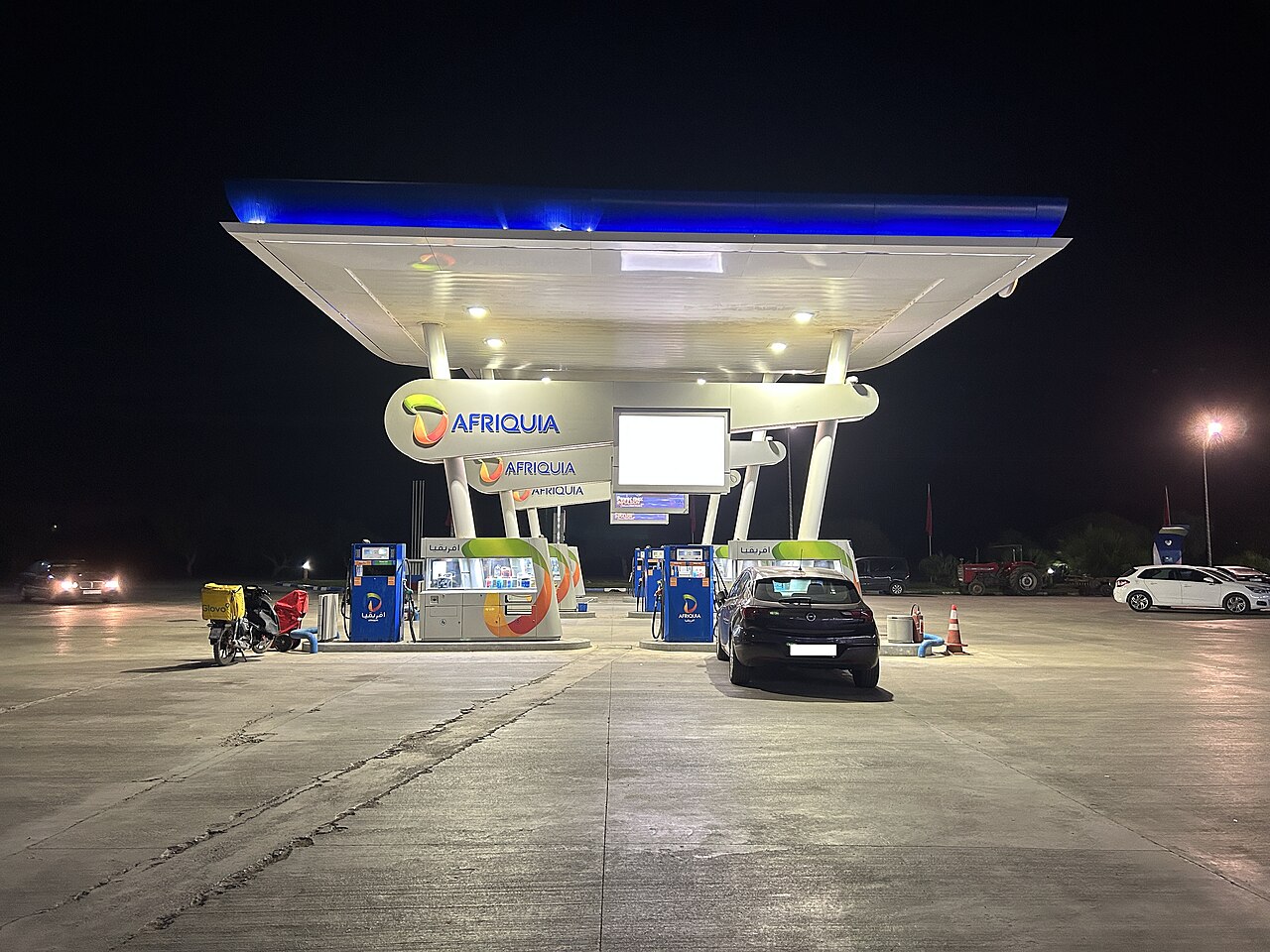
Photo: an Afriquia service station in Bouznika, Morocco, October 2023. Illustrative – the protest call asks motorists to leave stations alone, not to block them. Anass Sedrati, via Wikimedia Commons, CC BY-SA 4.0.

Corrections, November 8, 2026: This article originally stated the end-2015 storage findings in the present tense and derived an approximate “months of cover” figure from storage capacity and import volumes; storage capacity is not inventory, and that derivation has been removed. The audit cited here concerns end-2015, and the article now says so. The closing paragraph was recast to remove an unproven causal claim about the minister’s November 4 remarks. No figure or forecast was changed.