
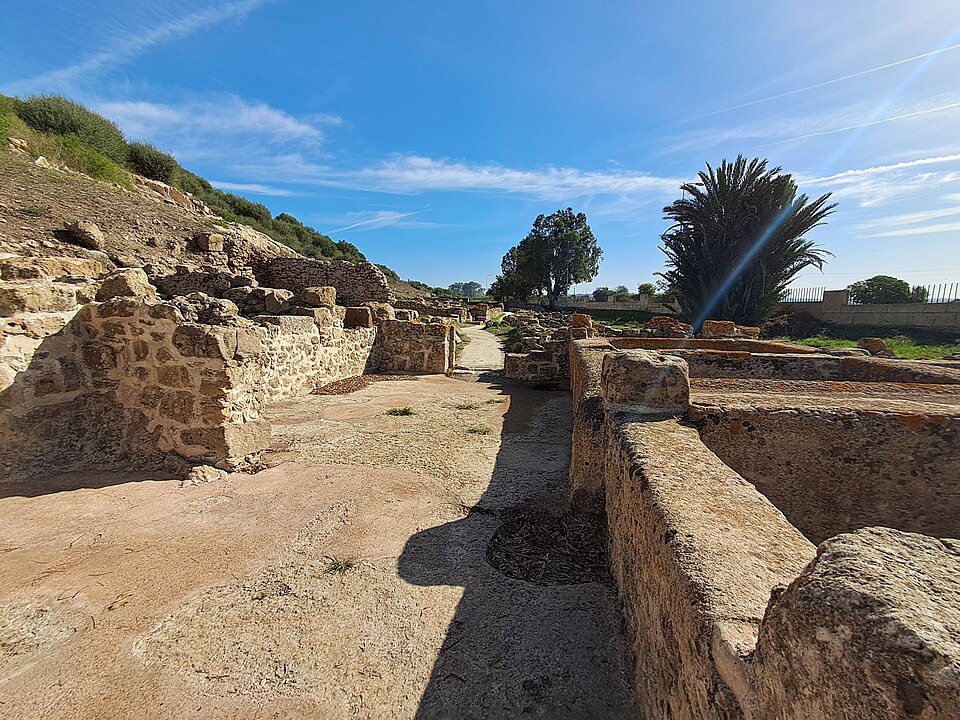

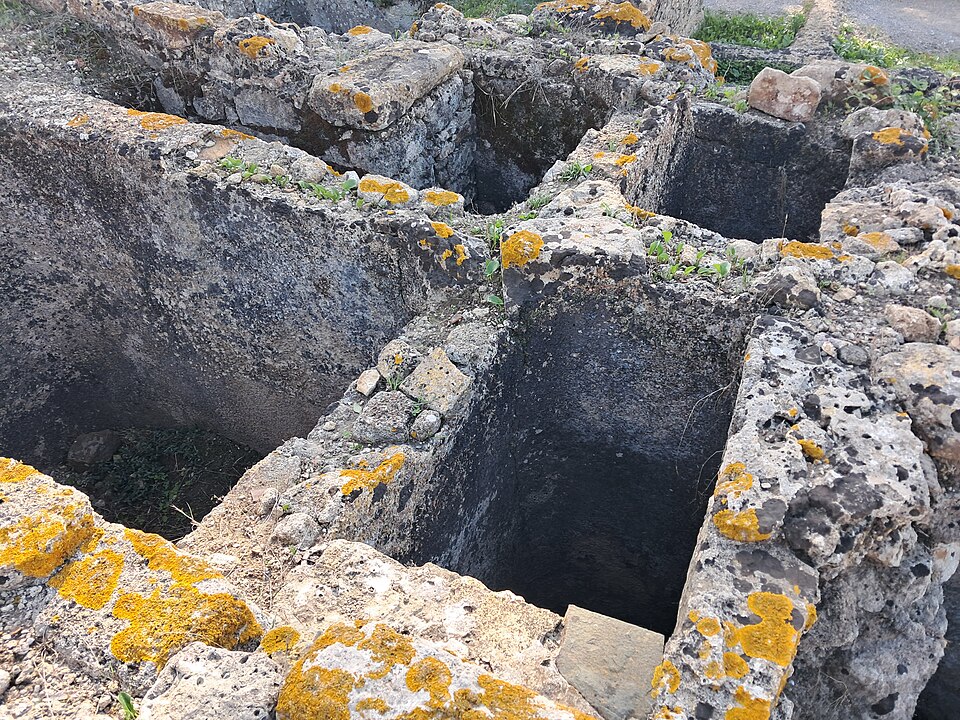
At Lixus, near Larache on Morocco’s northern Atlantic coast, rows of stone basins preserve the outline of an ancient fish-processing economy. But the basins do not answer every question. Fish had to be caught, salted or made into sauce, packed and transported. Understanding the city means following that chain beyond the visible ruins.
A 2026 study in the archaeology journal Lucentum brings one part of that chain into focus: the clay transport jars known as amphorae. Tests on a selected group of 26 jars found many that were inconsistent with a local origin. The result shows Lixus participating in regional exchange, while leaving an important question open: where were the containers for its own fish products made?
A city older than Roman rule
Lixus overlooks the Loukkos River, near the modern city of Larache. It is often described through its Roman remains, but its history is longer. Archaeology magazine’s 2024 account dates the earliest settlement traces to the eighth century BCE, when Phoenicians from the eastern Mediterranean established an outpost there. The city later developed within the ancient kingdom of Mauretania before Roman annexation. Ancient Mauretania is not the present-day country of Mauritania.
The river setting also needs historical interpretation. Archaeologist Stephen Collins-Elliott told the magazine that around two thousand years ago Lixus stood on a peninsula in a brackish lagoon, rather than as far inland as it appears today. Reading today’s landscape as an unchanged map of the ancient port would therefore be misleading.
The city’s pre-Roman development is an active subject of scholarship, not simply a preface to Rome. The University of Valencia’s research history describes its joint work with Morocco’s heritage institute at Lixus between 1995 and 2009, tracing Phoenician occupation and the later monumental project associated with King Juba II.
The work behind the basins
The processing district produced salted fish and fermented fish sauces, commonly discussed under the name garum. Those products belonged to a wider system of fishing, salt supply, preparation, storage and distribution. A basin is evidence of production infrastructure, not an annual sales ledger.
Moroccan and Spanish researchers have returned to this system through a partnership involving Morocco’s National Institute of Archaeological Sciences and Heritage, known as INSAP, and Spain’s University of Cadiz. The university’s project record describes an interdisciplinary study of ancient marine resources at Lixus. Its funding entry is dated 2024-2025; it is not evidence of the project’s present budget or staffing.
In a November 2024 interview with ABC, archaeologist Dario Bernal described work combining terrain models, geophysical surveys, material studies and excavation. He reported garum remains but said the ingredients were still being analysed. That distinction separates finding a production residue from reconstructing a recipe.

A jar’s shape is not its birthplace
The Lucentum study, by Leandro Fantuzzi and colleagues, examined amphorae from excavations in Lixus’ Southern Sector. The researchers used thin-section optical microscopy: studying very thin slices of ceramic under a microscope to identify minerals, rock fragments and texture. They compared those features with the geology around Lixus and with pottery from known production areas.
The sample included jars whose appearance had suggested possible local manufacture. The analysis instead found a varied group, with most ceramic compositions incompatible with a local origin and several linked to southern Hispania, the Iberian territory across the Strait of Gibraltar. Different vessels could resemble one another in shape without having been made from the same clay or in the same workshop.
That does not mean Lixus made no jars. The authors explicitly leave local amphora production unresolved. They discuss misfired bricks and ordinary pottery found in recent excavations as possible signs of nearby workshops, while warning that this does not yet establish amphora manufacture. A selected sample of 26 is not a census of every container used throughout the city’s history.
Production and circulation need separate evidence
The researchers consider external supply and possible reuse of regional containers, but treat these as hypotheses requiring more work. An imported jar’s presence at Lixus does not, by itself, prove where it was filled, every cargo it carried or its complete route. Nor can the surviving basins be converted directly into annual export tonnage without evidence about their use over time.
This is what makes the site more than a collection of Roman monuments. As at Volubilis, buildings become more informative when read alongside the work that supported the city. The relationship between a port and its working economy also matters to understanding Essaouira, although its history belongs to a different period. At Lixus, the basins establish a place of processing; the jars reveal a network whose details are still being tested.
Sources and method: This explanation draws on the full 2026 Lucentum paper, institutional research records and dated specialist and newspaper reporting. It is not a site visit or a current visitor-access guide. Historical observations and research dates remain explicit. AI assisted research, translation, drafting and editorial review; material claims were checked against the linked sources.
Lead photograph: Lixus’ fish-processing district, 7 November 2024 according to source camera metadata. Archive context, not current site conditions. Photograph: Ideophagous, Wikimedia Commons, CC BY-SA 4.0. Full-frame reduced-resolution reproduction; no generative changes. Wikimedia Morocco supported the making of both source photographs.
