
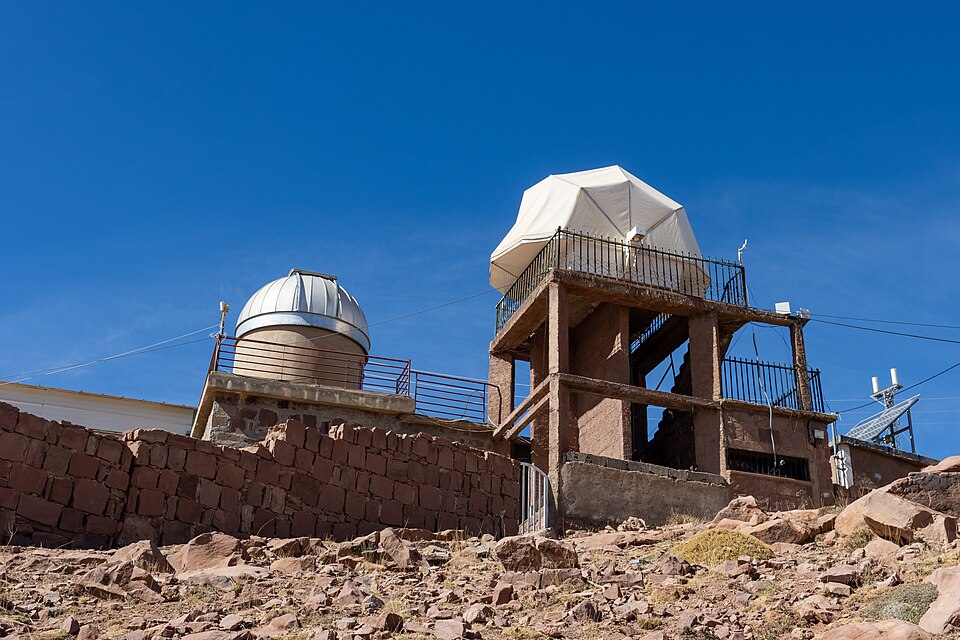

At Morocco’s Oukaimeden Observatory, an image of the sky is often the beginning of the work, not the result. Repeated measurements can show a star dimming as a planet crosses it, trace gases escaping from a comet or help refine an asteroid’s path. The site’s scientific value lies in turning those observations into evidence that other researchers can test and use.
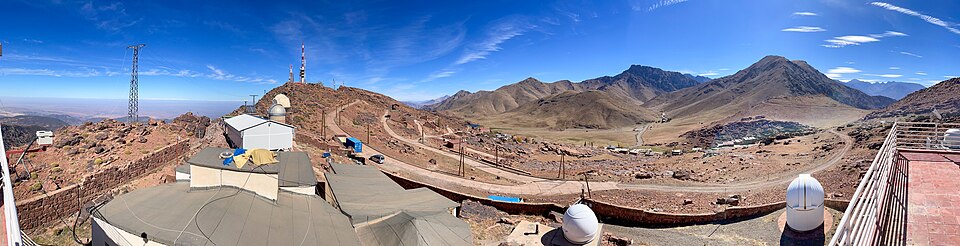
Operated by Marrakech’s Cadi Ayyad University in the High Atlas mountains, the observatory is about 2,750 metres above sea level. Its university history dates the inauguration of new facilities to April 2007, while recording Moroccan researchers’ use of the site since 1987. That distinction matters: a building’s opening date is not the start of the scientific activity that made it possible.
A small telescope with a specific job
One instrument illustrates the approach particularly well. TRAPPIST-North is a robotic telescope with a primary mirror 60 centimetres across, installed in May 2016 through a collaboration between Cadi Ayyad University and the University of Liège in Belgium. Its twin, TRAPPIST-South, operates at La Silla in Chile. A 2017 instrument and comet study describes how the Moroccan telescope extends the pair’s access to the northern sky.
The two locations make it possible to follow comets over more of their orbits than either site could alone. That does not mean uninterrupted coverage: an object’s position, daylight, weather and observing conditions still restrict what a ground-based telescope can record. The researchers’ later observing logs show those practical limits as well as the network’s advantages.
A planet measured through a dip in light
In a 2017 conference paper, Khalid Barkaoui and colleagues reported an observation of the already known exoplanet TrES-3b on 1 June 2016. An exoplanet is a planet orbiting a star other than the Sun. When one passes in front of its star from the observer’s viewpoint, the star’s measured brightness falls slightly. This crossing is called a transit.
The team observed for almost three hours, taking exposures of 13 seconds. They compared the target star’s light with stable comparison stars to reduce atmospheric effects, then fitted a model to the brightness curve. The scatter in the residuals, the differences between the measurements and the fitted model, was 600 parts per million, or 0.06%.
That figure describes the precision of this observation, not the fraction of planets the telescope can discover. The analysis refined the planet’s estimated radius and found agreement with earlier work. It is a useful example of follow-up science: a new instrument can improve knowledge of an existing object without announcing a new world.

What a comet image can reveal
Comet research asks a different question. Rather than measuring a brief dip in starlight, researchers use filters to isolate light associated with particular gases and with dust around a comet. Repeated observations help them follow changes as the object moves around the Sun.
A 2018 paper in Astronomy & Astrophysics reports observations of comet 41P/Tuttle-Giacobini-Kresak on 34 nights between 16 February and 27 July 2017. The team obtained 600 images with TRAPPIST-North during that campaign. Before interpreting the signal, they calibrated images, subtracted the sky background and accounted for dust contaminating the gas measurements.
The same study explains why gaps matter. Comet 45P/Honda-Mrkos-Pajdusakova was too close to the Sun in the sky around its closest approach to the Sun for most ground-based telescopes to observe it. The Moroccan observations covered a later period. A missing measurement is therefore not proof that nothing happened; it can reflect where the telescope and target were.
Discovery and follow-up are different contributions
Oukaimeden also hosts the Morocco Oukaimeden Sky Survey, known as MOSS. In a July 2018 account, the Planetary Society described a partnership in which Cadi Ayyad supplied a building, Switzerland’s Jura Observatory built a dome and astronomer Claudine Rinner supplied a half-metre telescope. The survey began operating in 2011.
The report explains why repeated asteroid positions matter: multiple observations refine a trajectory and help researchers assess a possible Earth impact. Finding an object and constraining its orbit are related tasks, but they are not interchangeable. Nor should a 2018 description of staffing, funding or equipment be read as the observatory’s position in 2026.
This distinction between an observation and the conclusion drawn from it runs through Moroccan science. The work at Jebel Irhoud combines fossil interpretation with dating evidence; northern bald ibis monitoring depends on knowing which birds and periods a record describes. At Oukaimeden, the equivalent discipline is to identify the instrument, the observing dates and the analysis behind the claim.
The observatory is also a training site. An April 2024 university account describes students from Liège and Cadi Ayyad spending a week observing at night, processing data and attending classes during the day. The work ranged from asteroid rotation curves to exoplanet transits and comets. The mountain setting provides a view of the sky; the lasting contribution comes from learning how to measure it.
Sources and method: This explanatory article draws on published research, university records and dated specialist reporting. It is not a site visit, a current equipment audit or a guide to public access. Research examples retain their observation and publication years. AI assisted research, translation, drafting and editorial review; material claims were checked against the linked sources.
Lead photograph: Buildings and observing domes at Oukaimeden Observatory, 1 November 2023. Archive context, not a current equipment inventory. Photograph by Mike Peel, via Wikimedia Commons, CC BY-SA 4.0. Reduced-resolution reproduction; no generative changes.
