

On Wednesday, King Mohammed VI chaired a working session at the Royal Palace in Rabat on what follows the end of MINURSO’s mandate. According to the Royal Cabinet statement carried by MAP, the King reaffirmed that Morocco’s commitment to the ceasefire is “a voluntary commitment that will not change with the end of the mandate of the United Nations mission”, and instructed that the Office for Coordination with MINURSO, under the Interior Ministry, coordinate and support the mission’s liquidation and withdrawal. Head of Government Fatima Ezzahra El Mansouri, royal advisor Fouad Ali El Himma, Interior Minister Abdelouafi Laftit and Lieutenant General Mohammed Berrid, the armed forces’ Inspector General and South Zone commander, attended.
That is the statement. The harder question is what now verifies the promise.
Precision matters here, because two different things happened at once. The mandate expired at midnight on October 31, and the UN says the mission’s operations have ended. But the mission has not physically left. A liquidation period began on November 1, with a smaller team reporting to the UN Department of Operational Support overseeing the disposal of equipment. So UN personnel remain on the ground for now, without a monitoring function. What has ended is not the UN’s presence but its mandate to observe: no mission team is any longer tasked with visiting sites, investigating alleged violations or reporting on them.
That monitoring role was real. At the mandate’s end, according to UN News (November 1), MINURSO had about 160 military observers and around 180 civilian and affiliated personnel, nine team sites – four west of the berm and five east of it – plus a liaison office in Tindouf and a mine action capability. MINURSO was the UN mission specifically mandated to monitor the ceasefire on the ground. Whatever its limitations, alleged violations could be reported to an external UN mission, whose reporting provided foreign capitals with a common, if imperfect, reference point.
The Royal Cabinet statement argues the mission had “repeatedly proved unable to monitor compliance” with the ceasefire or “determine the consequences of its violation”. That was Rabat’s case for letting the mandate lapse. But the argument cuts both ways: if the referee was already weak, removing the function entirely does not strengthen the ceasefire. It converts a monitored arrangement into a unilateral assurance.
Morocco’s pledge is one side’s word. On the other side, the only Polisario reaction found so far is a secondary report: Algerian outlet Algerie 54 quotes Sahrawi foreign minister Mohamed Yeslem Beissat saying on Wednesday that the Front does not refuse negotiations with Morocco and remains open to a political process guaranteeing the Sahrawi right to self-determination. That is openness to talks, not a ceasefire commitment, and since the original statement was not seen directly, this report alone does not establish everything the Front said on Wednesday. The Front seeks independence for the territory and announced in 2020 that it no longer considered itself bound by the ceasefire. Low-intensity hostilities have been reported since 2020, which the UN acknowledged this week. The status of Western Sahara remains contested, and Algeria hosts and backs the Polisario leadership in the Tindouf camps.
Rabat’s incentives to keep the line quiet are real. The statement pairs the ceasefire pledge with the priorities of the October 30 Royal Office communiqué: territorial integrity, national security, the calm of citizens in what Morocco calls its Southern Provinces, and continuity of the development programme there. The diplomatic momentum the statement cites, including what it calls recognitions of Moroccan sovereignty by friendly and brotherly countries, depends on the territory looking stable. A visible clash would undercut the diplomatic momentum Rabat says it has gained.
Incentives, though, are not verification. The risk in the coming months is not necessarily a deliberate offensive. It is the smaller category of event – a patrol incident, an alleged drone strike, a casualty near the berm – that each side could describe differently, with no mission mandated to check. Under the old framework, that is what mission reports were for.
The diplomatic track does not pause. The Secretary-General said the mission’s departure “does not abrogate” the Sahrawi people’s right to self-determination, and his Personal Envoy, Staffan de Mistura, keeps his mandate. On November 10 the General Assembly meets under agenda item 62, “Use of the veto”, convened by the Assembly president’s letter of November 2 under resolution 76/262, following the veto cast at the Council’s October 30 meeting; the meeting is a debate about the veto, not a vote on the territory’s status. Morocco also wants the file removed from the Assembly’s Fourth Committee, according to a November 1 report by Assahifa of comments by Foreign Minister Nasser Bourita. None of these forums has a monitoring presence on the ground.
What to watch
- Whether the liquidation proceeds on schedule and without friction, including at the five team sites east of the berm.
- Any incident claimed by either side, and whether at least two independent sources can confirm it. With no mission reports, that test becomes the available evidence standard.
- Whether the Polisario’s stated openness to talks, reported November 4, is followed by any concrete step, and how Algiers frames it.
- The November 10 plenary: statements are expected; anything beyond statements would be a surprise.
- Whether Morocco’s voluntary commitment gains any reciprocal or third-party acknowledgement, or remains a one-sided assurance.
The ceasefire was monitored for nearly three decades and has been strained since 2020. Monitoring has now ended while the withdrawal continues. That does not make collapse likely. It means the next incident, if one comes, will be harder to read and easier to exploit.
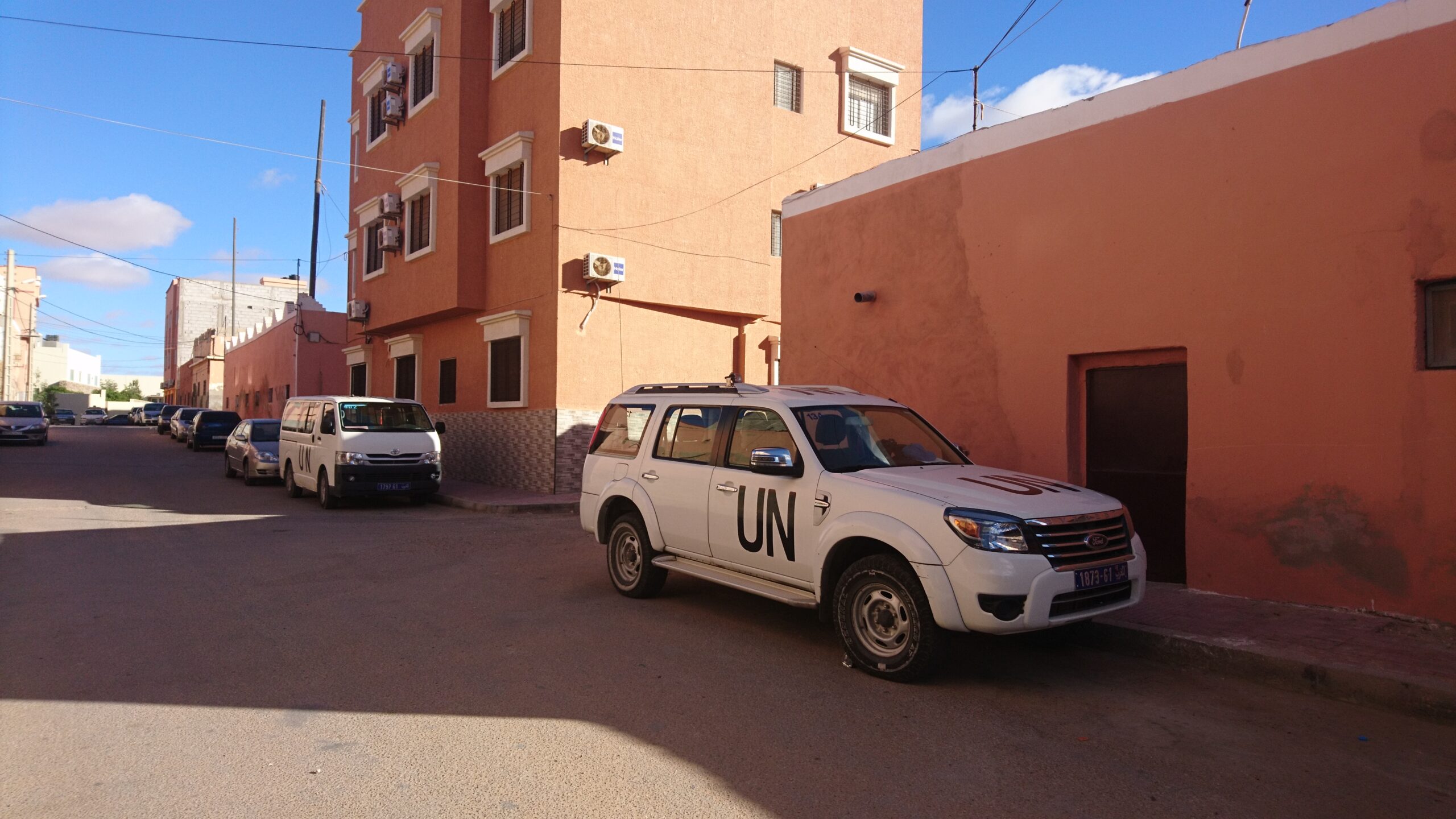
Featured image: MINURSO vehicles in Laayoune, Western Sahara, 2019. Photo: Anass Sedrati, CC BY-SA 4.0, via Wikimedia Commons. Context image.

- Royal Cabinet statement via MAP, Hespress English, Nov 4: https://en.hespress.com/148536-morocco-will-uphold-sahara-ceasefire-after-minurso-exit-royal-cabinet-says.html
- Same statement, Le Matin (French), Nov 4: https://lematin.ma/activites-royales/sm-le-roi-preside-une-seance-de-travail-consacree-a-lapres-minurso/374056 – also on maroc.ma: https://maroc.ma/fr/actualites/communique-du-cabinet-royal-10
- UN News, “UN ‘stands ready’ to keep supporting peace efforts as MINURSO mission ends”, Nov 1 (staff and site counts, liquidation, de Mistura, hostilities resumed 2020): https://news.un.org/en/story/2026/11/1168717
- UN General Assembly president’s letter convening the Nov 10 veto meeting, Nov 2: https://www.un.org/pga/81/documents/letters/letter-veto-initiative-meeting-2-november-2026/
- Bourita on taking the file out of the Fourth Committee: Assahifa, Nov 1: https://en.assahifa.com/morocco/bourita-morocco-sahara/ (secondary)
- Polisario openness to talks: Algerie 54, Nov 4: https://algerie54.dz/le-front-polisario-dispose-pour-un-processus-politique-serieux-garantissant-le-droit-des-sahraouis-a-l-autodetermination (secondary; original statement not seen)
- Security Council verbatim record S/PV.10260, Oct 30 (UN Digital Library): https://digitallibrary.un.org/record/4131906?ln=en
- Official Council page for the 10260th meeting: https://main.un.org/securitycouncil/en/events/10260th-meeting-minurso (its video transcript is automated, not the official verbatim record)