

Waiting for an olive to turn black can change how much oil a mill extracts. It does not, by itself, establish that the oil is better. Research on Morocco’s Picholine olives shows why harvest decisions involve several measurements that do not move together: fruit maturity, extractable oil and the characteristics of the finished oil.
A field experiment in Taza province, in northern Morocco, found more oil extracted per unit of fresh olive material as fruit ripened. Yet some chemical characteristics changed in other directions. The useful finding is not a national picking date. It is that the decision to harvest cannot be reduced to the colour of the fruit or one extraction percentage.
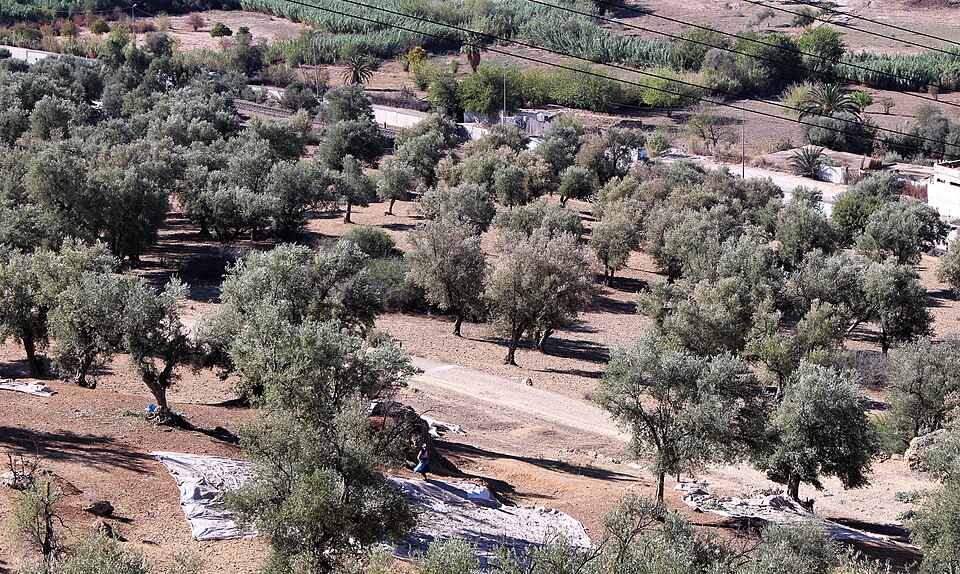
Archive photograph above: an olive orchard near Fez, photographed on 26 October 2017. It is not the experimental grove in Taza or evidence about this season’s harvest. Full photograph credit below.
Reading the fruit, then measuring the oil
Picholine Marocaine is used for both oil and table olives, according to the International Olive Council’s variety catalogue. A description of ripeness, however, is not an oil-quality certificate.
The council’s guide to assessing oil olives turns colour into a more systematic measure. A maturity index scores a sample using the colour of both the skin and the flesh, from deep green fruit to black fruit whose flesh has darkened through to the stone. It is a way to describe a sample, rather than relying on the appearance of a few olives.
The same guide calls for other tests: moisture, oil content, the amount that processing can extract, free acidity and sensory characteristics. It also distinguishes oil measured against fresh material from oil measured against dry material. Water is part of an olive’s fresh weight. A percentage calculated using that weight therefore answers a different question from total oil in a tree’s crop.
What the Taza experiment found
In a study published in 2020, Mohamed El Yamani and colleagues examined Picholine Marocaine olives during the 2017 crop season. Their experimental grove contained 30 adult trees, divided between a fully irrigated treatment and trees receiving no irrigation. The researchers harvested samples at different stages of ripeness and used the same laboratory-scale extraction procedure.
That procedure matters. They crushed the fruit, mixed the paste at room temperature and separated the oil by centrifugation. Their extraction percentage related the mass of recovered oil to the fresh olive paste used. It was not tonnes of oil per hectare, farm profit or the performance of every commercial mill.
Across the ripening sequence, extracted oil increased. But the paper’s analytical results show that the other measurements did not all improve together. Free fatty acids rose, while pigments and some oxidation indicators fell. Total phenols, a group of compounds measured in the oil, were lower at the latest stage than at the intermediate stage with the highest measured value.
Those results do not make the darkest fruit universally undesirable. They show why the objective matters. Recovering more oil from a given weight of paste is not the same as preserving every characteristic of that oil. Nor does one lower oxidation reading settle all questions about quality.
The water comparison needs equal care. Rainfed samples gave a higher extraction percentage on a fresh-weight basis than the fully irrigated samples. That is not proof that withholding water produces more oil per tree or hectare. A comparison of extraction percentages cannot supply the missing crop-weight calculation, still less a general irrigation recommendation.
A grade needs more than one favourable number
The International Olive Council’s June 2026 trade standard requires extra virgin olive oil to meet chemical and sensory criteria. Its free-acidity limit is 0.80 grams per 100 grams, expressed as oleic acid. Meeting that limit alone is not enough: the oil must also satisfy the other requirements for the category.
This is why a study’s individual laboratory results should not be turned into a grade for an untested bottle. A maturity score describes fruit. Extraction yield describes a processing result. Classification concerns the finished oil and includes its sensory assessment. They are related stages, not interchangeable labels.
The work continues beyond the crop. Sada Journal’s account of Taliouine saffron drying follows a comparable production question: harvesting a material does not complete the decisions that shape the finished food. For olives, extraction also leaves pomace, the residue examined in separate Moroccan research on battery materials. That later use does not establish the quality or economics of the oil that was removed.
The Taza experiment offers a practical way to read the harvest without pretending to prescribe it: ask which fruit was sampled, how the oil was extracted, what the percentage measures and which characteristics were actually tested. A black olive, a high extraction figure and an extra virgin label answer different questions.
Sources, method and photograph
This is an explanation of published research and technical standards, not a grove visit, a taste test or a report on the current Moroccan crop. The Taza paper concerns one site, one variety and one season. Its text repeatedly refers to three ripening stages while listing five sampling dates and presenting five maturity-index rows in Table 2. That reporting inconsistency is not silently resolved here: no exact optimum date, stage count or national numerical yield is inferred. Laboratory extraction and chemical measurements do not constitute an independent sensory certification. No raw data were reanalysed and no claim about current farm income, prices or nationwide harvest conditions is made.
Lead photograph: Lamiales – Olea europaea 8.jpg, olive orchard near Fez, 26 October 2017. Photograph by Emőke Dénes, via Wikimedia Commons, used under CC BY-SA 4.0. Supplied 960-pixel display version, no generative changes. Photograph and responsive display crops remain under the same licence. The orchard is not identified as the source of the study samples.
