

Morocco had 16.4 million mobile wallets at the end of 2025, but their growth is not yet a measure of how often people pay at a shop counter. Bank Al-Maghrib’s latest annual payment report shows a system used mainly for bills and transfers, with merchant purchases still a small part of the activity. The useful question is where the money goes after a wallet has been opened.
Executive summary
- The central bank reports 28 million mobile-wallet transactions worth MAD 7.3 billion in 2025. These are transactions, not individual users or retail purchases.
- Wallets issued by payment institutions account for about 93% of transaction numbers. Within that group, bills and person-to-person transfers dominate.
- Broader use at shops requires acceptance and repeat use on both sides of the counter. More wallets alone cannot establish that change.
Start with the transaction, not the registration
A mobile wallet allows payments and transfers through a phone. In Morocco’s reporting, some wallets are linked to bank accounts; others are issued by payment institutions. Those institutions provide payment services and form a separate category from banks. The central bank’s 2025 payment report, published on 21 October 2026, counts both groups.
Its 16.4 million figure is a stock of wallets at year-end, up from 13.7 million a year earlier. It is not a count of distinct adults, and it does not establish that every wallet was used. A person, an account and a wallet are different units; they should not be substituted for one another.
Activity did increase. Annual transactions rose from 19.7 million to 28 million, while their value rose from MAD 3.9 billion to MAD 7.3 billion. Calculated from those rounded totals, that is about 42% growth in number and 87% in value. Bank Al-Maghrib attributes much of the increase to direct social assistance paid into payment accounts. That is the regulator’s explanation, not a separate causal estimate by Sada Journal.
Receiving assistance digitally and spending it digitally are different steps. Our guide to Morocco’s social-aid system explains another distinction in that chain: registration and a payment decision are not the same event.
Bills, transfers and purchases are different uses
The issuer matters. Wallets supplied by payment institutions handled about 93% of wallet transactions by number and 90% by value in 2025. In this group, bill payments represented 69% of transaction numbers and mobile-to-mobile transfers 28%. Merchant payments remained marginal, according to the report.
Bank-linked wallets had a different mix: transfers represented 51% of transaction numbers, bills 32% and merchant payments 6%. By value, merchant payments represented only 2% of activity in this bank-linked group. The 6% and 2% figures therefore answer different questions and cannot be used interchangeably.
The report’s separate breakdown of wallet payments, limited to bills and merchant payments, assigns 99% to bills and 1% to merchants in both number and value. That denominator excludes transfers and cash withdrawals. It is not a measure of the share of all Moroccan retail sales paid by phone. Nor should a rounded zero on a chart be read as proof that no merchant transaction occurred.
Paying a bill remotely and sending money to another person are useful services. Their predominance does not make wallets a failure. It does mean that growth in those services is not, by itself, evidence of widespread use for everyday purchases.
An active account is still not a shopping habit
The central bank’s separate 2025 banking-supervision report records 4.26 million active payment accounts and an activation rate of 26%. These are payment-account statistics, not an activity rate for the 16.4 million wallets. Applying that percentage to the wallet stock would mix two different measures.
Even an activity indicator needs context: what operation qualifies, over which period, and how often does it recur? An account receiving a transfer and a customer repeatedly paying several shops do not demonstrate the same behaviour. The headline activation figure alone cannot establish a regular shopping habit.
Earlier research helps explain why both customers and merchants matter. A 2023 working paper by El Mehdi Ferrouhi and Mounia Sliman included interviews with 100 grocery retailers in Casablanca, Fes, Marrakech, Rabat and Tangier, conducted between May and September 2022. Respondents described limited familiarity, weak customer demand and security concerns, alongside potential benefits such as speed and less need to find change. This was a historical urban sample, not a representative survey of merchants in 2026.
The next test is repeat acceptance
Bank Al-Maghrib’s payment report describes an electronic-payment acceptance fund intended to help merchants and service providers, particularly smaller businesses. It identifies costs, enrolment complexity and weak initial profitability as barriers. The report says work in 2025 focused chiefly on designing the mechanism and preparing its operation; that is not evidence of a completed national rollout or a measured effect.
The proposed test is more demanding than counting equipment. The report calls for assessing active merchants, payment frequency, values handled and whether use continues after support ends. Those measures would show whether an acceptance network is becoming part of ordinary commerce rather than merely being installed.
Finally, more cash in circulation does not supply the missing retail measure either. The central bank notes that banknotes also reflect savings and precautionary holdings. As with the difference between a policy rate and an individual bank loan, a financial-system headline is a starting point, not a complete description of household behaviour. For mobile wallets, the next meaningful evidence is repeated use where people buy things.
Sources and method: Bank Al-Maghrib’s 2025 payment report, especially pages 64-68 and 87-88, its 2025 supervision report, and the cited working paper were inspected. Figures describe 2025, not transactions observed in November 2026. Growth rates are calculations from rounded published totals. Wallets, payment accounts and unique people are not combined. No merchant interviews, customer survey or field observation were conducted for this article.
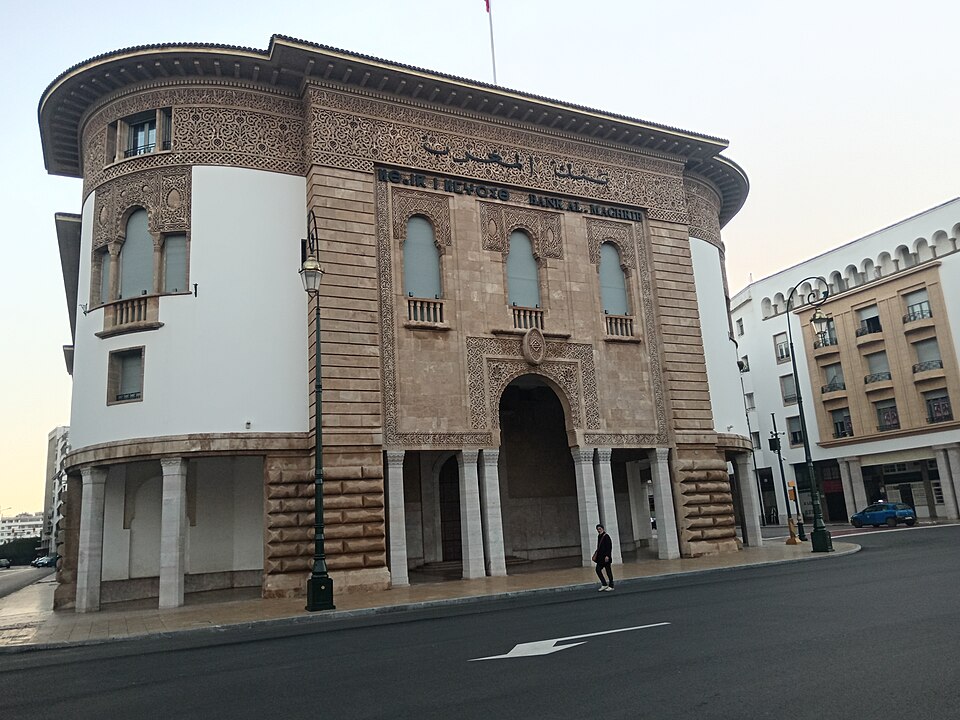
Featured archive photograph: Bank Al-Maghrib in Rabat, 1 February 2026. Photo: CAPTAIN RAJU, Wikimedia Commons, CC0 1.0. Illustrates the regulator, not a mobile-wallet transaction or a current meeting. Locally hosted Commons-resized copy; display may be cropped.
