

Morocco’s Independence Day falls on November 18, but France’s formal recognition of Moroccan independence dates to March 2, 1956. The dates describe different parts of the same transition: a public declaration after the sultan’s return from exile, followed by agreements that dismantled the protectorate and set out how powers would change hands.
That distinction matters on the anniversary. A national commemoration can identify a political turning point without serving as the date of every legal instrument. Morocco’s own official historical chronology records both November 18, 1955, the first Throne Speech after Mohammed Ben Youssef’s return, and March 2, 1956, when France recognised independence.
The return came before the settlement
Mohammed Ben Youssef, better known as Mohammed V, returned to Morocco on November 16, 1955. France had deposed and exiled him in August 1953. Two days after his return, he addressed the country on November 18. The speech announced the end of the protectorate and the advent of independence, as Jeune Afrique’s historical account explains.
The speech belonged to a process already under negotiation. On November 6, at La Celle-Saint-Cloud near Paris, the sultan and French foreign minister Antoine Pinay had agreed on a Moroccan government that would manage affairs and negotiate a new status. The declaration reproduced by the University of Perpignan’s legal-history collection envisaged an independent state linked to France through freely agreed interdependence. It was a route towards a settlement, not a completed transfer of every administrative function.
The sequence also prevents the history from becoming a story about a speech alone. Nationalist mobilisation, violence and negotiations formed the setting for the return. A US government assessment dated April 4, 1956 recorded months of disorder and violence before describing the sultan’s restoration, a new Moroccan government on December 7, and French recognition the following March. It is an outside diplomatic account, written through US policy concerns, rather than a neutral survey of all Moroccan experiences.

What changed on March 2
The March 2 declaration said that the 1912 Treaty of Fez could no longer govern relations between France and Morocco. France recognised Moroccan independence, including the right to a diplomatic service and an army. The two parties would negotiate as sovereign and equal states.
Those were consequential changes, but the attached protocol also described a transition. The sultan would exercise legislative power sovereignly. The French representative could see proposed decrees and make observations where French or foreign interests were concerned. Powers previously reserved to French authorities were to be transferred through agreed arrangements, while the status of the French army remained unchanged during the transitional period.
These provisions appear in the reproduced declaration and protocol. They were also identified in the Guardian’s report published on March 3, 1956. The report described substantial Moroccan gains while noting that the meaning of interdependence remained a matter for negotiation. Recognition and implementation were related events, not interchangeable words.
The French audiovisual archive INA distinguishes the signing on March 2 from the newsreel’s broadcast on March 7. Even an archive date needs reading carefully: the day footage reached an audience need not be the day the agreement was signed.
More than one colonial arrangement
Ending the French protectorate did not by itself dispose of every international arrangement affecting Morocco. Spain recognised Moroccan independence in a separate declaration on April 7, 1956. Another agreement, signed on October 29, abolished Tangier’s international regime. Both texts are reproduced in the same legal-history collection.
That is a reason to describe the particular arrangement being ended, rather than compress decolonisation into one signature. This chronology concerns the 1955-56 transition. It does not establish the later status of every territory claimed by Morocco or settle the separate Western Sahara dispute.
A commemoration, not a contradiction
November 18 concentrates public memory on the sultan’s return and declaration. March 2 identifies France’s formal recognition and a framework for new relations. April and October add other agreements. One date can carry the anniversary without erasing the others.
There was also a difference between winning recognition and building the institutions of an independent state. In an April 1956 essay in Foreign Affairs, Ahmed Balafrej, writing from an Istiqlal nationalist perspective, discussed the need to train Moroccan administrators and turn sovereignty into effective control of public affairs. His essay is evidence of a nationalist programme and expectations, not proof that those ambitions were achieved.
For readers encountering this history through Rabat’s layered capital landscape, the useful question is what each date records. Debates about what persisted after the protectorate, including the place of French in public life, examined separately in Sada Journal’s opinion section, are a different inquiry. They should not be confused with the narrower chronology of recognition.
November 18 and March 2 are not rival answers to a faulty history question. They identify different acts in a negotiated and contested passage out of colonial rule.
Sources and method
This historical explainer draws on the linked Moroccan chronology, reproduced diplomatic texts, a contemporary British newspaper report, a contemporary US policy assessment, INA’s catalogue and historical commentary, and later reporting. The INA footage itself was not viewed. No new interviews or archival visits are claimed.
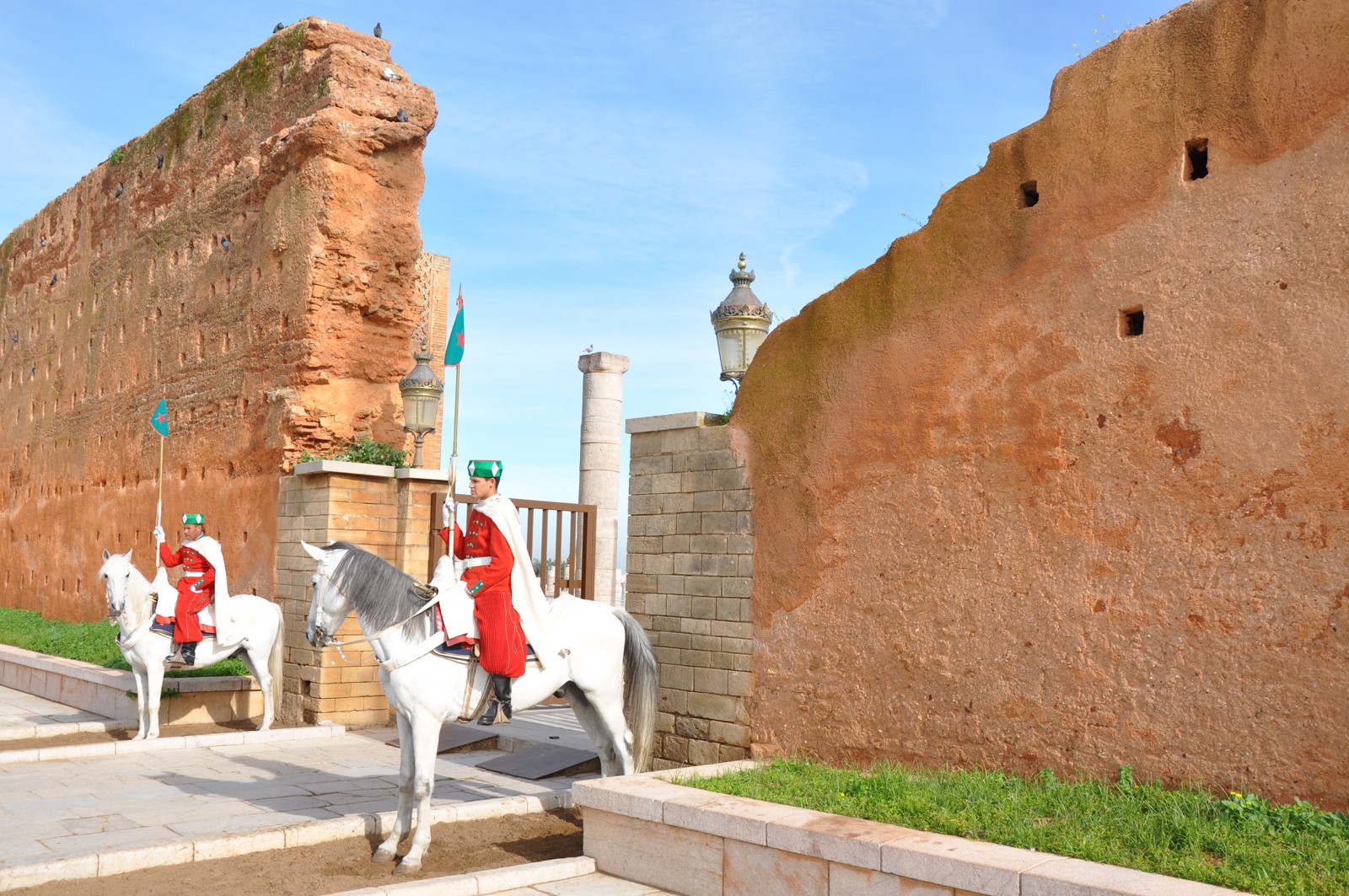
Lead photograph: mounted guards at the Mohammed V mausoleum complex in Rabat, January 4, 2011. Photo: Jorge Lascar / Wikimedia Commons, CC BY 2.0. Resized and recompressed. Archive illustration, not the 1955 return or a 2026 Independence Day ceremony.
