

Opinion / Geopolitical Analysis. Facts, reported positions, interpretation and forecast are distinguished below.
On Monday evening, November 16, the first five United Nations military observers flew out of Hassan I Airport in Laayoune, seen off by Alexander Ivanko, who now heads the mission’s liquidation. The next day, the American ambassador to the United Nations, Mike Waltz, stood in Rabat and called on the Polisario Front to “choose peace”. The United Nations Mission for the Referendum in Western Sahara, deployed since 1991, is being dismantled around them. As Morocco marks Independence Day today, the UN mission whose name carried a promise is folding that promise away.
- MINURSO did not end by a UN decision to leave. It ended on October 30 when Russia vetoed an American draft that had eleven votes, and a Russian plain-rollover text then failed with only three votes in favour. The mandate expired at midnight on October 31.
- What disappears is the only dedicated UN monitoring mechanism for the 1991 ceasefire, as the European Union told the General Assembly: nine team sites on both sides of the berm, 158 unarmed observers by the American count and the independent tripwire they provided. The referendum the mission was created to organise was never held, and the UN’s own record says referendum preparations ended more than two decades ago.
- Nothing replaces the monitors. The political track now runs through American-led diplomacy on the basis of Morocco’s autonomy plan, with the UN Secretary-General’s personal envoy continuing. Morocco says its ceasefire commitment is now voluntary; the Polisario Front says it has not considered itself bound by it since November 2020.
How the mission actually died
Documented facts. The Security Council’s own meeting record shows two failures on October 30, not one decision. The American draft, document S/2026/868, would have renewed the mission for a year and reaffirmed Morocco’s autonomy proposal as the basis for negotiations; it received eleven votes in favour, one against, with China, Pakistan and Somalia abstaining. The one against was Russia, a permanent member, so the draft failed. Russia’s counter-draft, S/2026/870, a one-year technical rollover without the political language, was then rejected three votes to one, with eleven abstentions: only China, Somalia and Russia itself supported it. The mandate lapsed the next day, October 31, a date Morocco marks as Unity Day, and the mission states it ceased operations on November 1.
The mechanics matter, because two easy summaries both misstate the record. The mission was not “closed by the United States”, and “the UN decided to leave the Sahara” is equally wrong. A supermajority of the Council voted to keep the mission under American terms; a supermajority also refused to keep it under Russian terms. The General Assembly’s November 10 veto-initiative debate put both facts on the record, with Finland, speaking for the Nordics, noting that eleven members had supported the extension and warning of “a dangerous precedent”.
Each side’s stated reasoning is also on the record. The American delegate called it “truly unfortunate” that the veto was used to “preserve the letter R (in the Mission’s name) for referendum”, arguing the Council had reviewed thirty years of failure and that the mission’s own website acknowledges referendum preparations ended more than twenty years ago. Russia’s delegate called his vote “a life-saving veto”, saying the deletion of that letter could not be interpreted “as anything other than the betrayal of the interest of the residents of the Tindouf camp”. Algeria thanked Russia and called the outcome “a blessing in disguise”, while Morocco’s delegate replied that “the Sahara was Moroccan before the 30th of October” and “will remain Moroccan until the end of time”. These are adversarial statements in a diplomatic forum, and should be read as such.
What the mission was
MINURSO was established by Council resolution 690 in April 1991, under settlement proposals accepted in 1988 by Morocco and the Polisario Front, to prepare a referendum in which Western Sahara’s people would choose between independence and integration with Morocco, and to monitor the ceasefire that took effect that September. The referendum never happened, blocked first by disputes over who was eligible to vote and later by Morocco’s rejection of independence as an option, as Al-Monitor’s account summarises. What remained for thirty-five years was the monitoring: unarmed observers patrolling from team sites on both sides of the berm, recording what both armies did.
The mission was small at the end. The United States mission put the military observers at 158, all unarmed; Sada Journal’s reporting gives about 160 military observers and roughly 180 civilian and affiliated personnel, some 340 in total, across nine team sites, four west of the berm and five east, plus a liaison office in Tindouf. The two observer figures are the American count and the mission’s reported composition respectively; the small difference is noted, not reconciled. Twenty people died serving it over thirty-five years, the General Assembly recorded. One thing the mission never had was a human-rights monitoring mandate; Amnesty International urged one for years, and it was never added. So the rights file never had a dedicated UN presence on the ground, and once the withdrawal completes, the ceasefire file will have none either.
What actually ends
Interpretation. The honest answer is narrower than the headlines and larger than the shrugs. The ceasefire being monitored was already degraded: the Polisario Front announced it no longer considered itself bound in November 2020, after the Guerguerat crisis, and Foreign Minister Nasser Bourita said in late October that the movement had told MINURSO directly it refused to comply, according to Maroc Hebdo’s account in Sada Journal’s report. Morocco’s Royal Cabinet said on November 4 that its own commitment to the ceasefire is voluntary and “does not change with the end of the mandate”, adding that the mission had been unable to monitor compliance or establish the consequences of violations. That last claim is Morocco’s characterisation; the mission’s reporting was restricted on both sides of the berm for years, but its patrols were the territory’s only independent monitoring presence, as the European Union later told the General Assembly.
That record is what ends. France warned at the Council that an abrupt closure would be “exceedingly alarming in the context of resumed tensions”, and the European Union told the Assembly that the veto removed “the only dedicated UN monitoring mechanism for the 1991 ceasefire”, increasing “the risk of miscalculations and instability”. The ground context is live: Moroccan troops were deployed along the berm this month, and any future incident, a shot, a crossing, a drone, will now be narrated only by the parties themselves. The UN’s tripwire function, the ability to say with neutral authority what happened, is gone. That is the real loss, and it falls heaviest exactly when something goes wrong.
The referendum, formally buried
What also ends, though it died in practice long ago, is the institutional embodiment of the referendum promise. The fight over the mission’s name tells the story: the American draft would have removed the word “Referendum” from it, which Namibia told the Assembly would “prejudge sovereignty, deny self-determination, and rewrite the decolonization mandate” of the United Nations, calling Western Sahara “Africa’s last colony”. The American position is that a referendum that can never be held “serves no one”. Resolution 2797 of October 2025, adopted with eleven votes in favour and none against, had already made Morocco’s autonomy proposal the basis for negotiations and recognised that “genuine autonomy could represent a most feasible outcome”. Algeria did not participate in that vote.
Secretary-General António Guterres has said the mission’s departure “does not abrogate” the Sahrawi people’s right to self-determination, and his personal envoy Staffan de Mistura continues the political process. Legally that is correct: a lapsed mandate does not settle a decolonisation question. But the practical instrument the UN built in 1991 to deliver that right, a vote, no longer exists even on paper. Self-determination now has a forum and a formula, autonomy under Moroccan sovereignty, and no mechanism. Whether that formula can be made to carry the right is the diplomatic question of the next year.
What replaces it
Nothing institutional, something political. On the ground, nothing replaces the monitors; a smaller UN team reporting to the Department of Operational Support will dispose of equipment during liquidation. Politically, the track has shifted almost entirely to Washington. Mike Waltz, the United States ambassador to the UN, spent November 15 to 17 in Rabat, met liquidation chief Alexander Ivanko, and stood with Bourita to reaffirm that Washington sees the autonomy plan as the only basis for a settlement, urging Polisario to return to the ceasefire and warning that violence offers only “the illusion of a solution”. He said the United States had facilitated roundtables bringing Algeria, Morocco, Mauritania and Polisario representatives together, a claim of process this desk could not independently confirm from public records. Bourita, for his part, described military cooperation as “exemplary”, confirmed the twenty-third African Lion exercise for May 2027 and said the partnership is expanding into defence industries, artificial intelligence and energy, as reported by Alyaoum24.
The liquidation itself is orderly and cooperative. Ivanko, the mission’s last chief, now heads its liquidation entity and told Medi1TV at the airport that the UN is “trying to make January 31 the final deadline for our presence here”, while cautioning the work could take longer. He described three closing acts: lowering the UN flag, closing the mission’s offices in the Sahara, and handing the keys to the Moroccan authorities. Morocco’s Interior Ministry runs a dedicated coordination office, created after a November 4 working session chaired by King Mohammed VI, and Ivanko called Rabat’s cooperation “excellent”. By the time the flag comes down, the closure will have been orderly and cooperative, which is precisely the point Morocco wants made.
Risks and what to watch
The near-term risks are specific. First, an incident along the berm with no neutral verifier, in a month when both sides are posturing and Algeria is framing the mission’s end as vindication. Second, the precedent: a permanent member has now vetoed a peacekeeping mission out of existence to block language it disliked, and every future mandate renewal is weaker for it, as the Nordics warned. Third, Tindouf: Waltz raised the camps directly in Rabat, saying families there deserve a way out, while Morocco’s delegate told the Council “let them go home”. The camps are moving from the margins of this file to its centre, and no agreed registration or census of their population has been carried out, a blockage Morocco’s delegate laid at Algeria’s door at the Assembly.
Watch three dates and one actor. The January 31 target Ivanko set for the final UN presence. The February rounds, if any, of the American-facilitated talks. The May 2027 African Lion exercise, the first on this new footing. And the Polisario Front, which rejected the mission’s closure in a letter to the Council circulated November 16, according to the Sahara Press Service, and must now decide whether “choosing peace” or refusing it serves a cause that just saw the UN close the mission created to hold its referendum.
Forecast. This desk assesses the probability at 0.70 that MINURSO’s liquidation completes, meaning the UN flag is lowered and the Laayoune headquarters handed over to the Moroccan authorities, on or before March 31, 2027. In favour: Ivanko’s January 31 target, daily coordination with a dedicated Moroccan office, excellent reported cooperation and the modest size of what remains. Against: the logistics of closing nine team sites on both sides of a militarised berm, including sites east of it where cooperation from the Polisario side is untested, and Ivanko’s own caution that the work could take weeks or months beyond the target.
Resolution rule. The forecast resolves true if the mission or the United Nations announces the completion of the withdrawal and the handover of the Laayoune headquarters on or before March 31, 2027; it resolves false if personnel or UN-flagged premises remain after that date. UN statements and mission announcements are the resolution source. The original probability and criteria remain recorded if later assessments change.
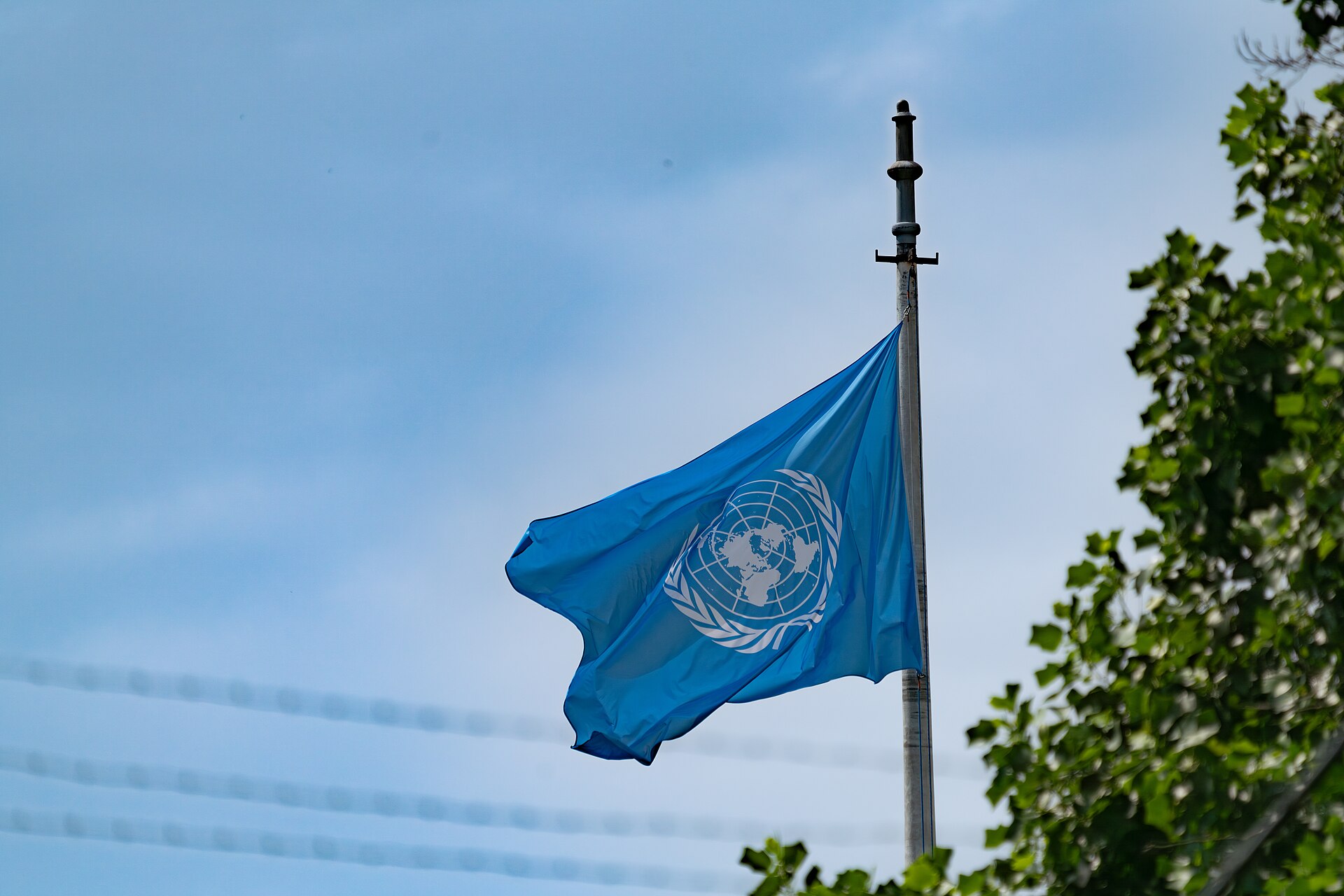
Image: the United Nations flag. Under the liquidation plan, the mission’s flag over Laayoune will be lowered and the keys handed to the Moroccan authorities. An illustrative image, not a photograph of any event described in this article. Photo: Tony Webster, Wikimedia Commons, CC BY 2.0; resized for display.

Source limits: the Security Council’s October 30 meeting record, the General Assembly’s November 10 veto debate record, the October 2025 adoption record of resolution 2797 and MINURSO’s official departure statement were read directly, as were Al-Monitor’s, Morocco World News’ and Atalayar’s reports. Alexander Ivanko’s airport remarks were made to Medi1TV and other Moroccan outlets and are quoted from those outlets’ accounts as relayed in Sada Journal’s own coverage; the Waltz-Bourita press conference was not watched directly and its quotations are drawn from Moroccan reporting as attributed. The claim of American-facilitated roundtables is Waltz’s own and could not be confirmed from public records. The full verbatim Security Council records, the Polisario letter circulated November 16 and MINURSO’s budget documents were not inspected. This article is analysis and does not report first-hand from Western Sahara.