

Ifrane is using its astronomy festival to prepare audiences for Morocco’s total solar eclipse of August 2, 2027. But the town hosting the lessons and the places that will see the Sun completely covered are not the same: totality will cross the country’s far north, including Tangier, while Ifrane will see a partial eclipse.
That distinction gives the 14th Ifrane Astronomy Festival a practical purpose beyond celebrating a future spectacle. Understanding an eclipse means knowing where to observe it, what a prediction does and does not promise, and how to protect people’s eyes.
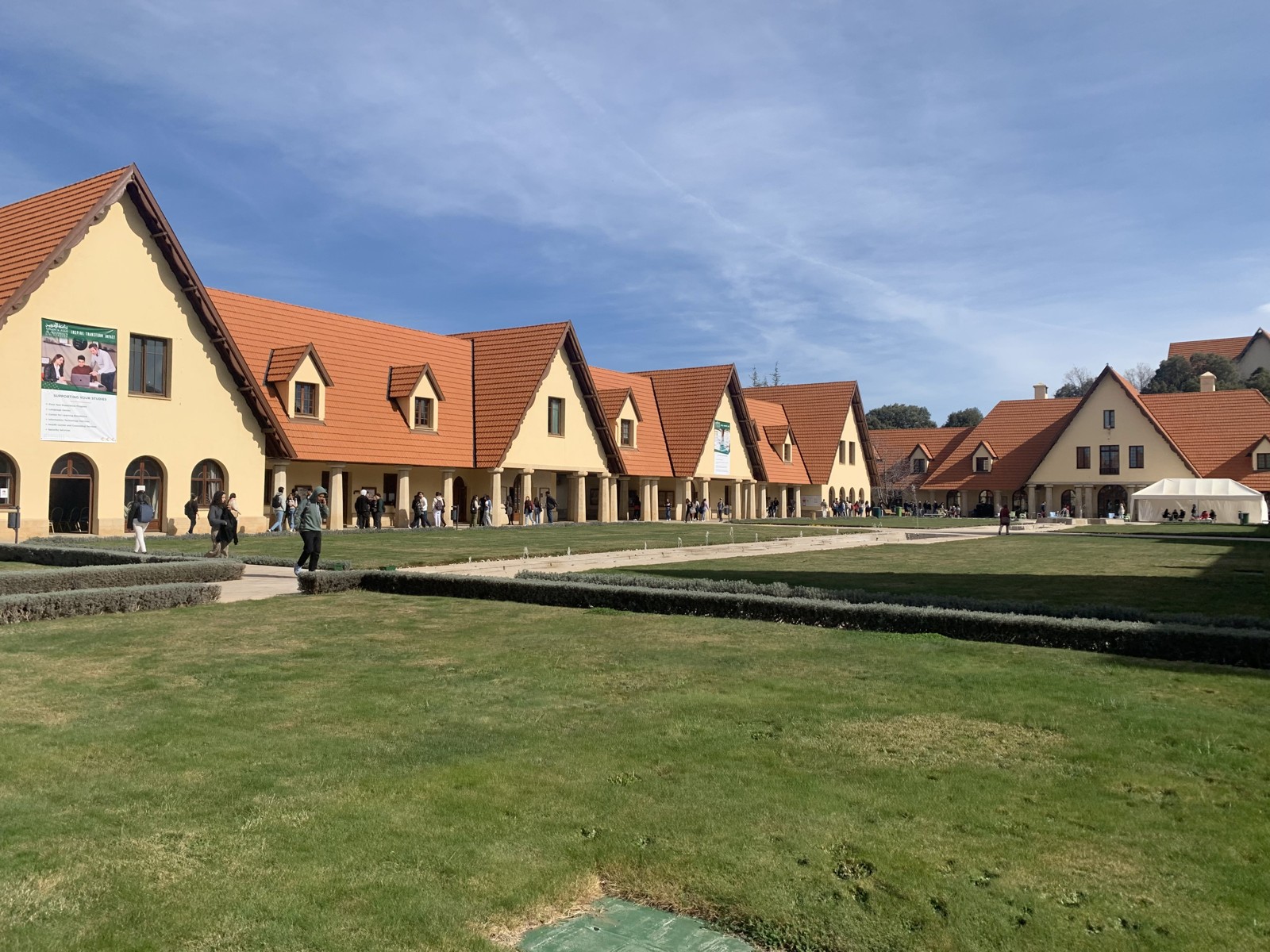
Lead photograph: Al Akhawayn University’s campus in March 2023. Archive setting, not a photograph of the current festival. Full credit below.
A festival before the shadow arrives
The official festival website dates this edition to November 12-16, 2026, at Al Akhawayn University in Ifrane. Its theme is “Eclipses: Between Science and Heritage”. Reporting published by SNRT News from Morocco’s MAP news agency on November 13 confirms that the event opened on November 12 and describes lectures, workshops and sky observations on campus and in the town.
MAP attributes the emphasis on advance preparation to festival director Hassane Darhmaoui. The programme brings scientific explanation together with activities for younger audiences and training in presenting eclipses to the public. These are reported activities and educational aims, not evidence that attendance or scientific understanding has already increased.
The official site also illustrates why visitors should check individual activities rather than assume that everything remains open for registration. It still carries competition applications with a November 6 deadline. A festival running through November 16 does not mean that its competition entry window is still open. This article is not a live booking or access guide.
Totality belongs to a narrow path
During a total solar eclipse, the Moon passes between Earth and the Sun and completely covers the Sun’s bright face for observers within a limited band on Earth’s surface. Outside that band, an observer may see a partial eclipse instead. A large partial eclipse is still not totality.
The US National Solar Observatory’s account of the August 2027 event includes Tangier among cities in the totality path. NASA’s published path table places the shadow’s passage across Morocco’s northern latitudes. A location-specific calculation for Ifrane identifies its eclipse as partial.
The festival’s role is therefore preparation, not proof that its host town is a total-eclipse viewing site. Nor does an astronomical prediction guarantee a clear view: cloud and the exact observing location still matter. Precise contact times should be checked for the chosen site, with the time standard clearly identified, rather than copied from another city or a national headline.
Eye safety is part of the science
NASA’s eclipse-safety guidance says ordinary sunglasses are not safe for looking at the Sun. Direct viewing during partial phases requires safe solar viewers or eclipse glasses meeting the ISO 12312-2 standard. Viewers should be checked for damage, and children need supervision.
Cameras, binoculars and telescopes require different, purpose-made solar filters secured over the front of the optics. Wearing eclipse glasses while looking through unfiltered optics is dangerous. NASA advises seeking expert guidance before using solar filters with such equipment.
The brief exception to filtered direct viewing applies only during complete totality, when the Moon fully blocks the Sun’s bright face. It does not apply to a location experiencing only a partial eclipse. That makes the geographical distinction a safety issue as well as an astronomical one.
Preparation is a different contribution from prediction
Morocco’s astronomy work includes the research and training described in Sada Journal’s account of Oukaimeden Observatory. Public interpretation has a different job: helping people understand evidence and act on it. The education responsibilities of M’Goun’s UNESCO geopark offer another Moroccan example, concerned with landscapes rather than the sky.
For Ifrane, the immediate test is not whether a festival can promise an unforgettable eclipse. It is whether audiences leave better able to distinguish a partial view from totality, an announced programme from a confirmed arrangement, and a safe observing method from a dangerous shortcut.
Sources and method: Checked November 14, 2026, against the official festival site, dated MAP reporting and linked astronomical and safety sources. No festival visit, interviews, attendance measurement or independent eclipse calculation was conducted. Site-specific timings, weather forecasts and 2027 event-access arrangements are not verified here.
Lead photograph: Anass Sedrati, Al Akhawayn University campus, March 13, 2023, via Wikimedia Commons, CC BY-SA 4.0. Resized and recompressed; this image version remains under the same licence. No generative changes. Archive context, not current festival coverage.
