

Opinion / Budget Analysis. This is analysis, not straight news. Documented facts, official statements, disputed reporting and interpretation are labelled. Sources are listed at the end.
Morocco’s first post-election budget is an 825.6-billion-dirham attempt to turn a campaign about the social state into appropriations. The money is real, the increases are dated, and the tightest constraints are not where the debate has spent its energy.
For more than eight hours on October 28, the finance committee of the House of Representatives worked through the first budget of Fatima Ezzahra El Mansouri’s government: three hours in the morning, five more in the afternoon, all of it broadcast live, TelQuel reported. The session carried a charge an ordinary finance debate does not. The Authenticity and Modernity Party (PAM), which leads the new majority, presented the 2027 finance bill as a break with the policies of its predecessor. The National Rally of Independents (RNI), which led that predecessor until a few weeks ago, now sits in opposition and answered the charge. Between them sat the bill itself: 825.6 billion dirhams in state charges, up 8.4 percent on 2026, according to the detailed figures published by Medias24.
The political setting is documented fact. On September 23, Moroccan voters elected a new House of Representatives. PAM took 97 of 395 seats, Istiqlal 65 and the outgoing RNI 66, per the coalition announcement and the definitive count. On September 29, King Mohammed VI appointed El Mansouri, the PAM leader and mayor of Marrakech, as Head of Government, the first woman to hold the office, the Royal Cabinet announced. On October 13, PAM, Istiqlal, the Socialist Union of Popular Forces (26 seats) and the Party of Progress and Socialism (19 seats) declared a coalition holding 207 seats, nine more than the 198 a majority requires. The government was sworn in on October 16, per the Royal Office. The 2027 finance bill is the first full act of that majority: the place where its program becomes numbers.
It also arrives roughly a year after the GenZ212 protest movement put the state of public hospitals, schools and household purchasing power at the center of Moroccan politics, demanding accountability and education reform in the autumn of 2025, as the Carnegie Endowment’s analysis records. The election was constitutionally scheduled, and this article does not claim the protests caused it. The connection this analysis examines is narrower: the demands that filled the streets in 2025 are now the stated priorities of the governing majority, and a budget is the instrument that shows whether stated priorities survive contact with the treasury.
The arithmetic the government chose
The macroeconomic frame is set out in the bill’s presentation note, as Medias24 details it. Growth is forecast at 3.7 percent in 2027, after an estimated 4.7 percent in 2026 and 4.9 percent achieved in 2025. The assumptions include a cereal harvest of 70 million quintals, down from 90 million in the 2025-2026 season, butane gas at 600 dollars a tonne and Brent crude at 75 dollars a barrel, down from 87 in 2026. Inflation is projected at 1.5 percent, per Hespress’s account of the committee debate. The budget deficit is held at 3 percent of GDP in 2026 and 2027, and Treasury debt is projected to ease from 67.5 percent of GDP in 2026 to 66.9 percent in 2027, with a stated target of 62 percent by 2031.
The revenue line is where the first precision problem sits. General-budget ordinary revenue is projected at 482.4 billion dirhams, up 14.5 percent, with tax revenue at 437.4 billion, up 16.3 percent, and corporate tax alone up 31.8 percent to 126 billion. Opposition deputies asked how corporate tax receipts can rise by nearly a third while the economy grows by 3.7 percent. Answering in committee on October 30, Economy, Finance and Public Efficiency Minister Fouzi Lekjaa used a different denominator: tax revenue of about 423 billion against roughly 386 billion expected at the close of 2026, an increase of 9.6 percent, which he called prudent against an average annual rise of 12.5 percent between 2021 and 2026, Le360 reported from the session. Both sets of figures come from the same budget debate, with two differences, not one: the baseline (the 16.3 percent is measured against the initial 2026 finance law; the 9.6 percent against the expected 2026 outturn) and the numerator (the bill’s 437.4-billion tax line versus the minister’s approximate 423 billion). When a deputy says the bill assumes a revenue surge and the minister says the bill is cautious, they are dividing by different years and starting from different figures. Ask which baseline and which numerator are on the table before accepting either adjective.
The same discipline applies to the totals. The 825.6 billion in charges comprises 571.1 billion for the general budget excluding debt amortization, 183.4 billion for special treasury accounts, 69.4 billion for debt principal and 1.6 billion for autonomous state services. The much-cited 400-billion-dirham public investment program is a different, wider perimeter: consolidated across the state budget (124 billion), public establishments and enterprises including the Mohammed VI Investment Fund (251 billion) and local authorities (25 billion). When PAM lawmaker Aziz Lebbar argued that roughly 70 percent of investment and economic activity runs along the Tangier-Rabat-Casablanca corridor, that share was his party’s assessment, not an independent statistic, and Hespress’s reporting labels it as such. A number without its perimeter is not a number.
The social turn, itemized
What the bill actually appropriates for the social state is a matter of documentable lines, and they are substantial. The wider envelope for education, higher education and vocational training is reported at 121.3 billion dirhams, a combined figure carried by Le360 that the official presentation note does not state as a single line. What the note does state explicitly is the national education department’s own credits: 106.9 billion dirhams, up from 102.2 billion under the 2026 finance law, a 4.7-billion increase of which 4.57 billion is payroll, mainly the revised staff statute and allowance measures. The payroll component is nearly the whole of the department’s increase, not of the education budget as a whole. Health and social protection receive 45.4 billion dirhams, with 8,000 new budgeted positions planned for the sector: 5,400 allocated to the Ministry of Health and Social Protection and 2,600 to the new territorial health groups, the GST, according to the staffing table attached to the bill’s Article 21 and the official presentation note. The sector-wide headline is unchanged from 2026, but the composition is not: the 2026 finance law granted 8,000 positions to the ministry alone, so the ministry’s direct allocation falls by 2,600 while the territorial health groups – regional public establishments with their own budgets and organizational structures – take them over, as TelQuel documented. That moves part of recruitment administration, and with it part of parliament’s staffing scrutiny, from the ministry to the groups. These are authorized positions; whether they are recruited, and then retained, is a separate question the budget does not answer. The wider staffing picture is accounted for separately: the bill creates 34,454 budgeted posts across the state as a whole, plus 15,590 posts for the regional education and training academies reserved for teacher recruitment. A further 600 posts are allocated to regularize certain education-ministry staff, with their previous posts abolished at the same time; these are not 600 net-new hires. The minimum monthly direct social assistance payment rises from 500 to 600 dirhams in 2027, with a stated trajectory toward 1,000. The minimum pension rises to 1,700 dirhams in 2027, from 1,500 in some regimes and 1,000 in the private-sector regime, then to 2,000 in 2028, 2,500 in 2029 and 3,000 in 2030, at an estimated 3.3 billion dirhams a year for the first step. Survivors’ pensions for widows rise from 50 to 100 percent of the deceased spouse’s pension, covering 431,334 women across the CNSS, the collective retirement scheme and the civil and military pension regimes, at an estimated 7.33 billion a year. Households whose monthly electricity bill does not exceed 100 dirhams will have it covered, excluding the 29 percent of subscribers on such meters whose dwellings are vacant, seasonal or second homes, at an estimated 2.83 billion a year, with prepaid rural meters credited monthly. The income-tax reform raises the professional-expense deduction ceiling to 45 percent and, on the minister’s figures, lifts the share of salaried workers fully exempt from income tax from 80 to 87 percent.
These are the government’s figures and commitments, stated as such, and two carry precision warnings. Government announcements associate the tax reform with salaries of 10,000 dirhams, and the PJD’s Driss El Azami El Idrissi asked in committee whether that figure is gross or net, a distinction that decides who actually benefits. The PJD also read the same reform’s distribution as some low-income workers gaining about 30 dirhams against 4,000 to 5,000 for high earners, TelQuel’s account records. Lekjaa’s own answer concedes the structural point: the salaried workers who already pay no income tax, 80 percent of them, gain nothing directly from cutting it, which is why the government points to the social-dialogue track for that population.
The gaps the totals do not close
Three gaps sit inside the bill’s own numbers, and none of them is a complaint about size.
The first is the calendar. The headline social commitments are real but backloaded. The 3,000-dirham minimum pension arrives in 2030; the income-based eligibility indicator for direct aid is a 2029 objective; and several commitments highlighted in the government’s presentation extend to 2031, the end of the legislature, as the RNI’s Yassine Oukacha was quick to point out. A government that will face voters again in 2031 has scheduled its most visible promises to land shortly before that date. That is a political choice about sequencing, not a concealment, but it means 2027 delivers the 1,700-dirham pension and the 600-dirham assistance floor, not the round numbers in the speeches.
The second is the difference between registration and coverage in health insurance, a distinction the minister himself drew. Across the insurance regimes, 32.7 million people are registered, about 89 percent of the population, but only 28.6 million have open rights; the 4.1 million in between have suspended rights, largely over unpaid contributions or changed employment, and roughly four million more are affiliated with no regime at all, he told the committee. Expanded enrollment statistics are not the same as usable coverage. The health debate has a second layer: Istiqlal’s Salma Al Alami questioned recruiting foreign doctors while Moroccan-trained doctors emigrate, asking for better pay, revised on-call arrangements and a national assessment of the cost of medical emigration; as of June 2025, the then-health minister reported 580 foreign doctors practising in Morocco under the 2021 framework, Hespress notes.
The third is distribution. The education envelope coexists with the figures Popular Movement MP Rime Chabat read into the record: of more than 1.3 million university students, 421,000 receive scholarships, leaving more than 900,000 without one; universalizing scholarships would cost about 5 billion dirhams a year by her estimate, and a household can currently lose a student’s scholarship because it receives 500 dirhams of direct aid. The compensation fund for subsidized goods falls from 22 billion dirhams in 2026 to 19.4 billion in 2027. None of these figures contradicts the bill’s increases. They measure the distance between an increased envelope and a closed gap, which is the distance elections are actually about.
The fight in the committee room
The political argument around the bill rewards precise reading, because both opposition charges are on the record, and they are not mutually exclusive. The RNI, defending the Akhannouch record, argues the new majority’s break is rhetorical: if the transformation were real, Oukacha said, it would appear in the structure of the budget and the allocation of its funds, and what is presented instead amounts, in his words, more to populism than to a coherent reform agenda. The PJD argues the opposite: that the bill itself, in El Azami’s words, enshrines a form of neoliberalism that will crush the weakest to enrich the most powerful, citing the planned regional agricultural distribution companies, which he called potential capitalist monsters, and tax exemptions on livestock imports he described as a gift to large importers, all from the same broadcast session. One party says the budget changes too little; the other says it changes in the wrong direction. These are distinct criticisms that can be made of the same bill, and they may overlap. The disagreement itself is the useful information: the bill is an incremental social expansion wrapped in the previous government’s fiscal frame, which is exactly the kind of object that attracts both charges. That characterization of the bill is this desk’s analysis.
Lekjaa’s October 30 responses show a government negotiating with its own majority’s themes. On the regional distribution companies, he opened the number, six, eight or more, and their capital structure to discussion, while ruling out any return to a state marketing monopoly like the old OCE. On the corporate-tax surcharge for hydrocarbon distributors and importers with net profits of at least 100 million dirhams, raising their rate from 35 to 40 percent to align it with banks and insurers, he left the targeting criterion, net profit or turnover, open to debate. On agricultural exports, he called it abnormal that Morocco exports large volumes after years of drought while domestic food prices rise, proposing rules set with producers plus monitoring of stocks, prices and exported volumes, an approach that would formalize the kind of export management this desk analyzed in the tomato case. On health, he conceded that budgets and buildings alone do not fix hospitals, per Le360’s report. The government says its program’s costed commitments total 62 billion dirhams in 2027; Oukacha, asking that the figure be itemized, read it as encompassing 25 billion for regional development and 5.5 billion for the income-tax reform.
What would count as a break
A budget cannot prove a rupture in one year, and this analysis does not ask it to. The prior government’s frame, a 3 percent deficit, a falling debt ratio and rising revenue, is kept. What the new majority adds is a deliberate redistribution of the increment toward the social floor, and a set of dated, priced commitments that can be checked annually. Whether that amounts to a break will be decided by execution rather than text: by whether the 8,000 health positions are filled and retained rather than posted and emigrated; by whether the public-performance dashboard Lekjaa described, a dedicated structure created by decree to reconcile budget, accounting and procurement data daily against cost benchmarks, actually publishes slippage; and by whether investment approvals outside the Tangier-Rabat-Casablanca corridor move at the speed the investment charter promises.
This desk records two checkable forecasts, as it does whenever it makes them. First, the 2027 finance bill will be adopted by both chambers and promulgated before December 31, 2026. This is a prediction, not a legal necessity: if the finance law has not been voted, or has not been promulgated because it was referred to the Constitutional Court, Article 75 of the Constitution and Article 50 of Organic Law 130-13 let the government open by decree the appropriations needed to keep public services running, based on the budget proposals submitted for approval, with existing taxes continuing to be collected. The forecast rests on arithmetic instead: no parliamentary constellation in the current House points toward rejection. Second, the adopted text’s architecture for agricultural distribution will differ from the six-company version now on the table, in number or capital structure: the minister has publicly opened both, and committee amendments on this point are where the majority’s internal negotiation will show. Both forecasts are recorded in this desk’s ledger with their resolution criteria.
The honest finding is narrower than either the majority’s break or the opposition’s populism. The 2027 budget is a real, dated and funded expansion of the social floor, built inside the fiscal frame of the government it replaces, with its largest promises scheduled for the years this majority will next be judged. The numbers say the direction changed. They do not yet say the distance did.
Sources
- TelQuel, “2027 Budget Bill: The El Mansouri administration’s first budget comes under scrutiny by lawmakers,” November 5, 2026: https://telquel.ma/2026/11/05/2027-budget-bill-the-el-mansouri-administrations-first-budget-comes-under-scrutiny-by-lawmakers_2016345
- Hespress English, “Morocco’s 2027 budget faces scrutiny over unequal investment, medical brain drain and tax relief,” October 29, 2026: https://en.hespress.com/148204-moroccos-2027-budget-faces-scrutiny-over-unequal-investment-medical-brain-drain-and-tax-relief.html
- Le360, “PLF 2027: ce qu’il faut retenir des réponses de Fouzi Lekjaa aux députés,” November 2, 2026: https://fr.le360.ma/economie/plf-2027-ce-quil-faut-retenir-des-reponses-de-fouzi-lekjaa-aux-deputes_5KLEENQP7BENXO5FKIBZ2LQBPA/
- Medias24, “Les chiffres détaillés du budget de l’État pour 2027,” October 24, 2026: https://medias24.com/2026/10/24/les-chiffres-detailles-du-budget-de-letat-pour-2027-1783584/
- Le360, “2027 Finance Bill: MAD 106.9 billion for education, 49 new university institutions,” October 25, 2026: https://en.le360.ma/economy/2027-finance-bill-mad-1069-billion-for-education-49-new-university-institutions_YLM4OPGRWFFIBKRP4BTKTU3P64/
- Maroc.ma, “HM the King Appoints Fatima Ezzahra El Mansouri as Head of Government,” September 29, 2026: https://maroc.ma/en/news/hm-king-appoints-fatima-ezzahra-el-mansouri-head-government-entrusts-her-forming-new-govt
- AP News, “Morocco’s Authenticity and Modernity Party wins parliamentary election,” September 25, 2026: https://apnews.com/article/morocco-elections-authenticity-modernity-party-ca3df681dcdc865b11432248ebad4248
- Le360, “Législatives: voici le décompte définitif, avec 97 sièges, le PAM est le vainqueur du scrutin,” September 25, 2026: https://fr.le360.ma/politique/legislatives-voici-le-decompte-definitif-avec-97-sieges-le-pam-est-le-vainqueur-du-scrutin_4ANKJGQAIJGYTJGOZ76O32SPYY/
- Anadolu Agency, “Morocco’s PAM agrees to form governing coalition with 3 other parties after election victory,” October 13, 2026: https://www.aa.com.tr/en/africa/morocco-s-pam-agrees-to-form-governing-coalition-with-3-other-parties-after-election-victory/4086722
- Maroc.ma, “HM the King Chairs New Government Appointment Ceremony,” October 16, 2026: https://maroc.ma/en/news/hm-king-chairs-new-government-appointment-ceremony
- Morocco World News, “Fouzi Lekjaa Takes Charge of Morocco’s Economy and Finance Ministry,” October 16, 2026: https://www.moroccoworldnews.com/2026/10/342464/fouzi-lekjaa-takes-charge-of-moroccos-economy-and-finance-ministry/
- AP News, “Morocco’s Gen Z protesters demand accountability, education reform,” October 18, 2025: https://apnews.com/article/morocco-gen-z-protests-soccer-654e45f09636365e9ae2f5b4e0ff6abb
- Carnegie Endowment for International Peace, “Understanding Morocco’s GenZ Uprising,” October 24, 2025: https://carnegieendowment.org/middle-east/diwan/2025/10/moroccos-genz-uprising
- Sada Journal, “Morocco Rations Tomato Exports: Africa Takes the Cut, Europe Doesn’t,” November 6, 2026: https://sadajournal.com/morocco-rations-tomato-exports-africa-takes-the-cut-europe-doesnt/
- Ministry of Economy and Finance, official 2027 Finance Bill page (bill text, explanatory note and supporting documents): https://www.finances.gov.ma/fr/vous-orientez/Pages/plf2027.aspx
- Ministry of Economy and Finance, “Note de presentation du projet de loi de finances 2027” (official explanatory note): https://www.finances.gov.ma/Publication/db/2027/Note-presentation_Fr.pdf
- Ministry of Economy and Finance, “Projet de loi de finances n° 60.26 pour l’année budgétaire 2027” (bill text; Article 21 staffing table): https://www.finances.gov.ma/Publication/db/2027/corps-PLF2027-fr.pdf
- Constitution of the Kingdom of Morocco, Article 75 (official text via the House of Representatives): https://www.chambredesrepresentants.ma/fr/titre-iv-du-pouvoir-legislatif
- Organic Law 130-13 on finance laws, Article 50 (official text via the Trésorerie Générale du Royaume): https://www.tgr.gov.ma/wps/wcm/connect/69dd8303-4ce0-4545-80a4-12105a78447f/loi+organique+n%C2%B0+130-13+relative+%C3%A0+la+loi+de+finances..pdf?MOD=AJPERES
- Le Brief, “PLF 2027 : 52.644 postes budgétaires prévus au Maroc,” November 2026: https://www.lebrief.ma/plf-2027-34-454-postes-budgetaires-100171388/
- TelQuel, “Santé : 9 milliards de dirhams et 2.600 postes en transit,” October 26, 2026: https://telquel.ma/2026/10/26/sante-9-milliards-de-dirhams-et-2-600-postes-en-transit_2014802
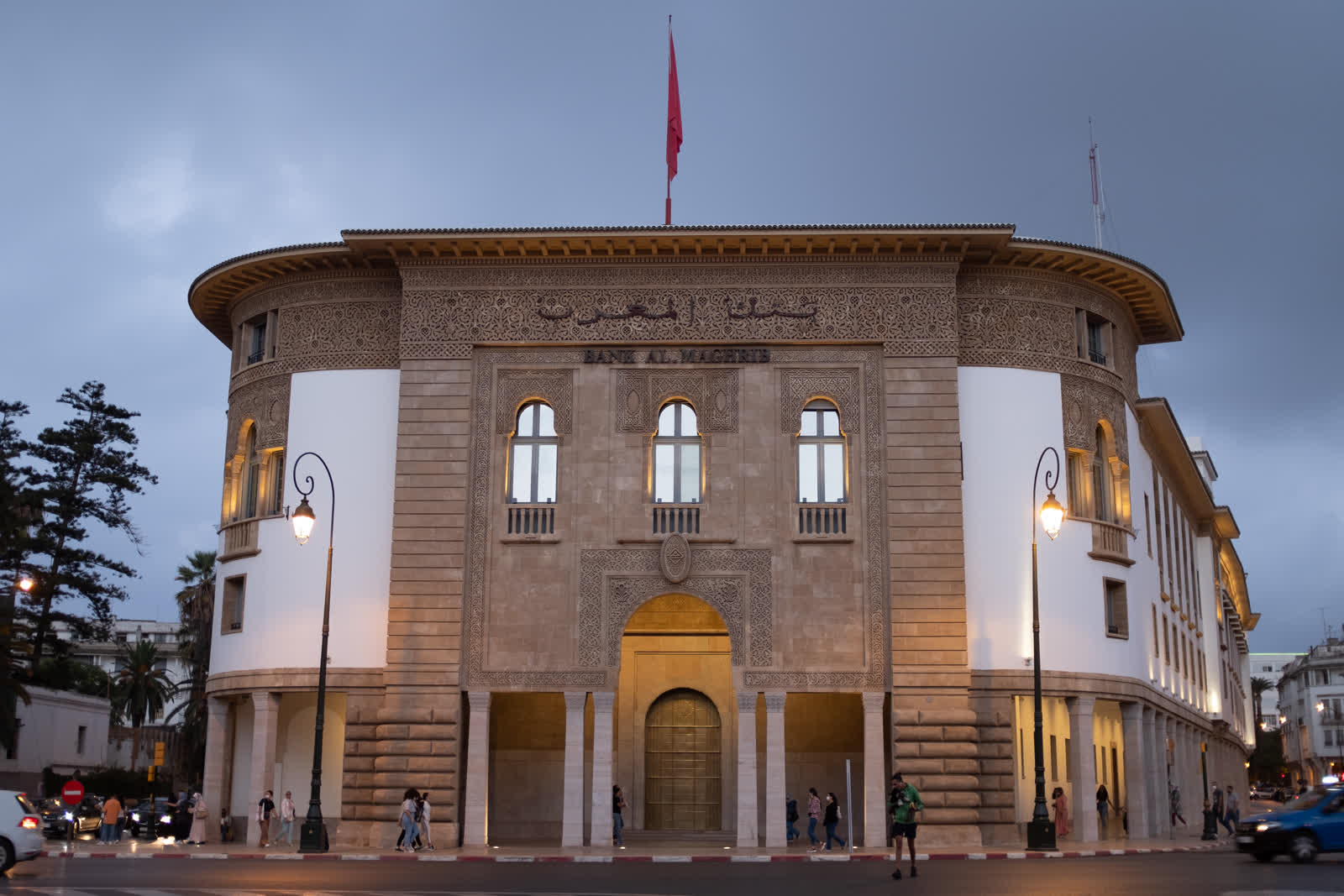
Featured image: the Bank Al-Maghrib headquarters on Mohammed V Avenue in Rabat – an illustrative image of Morocco’s central bank, included for context only: the bank is not a participant in the parliamentary budget debate described here. Photo: via Wikimedia Commons, CC0.
