

Opinion / Language Policy Analysis. This is analysis, not straight news. Documented facts, official statements, disputed reporting and interpretation are labelled. Sources are listed at the end.
Morocco's constitution names Arabic and Amazigh as the state's official languages. Yet the gateways to medicine, banking, public jobs and corporate life still speak French, seventy years after the protectorate. That is not nostalgia; it is a system, maintained in Rabat as much as Paris.
In September 2023, candidates for administrator posts at Morocco’s National Agency for the Fight Against Illiteracy opened their exam papers and found them written in French, answers required in French, although the competition’s own announcement was published in Arabic. Most boycotted on the spot, Al-Omk reported, and the agency, the state body charged with teaching Moroccans to read, postponed the competition.
Six months earlier, Rue20 published a higher education minister’s decision requiring applicants for director of the National Office of University Social and Cultural Works to master at least two foreign languages, including French and English, while not mentioning Arabic or Amazigh. Its silence about the official languages is not proof that they were legally excluded; it shows where institutional priority sits.
These are not anecdotes about attitudes. They are documents about institutions, compressing the unfinished business of independence into one question: who is this country’s public life for?
Morocco has been sovereign for roughly seventy years. Yet the road to a medical degree, an engineering career or a senior administrative post still runs through a language most do not speak at home. Colonial influence does not leave when the soldiers do. It survives inside institutions, curricula, hiring habits and prestige hierarchies, kept alive by those who inherited colonial power.
This article makes two charges separately. France created the colonial structures and, as scholarship documents, French policy worked to preserve its language’s place. Morocco’s own elites maintained and expanded that arrangement for seven decades, and they bear the larger responsibility now. The mechanisms are documented; what they mean is partly interpretation, and the article says which is which.
On paper, Arabic and Amazigh. In practice, French
Start with the law. Article 5 of Morocco’s 2011 constitution states that Arabic is the official language of the state, that the state works to protect, develop and promote it, and that Tamazight is also an official language. A final clause speaks of learning “the foreign languages of greatest use in the world” as tools of openness. French is named nowhere in it. It has no official status whatsoever.
The picture is not total neglect, and honesty requires saying so. Arabization ran in public schools for roughly three decades, even if scholars call it only partially implemented. The Royal Institute of Amazigh Culture has existed since 2001, and in 2019 organic law 26.16 set the stages for putting Tamazight’s official status into practice. These are real steps. The problem is their distance from the system’s commanding heights:
- A 2013 study in the WHO’s Eastern Mediterranean Health Journal, based on data collected in April 2012, counted eight medical schools teaching in French only, located across Morocco and Tunisia collectively; thirteen surveyed schools in Iraq, Sudan, Syria and Yemen teaching in Arabic only; and schools using English in every country except Afghanistan, Morocco and Tunisia.
- Morocco’s “international baccalaureate, French option” (BIOF), the French-taught public-school science track, enrolled 4,673 students in 2017-2018. By 2023-2024, after the 2019 framework law 51.17, the number had risen to 119,344, according to Ministry of National Education figures cited in the 2025 “Paradoxes” study by Chakrani, Ziad and Lachkar. The study describes it as compulsory in most high schools, supplanting Arabic-medium science instruction.
- Morocco’s French-accredited school network counts 44 establishments and nearly 49,000 students, almost 70 percent Moroccan nationals, according to the French embassy in Rabat; the second-largest French school network in the world.
- The Organisation internationale de la Francophonie estimated in 2022 that 13.5 million Moroccans, 36 percent of the population, are French speakers. That does not mean the rest speak no French at all; it does mean French is not the everyday language of the whole population, in a country where it controls the gateways to advancement.
What France built, and how it kept it
The mechanisms are documented, and more banal than conspiracy. During the 1912-1956 protectorate, French authorities built what Chakrani, Ziad and Lachkar describe as a bifurcated, class-based education system: French-medium tracks for Europeans and a selected Moroccan elite, underdeveloped Arabic-medium tracks for the majority. Language became the sorting mechanism for employment, authority and status, and it outlived the protectorate.
Morocco launched its Arabization reform in 1959; according to Soufiane Taif’s 2024 study “Language and Diplomacy,” it stalled by 1965 for lack of trained teachers and materials. Into that vacuum stepped French cooperation policy – aid workers, teacher training – maintaining French, Taif shows, as the main language of education, particularly in scientific disciplines. Taif adds a clarifying nuance: French diplomats were not opposed to Arabization in principle. They positioned French as the language of modernity and science while the reform faltered; prestige did the work orders could not. No secret instructions from Paris are required when the incentives are built into the architecture.
The harder question: why Morocco’s elites kept it
France did not pass framework law 51.17 in July 2019; Moroccan parliamentarians did. France did not design the “language alternation” policy it introduced; Moroccan officials did, in a government the study’s authors describe as led by French-trained technocrat ministers. The policy promised a balanced multilingualism alternating Arabic, French, English and Spanish in science and technical education. Four years in, the study documents, French had become the exclusive medium in science and technology classrooms, while English and Spanish tracks survived only in marginal pilots. What was sold as diversification functioned, in the authors’ words, as a resurgence of French that “undercuts a decades-long Arabization of science” – their interpretation, read as such. The enrollment numbers are the ministry’s own.
The deeper failure is older. Charis Boutieri’s ethnography “Learning in Morocco” (2016) describes students confronting an Arabization policy, highly politicized and never coherently implemented, crashing into a job market where French remained a prerequisite for advancement. Zakhir and O’Brien’s 2017 study of seven high schools found the same gap between policy and classroom reality in science subjects. Scholars cited in the 2025 study attribute Arabization’s shortcomings to inconsistent political commitment, inadequate funding and outdated methods, not to Arabic itself. The study notes the contrast with the French track’s expansion from 4,673 students to 119,344 in six years: when the state wants French expanded, it moves fast.
The 2025 study names the pattern “elite closure”: an affluent class maintaining its position through official language policy. French dominates the decisive domains – higher STEM education, business, the private job market – while advanced proficiency in it, the authors note, typically reaches only the upper class.
Who speaks to Moroccans, and in what language
The sharpest everyday measure of the hierarchy is communication. A small sample, observed on November 6, 2026, mixes three kinds of public address and distinguishes the language of a website, of a campaign name, of the advertisement itself and of the coverage around it. It is illustrative, not representative of all Moroccan advertising: a snapshot that shows where French sits today, not whether its visibility is growing.
| Type | Case | Language |
|---|---|---|
| Corporate website | Maroc Telecom homepage (iam.ma) | French (“Nouveau forfait, plus de liberté”) |
| Corporate website | inwi homepage (inwi.ma) | French (selector defaults to Français) |
| Corporate website | Attijariwafa Bank homepage | French (“premier Groupe bancaire et financier au Maroc”) |
| Public recruitment | Anti-Illiteracy Agency exam, Sept 2023 | French-only paper, despite Arabic notice (boycotted, postponed) |
| Public recruitment | Director post, National Office of University Works, March 2023 | Ministerial decision requiring French and English, official languages unmentioned |
| Consumer advertising | Maroc Telecom “L’Île aux Offres” Ramadan campaign, 2025 | Campaign name in French; trade coverage in French (coverage language is not evidence of the ads’ language) |
| Consumer advertising | inwi “Sir B3id” campaign, 2025 | Tagline in Darija; agency announcement and trade coverage in French (not evidence of the ads’ language) |
The honest finding is more specific than “advertising is in French.” The inwi case uses a Darija tagline, complicating any claim that mass-market advertising is uniformly French; the campaign’s own agency announced it in French, as did the trade coverage of both campaigns. Original campaign footage was not retrievable, so the ads’ own language is not claimed here. The hierarchy is not one language being everywhere; it is which language sits at the points of authority.
Why should a Moroccan bank’s front page, or a state exam, assume French where it is not the everyday language of the whole population? In a September 2025 Morocco World News opinion piece, Abderrahman Boukhaffa called French “a gatekeeper, a social filter, and a marker of class.” That is commentary, not measurement; the cases above are documents.
Other countries modernized without surrendering their languages
The standard defense of French is necessity: science needs a global language, Arabic supposedly cannot carry modern technical knowledge. The comparison record dismantles this.
Japan industrialized by translating: its own Ministry of Education records that Meiji-era academic societies, founded in nearly every field of natural science by 1890, performed “the standardization and dissemination of technical terms in the course of translating foreign scientific works into Japanese.” Foreign professors dominated the University of Tokyo’s science faculty in 1877; by 1893 not one remained. Japan absorbed Western science into Japanese rather than educating its elite out of it.
Turkey rebuilt its language by decree. Geoffrey Lewis’s “The Turkish Language Reform: A Catastrophic Success” (Oxford University Press) recounts how the republic outlawed the Arabic script in 1928 and, from the early 1930s, campaigned to replace Arabic and Persian vocabulary with words from popular speech or coined from Turkish roots. The reform was disruptive and remains controversial; its premise: sovereignty required a sovereign language.
Israel built modern Hebrew on a continuous written and literary tradition, revived as everyday speech over generations, and made it the language of courts, laboratories and parliaments; its Academy of the Hebrew Language still coins technical terms. South Korea’s education is offered in Korean, its TIMSS entry states flatly, and its industrial rise happened in Korean. China built its scientific expansion on a Chinese-medium system; even its English-medium university programs remain a bounded experiment.
The Arab world is not uniform. Syria’s University of Damascus still teaches medicine in Arabic, Al-Fanar Media reported in 2025. Cairo University’s Kasr Al-Ainy medical school runs textbooks and exams in English. Jordan University of Science and Technology states English is its language of instruction, and the University of Baghdad’s Al-Kindy College says its courses are mostly taught in English. The region’s choices split three ways: the national language, the current language of global science, or the language of the former protectorate. The levels matter too: school science, university medical teaching and research publication are separate decisions, and countries mix them.
None of this means abandoning English: Japan’s Imperial University was publishing research proceedings in European languages by 1887, the MEXT history records, and a 2023 global study reported by Al-Fanar Media found 55.6 percent of 189 countries teach medicine in their native language – Japan, Korea, Germany, Sweden and Norway among them. Israel’s Technion medical faculty teaches most courses in Hebrew. The principle: no country needs to surrender its national language to become scientifically capable or internationally connected. The honesty requirement: language policy alone did not industrialize Japan or Korea – investment, institutions and political choice did. But each of them treated a functional national language as infrastructure for development, not an obstacle to it. In this set, Morocco stands out: its public-school science track, and its medical instruction in the 2012 data, run in French.
The myth of French indispensability
French is a major world language and a genuine cultural asset. It is also, by the numbers, a declining language of science: in 2012 roughly 80 percent of Scopus-indexed journals published in English (Daphne van Weijen, Research Trends), and later studies cited by Chakrani and his co-authors record its continuing domain losses in scientific publication and trade. If Morocco chose on merit today which foreign language to privilege in science education, French would not survive a serious review. English opens the global research ecosystem. French opens plenty – diplomacy, much of Africa, a global institutional network – but it does not offer English’s breadth of access to international research. Privileging it for science education is a choice of inheritance over reach.
So why does the privilege persist? The 2025 study’s answer is institutional, not a claim about motives: whatever policymakers intend, French-medium science functions to select for the francophone class’s children and binds elite formation to a foreign cultural system. That is the study’s interpretation, endorsed here as such; the claim is about effects, not intentions, and the enrollment figures document the track’s expansion, not policymakers’ intentions or its causal effect on inequality.
The class barrier
Sociologists call French in Morocco linguistic capital: a resource convertible into jobs, status and deference. The result is a two-tier society: a minority that moves from French-medium school to French-medium university to the French-speaking professions, and a majority that hits the language wall precisely where opportunity begins. None of this indicts Moroccans who speak French; they inherited the system like everyone else. The target is the hierarchy, and the choice to keep funding it.
What Morocco should do
The answer is not to ban French. It is to end its automatic privilege:
- Make Arabic and Amazigh genuinely functional in administration and public institutions, as the constitution already commands.
- Fund the unglamorous work: scientific, medical and technical terminology, textbooks and teacher training in the national languages, the investments Japan, Turkey and Israel made at scale.
- Fix public education quality so a child’s prospects stop depending on family income.
- Expand English as the language of global science and commerce, as one foreign language among several.
- Keep French as an option, not an operating system.
- Require public-facing institutions to communicate in languages the public actually understands.
- Expect Moroccan companies to address Moroccan consumers accordingly.
- Judge language policy by educational outcomes and equality, not by inherited prestige.
The conclusion Morocco avoids
Boutieri shows Arabization was never implemented coherently; the 2025 study notes the contrast with the French track’s rapid expansion since 2017. The verdict this article draws from the asymmetry is its own: seventy years of political choice, in Rabat first and in Paris second.
Learning French is not the problem. Learning English is not the problem. Learning Chinese, Japanese or any other language is not the problem. The problem begins when a nation treats a foreign language as the measure of its own people’s worth. Morocco did not win independence in 1956 so that, generations later, its citizens would still need to borrow the language of the protectorate to be considered educated, modern or employable. Independence that stops at the border post is geography. Independence that reaches the classroom, the hospital, the job advertisement and the billboard is sovereignty. Morocco is still waiting for the second kind.
Sources
- Constitution of the Kingdom of Morocco (2011), Article 5: constituteproject.org
- Chakrani, B., Ziad, A., & Lachkar, A. (2025). "Paradoxes of Language Policy in Morocco: Deconstructing the Ideology of Language Alternation and the Resurgence of French in STEM Instruction." Languages 10(6): 135: mdpi.com
- Taif, S. (2024). "Language and Diplomacy. How French Language Was Maintained in Moroccan Public Schools (1960-1990)": rivisteweb.it
- Zakhir, M., & O'Brien, J. L. (2017). "French Neo-Colonial Influence on Moroccan Language Education Policy." Language Policy 16(1): 39-58: link.springer.com
- Boutieri, C. (2016). "Learning in Morocco: Language Politics and the Abandoned Educational Dream." Indiana University Press: iupress.org
- World Health Organization EMRO (2013). "Languages used for instruction in medical schools in the Eastern Mediterranean Region," Table 4: emro.who.int
- OIF Observatoire de la langue française (2022). "Estimation du nombre de francophones dans le monde": observatoire.francophonie.org
- Ambassade de France au Maroc. "Enseignement français au Maroc": ma.diplomatie.gouv.fr
- Van Weijen, D. (2012). "The Language of (Future) Scientific Communication." Research Trends 31: researchtrends.com
- Lewis, G. (1999). "The Turkish Language Reform: A Catastrophic Success." Oxford University Press: academic.oup.com
- Japan Ministry of Education (MEXT). "The Introduction of Modern Science and Development of Science in the Meiji Era": mext.go.jp
- Academy of the Hebrew Language. "Terminology": eng.hebrew-academy.org.il
- TIMSS 2015 Encyclopedia, Republic of Korea chapter: timssandpirls.bc.edu
- Al-Omk Al-Magharibi (September 25, 2023). "Because of French, candidates force the Anti-Illiteracy Agency to postpone the competition" (in Arabic): al3omk.com
- Rue20 (March 8, 2023). "Miraoui excludes the state's two official languages, requires French and English for a central director post" (in Arabic, with documents): rue20.com
- MediaMarketing.ma (March 6, 2025). "Maroc Telecom mise sur l'humour et le cinéma pour sa nouvelle campagne Ramadan": mediamarketing.ma
- Le1.ma (October 15, 2025). "inwi signe le mot d'ordre d'une génération: Sir B3id": le1.ma
- Boukhaffa, A. (September 16, 2025). "French in Morocco: Gatekeeper of Privilege." Morocco World News (opinion): moroccoworldnews.com
- Morocco World News (July 23, 2019). "Moroccan MPs Approve Controversial Bill to Bolster French Language in Education": moroccoworldnews.com
- Hu, G., et al. (2025). "English-medium instruction (EMI) language policy and implementation in China's higher education system." Current Issues in Language Planning: tandfonline.com
- Organic law 26.16 on the official status of Tamazight (September 12, 2019), official bulletin database: bdj.mmsp.gov.ma
- Law 51.17 official text (Adala, Ministry of Justice): adala.justice.gov.ma
- Dahir 1-01-299 (October 17, 2001) creating the Royal Institute of Amazigh Culture (IRCAM), reproduction of the official Bulletin Officiel text via Wikisource: fr.wikisource.org
- Al-Fanar Media (February 15, 2025). "Medicine in the Mother Tongue: Why Can't Arab Schools Teach in Arabic?": al-fanarmedia.org
- Jordan University of Science and Technology, Faculty of Medicine, English MD curriculum (official): just.edu.jo
- Al-Kindy College of Medicine, University of Baghdad, official FAQ (language of instruction): en.kmc.uobaghdad.edu.iq
- Rappaport Faculty of Medicine (Technion – Israel Institute of Technology), program directory profile noting most courses taught in Hebrew: mymedschool.org
- Jordan University of Science and Technology, institutional profile (Global Institutional Profiles Project, official JUST site): "English is the language of instruction": just.edu.jo
- Shem's Publicité (October 29, 2025). Agency announcement of inwi's "Sir B3id" campaign signature (in French): fr.linkedin.com
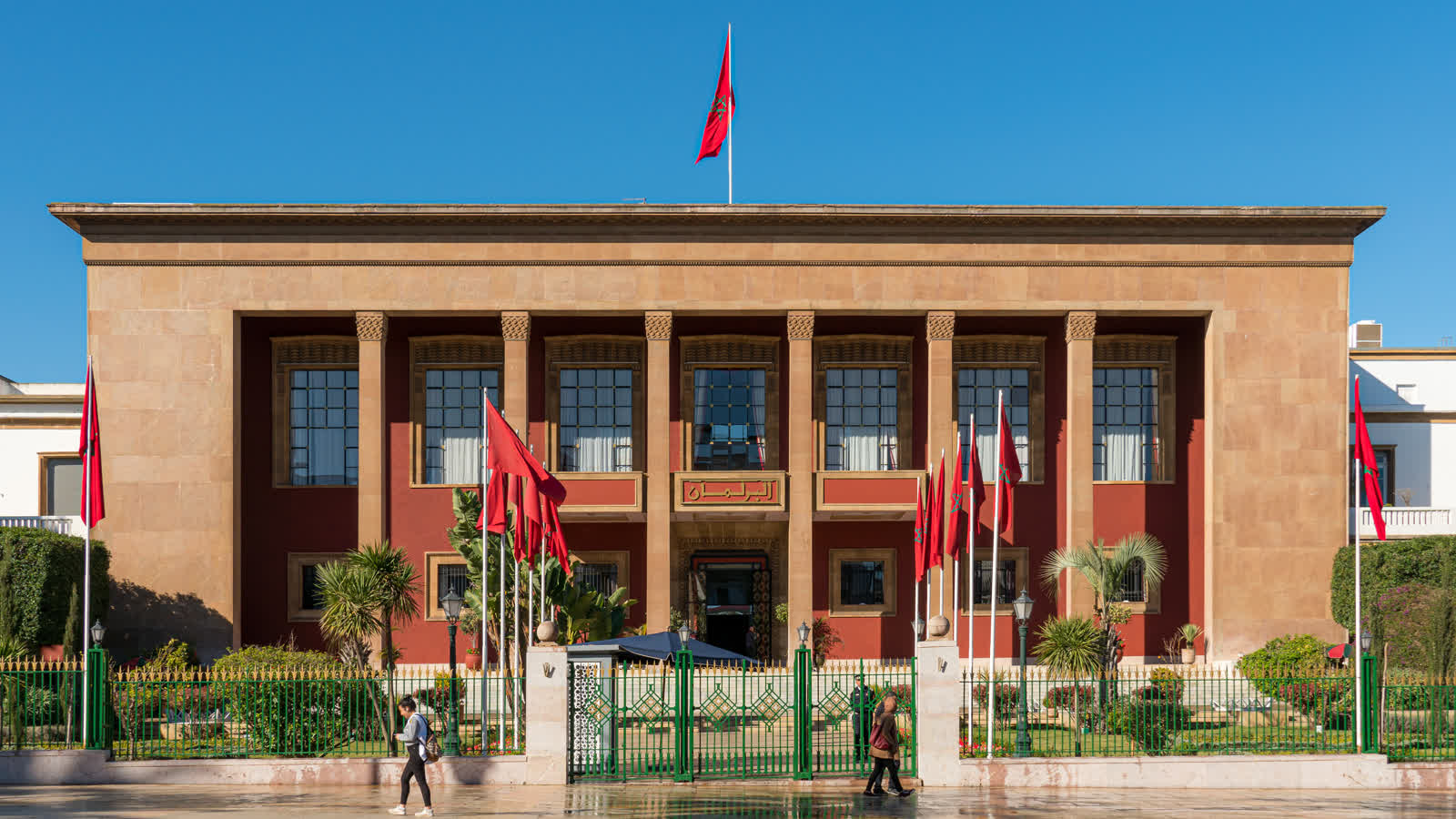
Featured image: the Moroccan Parliament building in Rabat, where the country’s language laws are made – an illustrative image of a state institution, not of any school or company named in this article. Photo: Fernando Pascullo, CC BY-SA 4.0, via Wikimedia Commons.
