

Opinion / Economic Analysis. This is analysis, not straight news. Documented facts, official statements, disputed reporting, interpretation and forecasts are labelled. Sources are listed at the end.
The documented result is that Morocco has stopped issuing new export permits for tomatoes bound for African markets, while shipments to Europe continue. What that choice reveals about the order of priorities in Moroccan food policy is interpretation, and it is labelled as such below.
On Thursday, November 5, exporters serving African markets were told that Morocco would no longer issue new tomato export permits for those markets, while licensed trucks already on the road continue as normal. A government source said the measure aims to strengthen supply to the domestic market. The decision landed the same week the government allocated another 400 million dirhams in subsidies for road transport professionals and ruled out capping fuel prices or fuel distributors’ margins.
What happened
Documented.
- The measure. Industry professionals were notified on Wednesday evening, and new export permits for African markets stopped being issued overnight from November 4 to 5, while trucks holding valid licenses keep operating, Bladi.net reported. Reuters separately confirmed that Morocco paused tomato exports to African markets, quoting Lahoucine Aderdour, head of FIFEL, the interprofessional federation of the fruit and vegetable sector. An anonymous government source told Reuters the suspension is temporary and exports will resume soon, without giving a date.
- The scope is disputed. Reuters and FIFEL describe a tomato-specific pause. Al Arabiya, citing the Moroccan outlet Al Omq, describes stopped export licenses for vegetables and fruits to Africa generally, with the same carve-out for licensed trucks. That wider claim came initially from a single secondary account, and we flagged the difference rather than resolving it; later named-source accounts, reflected in the November 9 update at the end of this article, describe the suspension as covering produce shipments to African markets generally.
- Europe is exempt. Tomatoes destined for European markets, where prices are higher, are not affected (Reuters). The European Union imported approximately half a million tonnes of Moroccan tomatoes in the 2025/26 season: a Eurostat-based trade analysis published by The Morocco Post put it at 493,327 tonnes, while Bladi.net reported 503,000 tonnes without naming its statistical source. We could not check either number against Eurostat’s own dataset, so we use the rounded figure.
- The cause is a supply shock. Yields in Souss-Massa, the main production region, fell after high temperatures in September, the planting period, followed by thrips and mite outbreaks. One Souss-Massa grower, Youssef Lakraa, puts the drop at up to 70% in his own operations and says the region is broadly similar, while expecting the market to return to normal by the end of the month because all growers have now planted (FreshPlaza). Fertilizer and fuel costs have also risen (Bladi.net).
- The political frame. Government spokesman Samir Belfquih did not answer directly when asked about the halt on Thursday, but said the government gives priority to “food sovereignty”. A week earlier, Finance Minister Fouzi Lekjaa said the government would regulate food exports to help bring prices down (Reuters).
- Another episode of reported export restrictions in 2026. In April, with Moroccan retail tomato prices at 17 to 20 dirhams a kilogram (Medias24), several outlets reported export restrictions, but their accounts conflict. Spain’s La Razón reported a suspension of tomato exports to Europe. Yabiladi reported a suspension to Africa and limits on supply to Europe. Sector sources told Medias24 the measures were limited to industrial tomatoes destined for certain African markets and denied any general suspension. The producers’ association APEFEL told the trade outlet HortiDaily it had received no official notification of an export ban, while hearing of a halt to fresh tomato exports to African markets; FIFEL’s president described consultations with the authorities and a temporary freeze of some segments, not a ban. Le360 Afrique reported that the export-control agency suspended tomato exports to African markets. The exact scope of the April measures remains disputed, so we describe them as reported restrictions, not as a confirmed identical suspension.
- The neighbor effect. Morocco supplies about 70% of Mauritania’s tomato consumption, according to Le360 Afrique. In October, Le360 reported Nouakchott prices of 300 to 400 ouguiyas a kilogram, against what it called a normal 80 to 100 ouguiyas, before talks between operators and the authorities restored supply. A currency caveat: Mauritania redenominated the ouguiya in 2018 (1 new = 10 old), Mauritanian outlets still quote both denominations, and Le360 does not say which one it uses. Because the denomination cannot be established reliably, we report Le360’s figures as published and do not endorse its dirham conversion. Separately, Mauritania’s Ministry of Commerce said on October 24 that prices had returned to 500 old ouguiyas a kilogram (50 new ouguiyas, about 12 dirhams at the November 6 mid-market rate of 1 ouguiya ≈ 0.242 dirhams, per Xe) after an anti-speculation enforcement campaign, describing that as the usual market level; Saharamedias reported the peak at about 4,000 old ouguiyas retail (400 new, about 96 dirhams). We could not establish how the ministry’s stated usual level relates to the range Le360 calls normal, so both are presented as attributed claims.
- The stakes. Agricultural exports rose 4.3% year on year to 33.1 billion dirhams (about $3.4 billion) in the first nine months of this year (Reuters).
What lies beneath
Interpretation. Three readings follow from the documented sequence.
First, the instrument is the story. Rabat did not cap tomato prices, tax exports or introduce direct consumer subsidies at the retail point of sale. Its support ran through the supply chain instead: the transport subsidies are meant to keep fares and freight costs from feeding into prices, which is indirect support, not direct aid to shoppers. What it did do to foreign demand was ration it at the border, by closing the permit window. The week’s other measures point in the same direction: 400 million dirhams in exceptional subsidies for roughly 200,000 road transport vehicles, covering passenger transport as well as freight, not food transport alone; tighter oversight of those subsidies; a plan to create six regional distribution companies next year to cut intermediary margins; and a refusal to cap fuel prices or distributors’ margins, which government spokesman Belfquih argued would risk reviving a compensation system he estimated at 70 billion dirhams. The pattern suggests a preference for intervening through subsidies and distribution logistics rather than directly regulating fuel-sector margins or imposing broad price controls. Whether that preference holds beyond this episode is an open question, and two reported episodes are not proof of a permanent doctrine.
Second, the observable hierarchy. The decision reveals a hierarchy in the government’s immediate response: domestic supply is protected, European shipments remain untouched, and African buyers absorb the restriction. That describes the observable outcome, not a declared government ranking – officials have not explained the exemption. One plausible reading is economic: European buyers pay more (Reuters). Another is simpler: faced with an urgent domestic supply shortage, the government may have applied the narrowest cut available rather than deliberately ranking export destinations. Either way, the cost of the cut lands in markets that matter to Morocco’s broader African economic partnerships, particularly the Atlantic-facing countries linked to its Atlantic initiative. Mauritania lived the April episode as a price spike, and on Le360’s reporting Nouakchott’s October prices reached several times what that outlet described as normal.
Third, this is becoming routine. Two reported episodes of export restrictions in seven months, plus a finance minister announcing regulation of food exports as a policy, suggest the permit tool is becoming a recurring policy instrument rather than an isolated emergency response. The driver may be structural. Morocco’s export tomato production is heavily concentrated in Souss-Massa: the region is described as the country’s main production basin (Medias24), and the producers’ and exporters’ association APEFEL put its share of national tomato exports above 96% (MAP dispatch, 2017). The region is also under documented water stress: FIFEL’s secretary general described depleted groundwater, recurring breakdowns at the Chtouka Ait Baha desalination plant and a key dam still closed for pipeline repairs as late as September, and academic research has documented groundwater overexploitation linked to export horticulture in the Souss plain. The concentration and the water stress are documented; that they make the supply base structurally vulnerable is our interpretation. Planting calendars are now exposed to September heat, and input costs transmit fuel and fertilizer prices straight into food. “Food sovereignty” is the government’s own words; the unanswered question is whether sovereignty means protecting consumers from export prices this month, or rebuilding the supply base so the choice stops recurring.
Our forecast
Forecast F5 – an analytical judgment, not a statement of current fact.
- Event: new export permits for Moroccan tomatoes to African markets are actually being issued again by November 30, 2026.
- Probability: 45%. This is an analytical judgment, not a statistically derived figure. Recorded November 6, 2026, at 60%; revised to 45% on November 9 after the announced resumption excluded tomatoes pending domestic supply and price stabilization. The original probability, the publication-day clarification of the verification criteria and this revision are all recorded in our forecast ledger.
- What counts as resumption: actual issuance of new permits, verified by an official statement or by credible, independently verifiable evidence from exporters. A government promise or announcement alone does not count, and syndicated copies of the same wire report do not count as independent confirmation.
- Scope: the forecast does not measure whether the resumption is sustained; any verified issuance of new permits on or before the deadline resolves it.
- Basis: the government source says temporary; a grower in the producing region expects normal supply by the end of the month with all plantings in; the October episode with Mauritania was resolved through operator-authority talks within weeks.
- Working against: no resumption date was given; the wider “vegetables and fruits” reading would signal a broader regime; and Lekjaa’s promised regulation could outlast the harvest gap.
- Scoring at the deadline: the forecast resolves TRUE on any verified issuance of new permits on or before November 30. It fails only if reliable evidence establishes that no qualifying issuance occurred at any point in the window – for example if the permit window is verified to have stayed shut into December despite full harvests. If the evidence cannot establish either that an issuance occurred or that none did, we will mark the forecast unresolved rather than failed, and say so.
What we do not know
Whether the suspension covers only tomatoes or produce generally (sources conflict, noted above); whether the April measures were a formal decision or an informal consultation, and how long they lasted; the quota mechanics behind permit issuance; why European shipments were exempted; which ouguiya denomination Le360’s Nouakchott price figures use; whether peppers, also hit by the pest outbreaks, follow tomatoes; and whether Mauritania and other African buyers will treat two episodes in a year as a reason to diversify supply.
Update, November 9, 2026. On November 8, Foreign Trade Minister Delegate Omar Hajira said the halted issuance of new export permits for agricultural products to African markets – tomatoes included – would resume gradually under committee monitoring, with Morocco Foodex issuing the licences. On November 9, Zakaria Hannich, president of the Moroccan interprofessional federation of fruit and vegetable producers and exporters, said an agreement with the Agriculture Ministry allows fruit and vegetables other than tomatoes, onions and potatoes to resume under stricter licensing and inspection, while those three products remain restricted until domestic supplies and prices stabilize, with monthly supply assessments to govern future restrictions; wholesale tomato prices at Inezgane had fallen to about 4 dirhams a kilogram, he said, while retail prices remained elevated. We report the minister’s remarks as carried by the outlets cited below and the federation’s account of the ministry agreement as its own; we have not inspected a ministry statement directly. This update narrows the scope question flagged above – the restricted set now includes onions and potatoes on the federation’s account – and it does not change the article’s account of the November 5 measure. The tomato forecast above is unaffected in its resolution rule: only verified issuance of new tomato permits resolves it; the resumption of other produce does not.
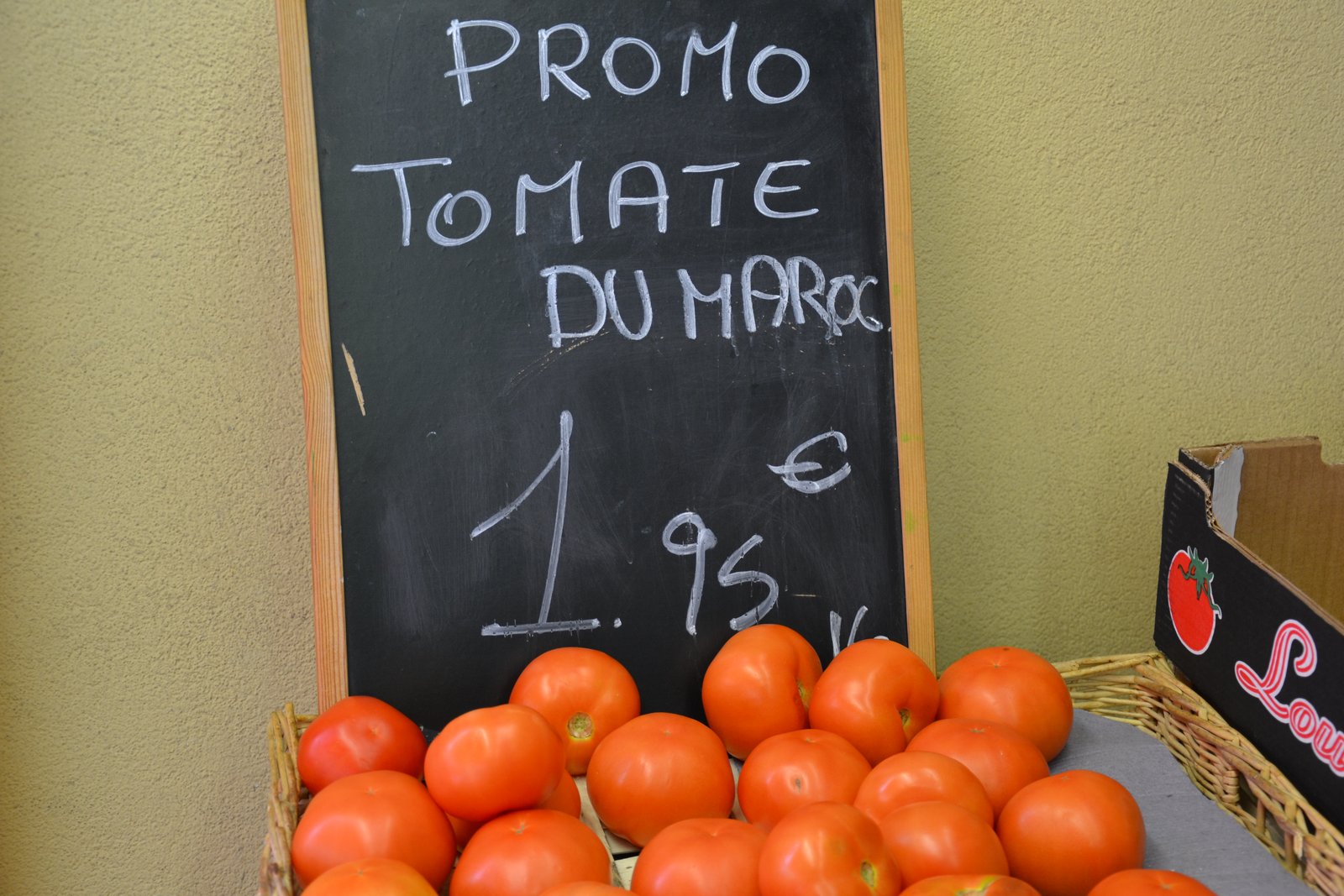
Featured image: Moroccan tomatoes on a market stall in France, 2015 – an illustrative context image, not a photograph of the current market situation. Photo: Ramagri, CC BY-SA 4.0, via Wikimedia Commons.

Sources
- Reuters (via Euronext), “Morocco pauses tomato exports to African markets amid high prices home”, November 5, 2026 – measure confirmation, Aderdour and anonymous government source, Europe exemption, Belfquih and Lekjaa quotes, export revenue figures: live.euronext.com
- Bladi.net, November 5, 2026 – permit mechanics, notification timing, valid-license carve-out, 503,000-tonne figure (unsourced variant): en.bladi.net
- Al Arabiya (Arabic), November 5, 2026 – wider “vegetables and fruits” scope claim, citing Al Omq: alarabiya.net
- FreshPlaza, November 5, 2026 – grower account (September heat, thrips and mites, up to 70% drop, end-of-month recovery): freshplaza.com
- Le360 Afrique (French), October 20, 2026 – 70% of Mauritanian consumption; October prices 300-400 ouguiyas/kg (currency denomination not stated; its dirham conversion not reproduced): afrique.le360.ma
- info Plus (Mauritania), October 24, 2026 – Ministry of Commerce communiqué: price back to 500 old ouguiyas/kg: infoplus.mr
- Saharamedias (French), October 25, 2026 – ministry statement; peak 4,000 old ouguiyas retail, 2,500 wholesale at the Moroccan Mosque market: fr.saharamedias.net
- ISO 4217 Maintenance Agency (SIX), Amendment 165 – ouguiya redenomination, 1 new = 10 old (2018): six-group.com (PDF)
- Exchange rate: 1 MRU ≈ 0.2415 MAD, November 6, 2026 mid-market quote: xe.com
- The Morocco Post, October 5, 2026 – Eurostat-based 2025/26 EU import analysis (493,327 tonnes; 17.74% share; Eurostat itself not re-queried): themoroccopost.com
- Medias24 (French), April 15, 2026 – sector sources: restrictions limited to industrial tomatoes for Africa; retail prices 17-20 MAD/kg; Souss-Massa as main production basin: medias24.com
- HortiDaily, April 17, 2026 – APEFEL (no official ban notification) and FIFEL (consultation, temporary freeze of some segments): hortidaily.com
- La Razón (Spanish), April 15, 2026 – reported suspension of tomato exports to Europe: larazon.es
- Yabiladi (English), April 16, 2026 – reported Africa suspension and limits to Europe: en.yabiladi.com
- Yabiladi (English), November 5, 2026 – six distribution companies plan; fuel price and margin caps ruled out; transport subsidy detail: en.yabiladi.com
- Hespress English, November 5, 2026 – MAD 400 million transport subsidy covering passenger and freight transport (~200,000 vehicles): en.hespress.com
- HortiDaily, September 25, 2026 – FIFEL secretary general on Souss-Massa water shortages, depleted groundwater, desalination outages: hortidaily.com
- Libé (MAP dispatch, French), November 27, 2017 – APEFEL: Souss-Massa accounts for more than 96% of national tomato exports: libe.ma
- Agricultural Water Management (2021), “Agricultural intensification can no longer ignore water conservation – the case of tomato producers in Morocco” (academic; groundwater overexploitation in the Souss plain): doi.org/10.1016/j.agwat.2021.107082
- zawaya24, November 8, 2026 – Minister Delegate Omar Hajira: gradual resumption of Africa-bound export licences, Morocco Foodex issuing, committee monitoring: zawaya24.com/en/export-fruits-legumes-afrique-reprise-0811
- Hespress English, November 9, 2026 – federation president Hannich: agreement with the Agriculture Ministry; partial resumption under stricter licensing; tomatoes, onions and potatoes remain restricted; Inezgane wholesale about 4 dirhams/kg: en.hespress.com/148843-morocco-partially-resumes-vegetable-exports-to-africa
Editorial note. Published November 6, 2026. Revised the same day under editorial review: Mauritanian price figures restated with the currency denomination uncertainty made explicit and the unverifiable dirham conversion removed; the April 2026 episode re-described as disputed reporting; the EU import figure stated in rounded form with both secondary variants attributed; permit-mechanics attribution corrected; forecast F5’s verification criteria clarified (original 60% probability unchanged). Final editorial corrections the same day: the Atlantic-initiative wording narrowed to Morocco’s broader African economic partnerships; the permit tool described as a recurring policy instrument rather than a standing one; the absence of direct retail consumer subsidies clarified alongside the indirect supply-chain support; and the exchange-rate source replaced with Xe. Claims were checked against the sources above. Forecasts are recorded in our ledger and reviewed monthly. See our Editorial Policy and Corrections Policy.