
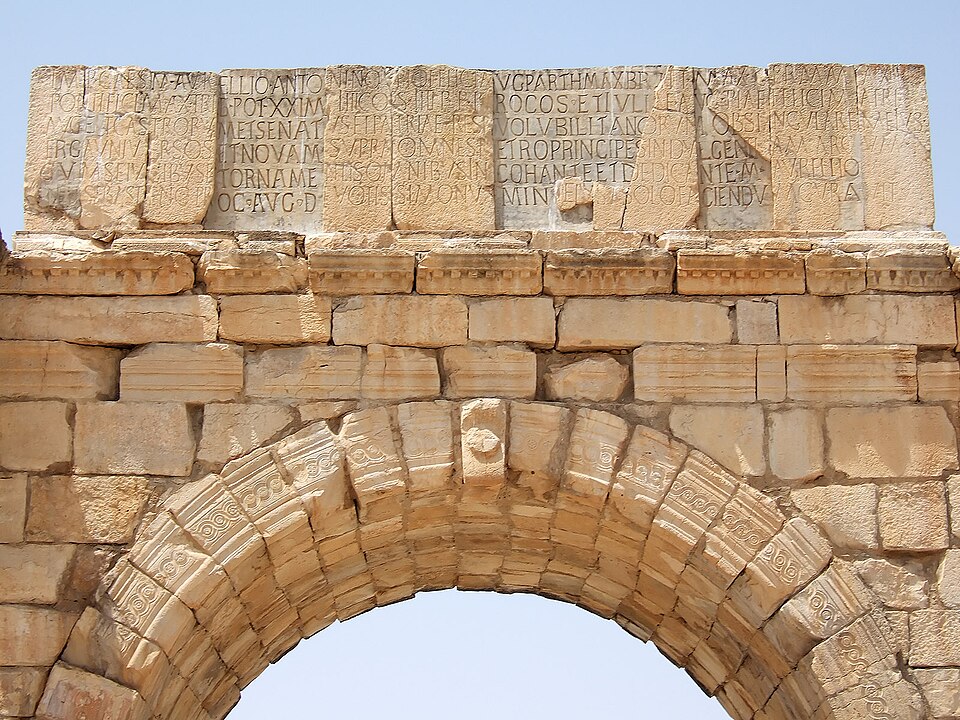

The triumphal arch is an easy place to stop at Volubilis. Its stone inscription makes an impressive photograph. But if that is the whole visit, a traveler misses much of what makes this archaeological site in northern Morocco worth understanding: a city that existed before Roman rule, a landscape that helped support its wealth, and a history that continued after the Roman army left.
Volubilis lies near Moulay Idriss Zerhoun, roughly 28 kilometres from Meknes. A useful visit connects three things: public monuments, domestic life and the countryside around them. That approach turns a collection of ruins into a more legible city.
Featured archive photograph: detail of the triumphal arch at Volubilis, 23 July 2006. Photo: Shawn Lipowski / Wikimedia Commons, CC BY-SA 3.0. Resized.

Start before Rome, and do not finish with it
UNESCO inscribed Volubilis on the World Heritage List in 1997. Its account describes a site shaped by several cultures, including pre-Roman Mauretanian, Roman, Christian and Arab-Islamic communities. Here, Mauretania means an ancient North African kingdom, not the modern state of Mauritania.
The archaeological project’s history, a collaboration between Morocco’s INSAP institute and University College London, explains how Roman rule changed the town’s government and built environment. Baths, civic buildings and an aqueduct were part of that expansion. The army’s withdrawal from the area in the late third century did not mean that all urban life immediately ended.
Later settlement and early Islamic history matter too. UNESCO identifies Volubilis as briefly the capital of Idris I, founder of the Idrisid dynasty, whose tomb is in nearby Moulay Idriss. This is a useful correction to the idea of an isolated piece of Europe deposited in Morocco. The site’s importance lies partly in exchanges between local communities and wider Mediterranean worlds.
Read a city, not a checklist of monuments
Use the arch and the public buildings as anchors, then look at how spaces connect. Where did streets lead? How close were homes, shops and places of public life? A monumental inscription tells a different kind of story from a floor inside a house.
The archaeological project’s account notes shops along house fronts, bakeries and numerous oil-pressing complexes. It treats those presses as evidence that olives were a major source of the town’s wealth. The surrounding agricultural landscape is therefore part of the explanation, not a backdrop to edit out of every photograph.
That distinction helps visitors avoid reading every elaborate house as proof that all residents lived comfortably. Monumental remains and decorated homes tell us about particular forms of wealth and status. They are not a complete census of everyday experience.
The mosaics are floors, and conservation work
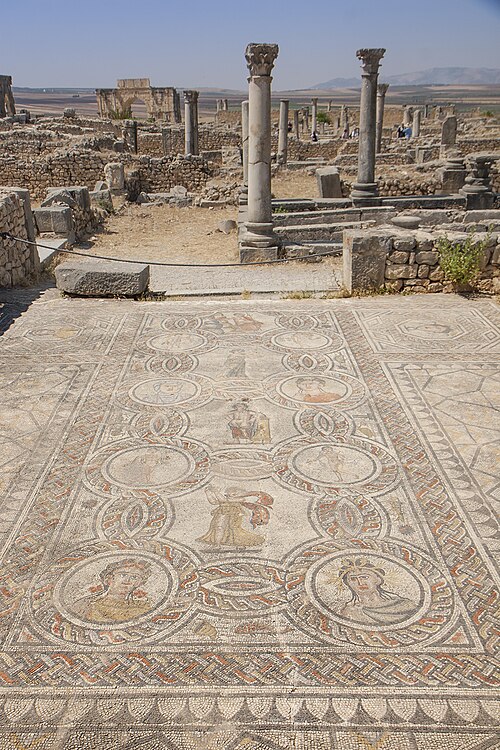

Pause at a mosaic long enough to consider its setting. It was part of a building people used, not originally a picture displayed on a museum wall. Looking between the decorated surface and the surrounding rooms can be more revealing than collecting close-up photographs alone.
A 2021 Getty account of mosaic conservation at Volubilis described training Moroccan technicians in stabilization and maintenance. It also explained that many mosaics had previously been detached, relaid and restored. That dated account is not a claim about staffing today. It is a reminder that the surfaces visitors see are also the result of decisions about how to preserve and present archaeological remains.
Stay outside protective barriers and do not step onto mosaics for a better photograph. A visit that depends on damaging the object being admired defeats its own purpose.
Plan the journey, not just the stop
The Meknes tourism council places the site about 28 kilometres from the city. Treat the onward journey as a separate part of the plan, including the return trip. Confirm transport arrangements rather than assuming that arriving at a railway station means arriving at the ruins.
Published visitor pages give differing opening-time descriptions. Check current hours and admission arrangements before traveling; this guide does not promise a particular ticket price or closing time. Bring water, sun protection and shoes suitable for uneven ground. Allow room in the day to stop and look rather than rushing between photographs.
Volubilis also works as a contrast to the living urban fabric described in our guide to Fes medina, or the overlapping historical layers in Rabat. The most useful question is the same: what changes when a place is read as somewhere people built, worked and adapted, rather than a view to collect?